June 4, 2026

Office phone booth rental vs purchase comparison for Indian startups

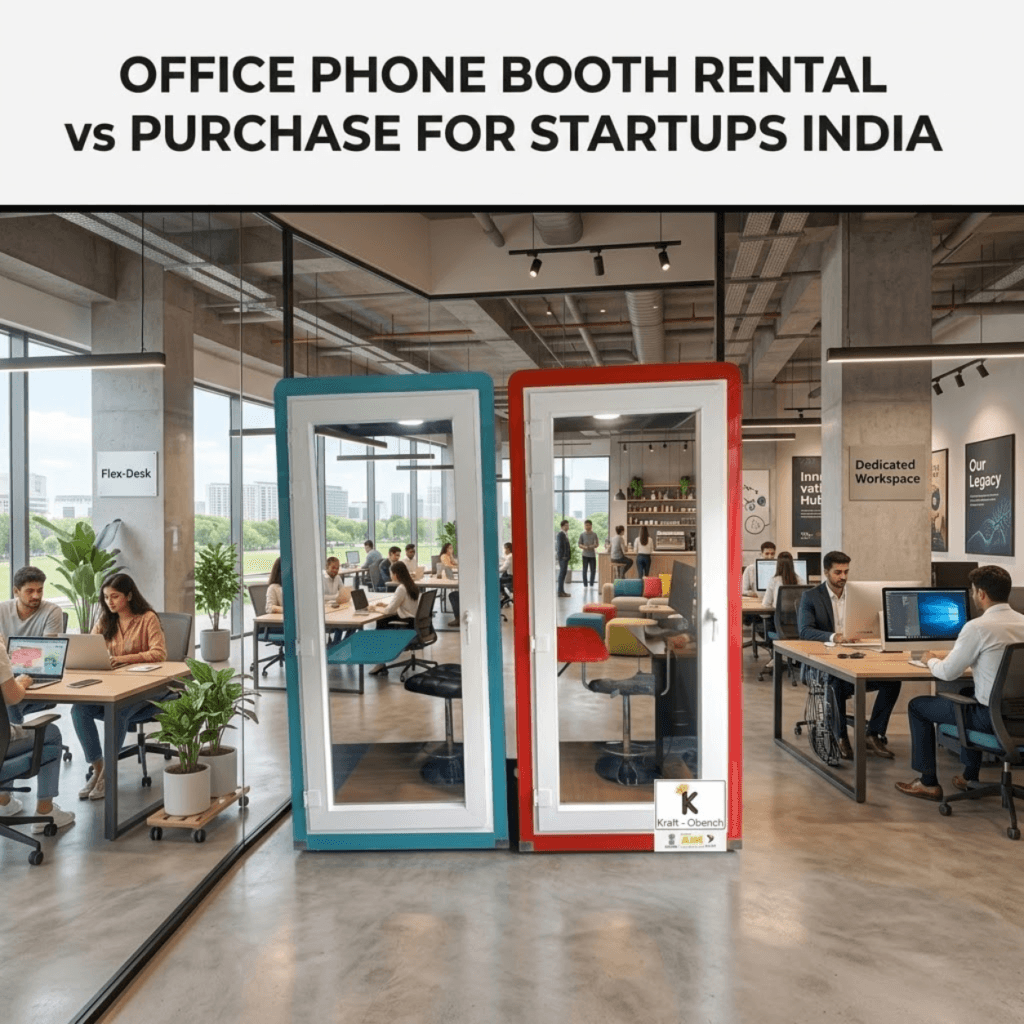
Office Phone Booth Rental vs Purchase for Startups India

The Startup Dilemma: Rent or Buy? Indian startups move fast, pivot frequently, and operate under financial constraints that make every capital allocation decision consequential. Committing to office equipment particularly at the scale of acoustic pods and phone booths requires careful analysis of cash flow, lease duration, growth trajectory, and tax position. Kraft-Obench offers both rental and purchase options for phone booths and acoustic pods across India. This guide provides a structured comparison to help startup founders and operations managers make the right decision for their stage of growth. Explore the full range including the Phone Booth, Nano Pod, and Work Pod before deciding. The Case for Renting an Office Phone Booth Renting makes strong financial and operational sense for startups in specific situations: companies on 12 to 24-month office leases where long-term space commitment is uncertain, early-stage teams under 20 people where pod utilisation may be unpredictable, pilot programmes testing pod productivity before scaling, and companies in coworking spaces where permanent installation may not be permitted. Rental also makes sense as a risk management strategy. If a startup pivots, downsizes, or moves offices, a rented pod is returned with no residual obligation. A purchased pod in the same situation must be relocated, sold, or written off. Rental options for all major pod models are available at our Rentals page with flexible monthly and annual terms. Rental Cost Analysis Kraft-Obench phone booth rentals typically range from ₹8,000 to ₹15,000 per month depending on model and rental duration. A 12-month rental costs ₹96,000 to ₹1,80,000. This is significantly more accessible than the upfront purchase price for seed or early Series A startups in cities like Bangalore, Mumbai, and Delhi, where operating capital is typically stretched across hiring, product development, and marketing simultaneously. The monthly rental payment is a predictable operating expense that flows through the profit and loss account with no balance sheet impact, which is a significant benefit for startups managing investor-monitored financial KPIs. The Case for Purchasing Purchase makes compelling sense when the startup has achieved product-market fit and is scaling rapidly, the team has grown beyond 30 people with a correspondingly higher pod utilisation, the office lease is 3 years or longer providing stability for a capital asset, and funding has been secured at Series A or beyond providing the capital for a considered fixed asset investment. At this growth stage, the Meeting Pod and Work Pod are the most commonly purchased units. The meeting pod addresses the collaboration and client-facing needs of a growing team, while the work pod provides the focused solo workspace that senior individual contributors and managers require for deep work. Total Cost of Ownership Analysis Over a 5-year period, the economics of purchase versus rental are clear. A purchased phone booth costs ₹1,50,000 to ₹2,80,000 including installation plus minimal maintenance costs of approximately ₹15,000 per year. Total 5-year cost: approximately ₹2,25,000 to ₹3,55,000. The same pod on rental over 5 years at ₹10,000 per month costs ₹6,00,000 nearly double the purchase cost. Purchase wins decisively on total cost of ownership. See real-world examples from our Clients page and Gallery for reference cases across different startup stages. Tax Considerations in India The Indian tax treatment of acoustic pods differs significantly between rental and purchase, and the difference matters for your effective cost calculation. Purchased pods depreciate at 25 percent per annum under the Income Tax Act under the furniture and fixtures block. This provides a declining tax shield over the asset’s life. In the first year of a ₹2,00,000 pod purchase, the depreciation deduction of ₹50,000 reduces your tax liability meaningfully. Rental payments are 100 percent deductible as operating expenses in the year they are incurred, with no depreciation schedule to manage. Startups in Hyderabad and Pune have successfully used both tax treatments depending on their specific profitability and cash flow position. Consult your chartered accountant for the optimal approach given your startup’s financial position. Flexibility Factor Uncertainty about office location is the strongest argument for renting over purchasing. If there is any meaningful probability that your startup will move offices, raise additional funding and expand into a larger space, or explore geographic expansion in the next 24 months, renting eliminates the friction and cost of relocating or disposing of owned pod assets. Startups in Noida and Gurgaon commonly begin with rentals and transition to purchase once their office lease is confirmed and headcount trajectory is established. This staged approach allows startups to benefit from pod productivity without committing capital before the organisation’s spatial needs are fully understood. Hybrid Strategy: Rent-to-Own Kraft-Obench offers a Rent-to-Own programme that bridges the gap between rental and purchase. Under this programme, monthly rental payments accumulate credits that reduce the eventual purchase price. After 18 to 24 months of rental, a qualifying startup can convert to ownership with rental credits applied against the purchase price. This approach gives early-stage startups the flexibility of rental while providing a defined path to ownership once growth and financial stability are established. Ask our team via the Contact page about the Rent-to-Own programme available for qualifying startups. Our team in Chandigarh and Jaipur can also advise on Tier 2 city rental and purchase options. Frequently Asked Questions Q1: What is the minimum rental duration for a phone booth? Kraft-Obench offers a minimum rental duration of 3 months for most pod models. Month-to-month rentals are available at a premium rate. Visit our Rentals page for current rental terms. Q2: Can a rented pod be returned if the startup downsizes or closes? Yes. Kraft-Obench’s rental agreement includes a defined return clause. Pods are collected by our installation team at no charge when the rental period ends. Q3: Does the rental price include maintenance and repairs? Yes. All Kraft-Obench rental pods include maintenance, filter replacement, and repairs as part of the monthly fee. Q4: Is there a security deposit for rental pods? A refundable security deposit equivalent to 2 to 3 months’ rental is typically required and is returned in full upon pod return in satisfactory

Office Phone Booth Rental vs Purchase for Startups India Read More »
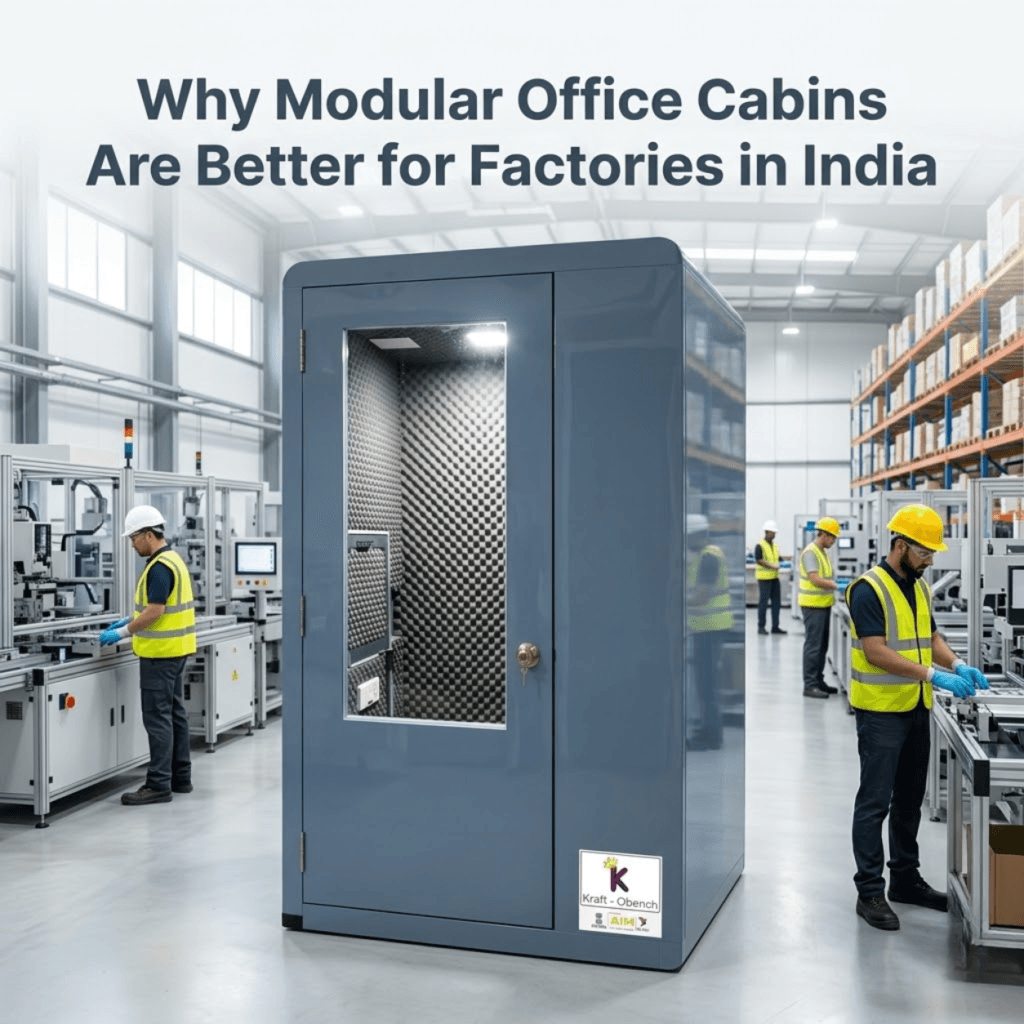
Modular office cabin installed on factory floor in India by Kraft-Obench

Why Modular Office Cabins Are Better for Factories in India

The Factory Office Challenge in India Indian manufacturing facilities face a challenge that is unique among commercial real estate contexts. Supervisors, quality control teams, HR managers, and procurement staff all need quiet, private office space to perform their roles effectively yet they must be physically present on the factory floor or in close proximity to production. Traditional office construction cannot keep pace with the operational demands of modern Indian manufacturing. Visit Kraft-Obench to explore modular solutions built for industrial environments. The noise environment of a typical Indian factory floor presents a particular problem. Ambient noise levels of 85 to 95 dB are standard in light manufacturing. Heavy manufacturing environments stamping, casting, and large-scale assembly routinely exceed 100 dB. Creating a functional office workspace in this environment requires serious acoustic engineering, not just a partitioned room. What Is a Modular Office Cabin? A modular office cabin is a pre-engineered, fully factory-assembled workspace unit that can be placed directly on a factory floor, in a warehouse, or in an outdoor industrial compound. It requires no civil construction work, no building permits in most Indian industrial zones, and can be relocated when production layouts change as they inevitably do. The Work Pod and Nano Pod are both popular choices for factory floor installations depending on the space available. For factories needing supervisor offices with space for two to three people, the Meeting Pod provides the right configuration. All models can be specified with industrial-grade exterior finishes and enhanced ventilation for demanding factory environments. Advantage 1: Speed of Installation Traditional cabin construction on a factory floor takes 4 to 8 weeks minimum, including civils, plastering, electrical fit-out, and finishing. During this period, the surrounding production area is disrupted by construction activity, contractor access, and material storage. A Kraft-Obench modular office cabin installs in 1 to 3 days with zero production downtime. Our installation teams across India including Pune, Ahmedabad, and Surat have completed factory installations at weekends and during planned maintenance shutdowns to ensure that production schedules are never affected by workspace improvements. Advantage 2: Acoustic Isolation from Factory Noise Factory floors commonly reach 85 to 95 dB in light manufacturing environments. This level of noise makes telephone calls effectively impossible without acoustic protection, causes hearing fatigue and stress in anyone exposed for extended periods, and makes concentration on detailed documentation work extremely difficult. Kraft-Obench pods achieve STC 38 to 42, reducing interior noise levels by 35 to 40 dB. A factory floor at 90 dB becomes approximately 50 to 55 dB inside the pod comparable to a quiet office environment. This protects both hearing health under occupational health legislation and call quality for customer-facing staff. Compare models at Kraft-Obench including the Phone Booth for call-focused factory office use. Advantage 3: Relocatability When Production Layouts Change Factory layouts are not static. Production lines expand, contract, and reconfigure as product mixes change, new equipment arrives, or lean manufacturing improvements are implemented. Traditional constructed offices become permanent obstacles to this flexibility. They cannot be moved and demolishing them is costly and creates construction waste. All Kraft-Obench pods can be disassembled and reassembled in under 8 hours by a two-person team. Our clients in Vadodara and Nagpur regularly relocate pods as factory layouts evolve with new machinery installations and production expansion projects. The pod retains its full acoustic performance and original appearance after relocation. Advantage 4: Dust and Chemical Resistance Indian factory environments expose office structures to dust, metallic particles, chemical vapours, and in coastal locations, salt-laden humid air. Kraft-Obench pods use powder-coated steel frames with a minimum 80-micron coating thickness, industrial-grade high-pressure laminate surfaces, and sealed acoustic panels with moisture-resistant facings. This is especially important for factories in Visakhapatnam and Kochi where coastal salt air significantly accelerates corrosion of unprotected metal surfaces. All Kraft-Obench pods used in coastal industrial applications are available with an enhanced anti-corrosion specification. Advantage 5: Cost Comparison Constructing a 100 square foot office within a factory building costs ₹3,00,000 to ₹6,00,000 when all civil, electrical, HVAC, and finishing costs are included. This investment is fixed to the property and has zero resale value if the factory moves or the space is reconfigured. A comparable Kraft-Obench Work Pod costs ₹2,00,000 to ₹4,00,000 installed and retains 40 to 60 percent of its original value after five years. It can be sold through our pre-owned programme or relocated to a new facility. The total cost of ownership over a 5-year period strongly favours the modular pod. View real factory installations in our Gallery. AI-Powered Factory Floor Management and Pod Integration Modern Indian manufacturers are implementing AI-powered factory management systems that monitor production metrics, quality data, and operational KPIs in real time. The supervisor and manager offices created by Kraft-Obench modular cabins are increasingly serving as the physical command centres for these AI systems. A modular office cabin placed at the floor level of a production line rather than in a remote second-floor office allows supervisors to interact directly with AI dashboards and immediately cross-reference digital data with physical production reality. This integration of intelligent digital systems with practical, acoustically isolated workspace represents a major operational improvement over both traditional factory office arrangements and remote office management models. Frequently Asked Questions Q1: Do modular office cabins in factories require fire safety approval? Freestanding pods that do not connect to building services typically do not require separate fire NOC amendments. Kraft-Obench pods are manufactured with fire-retardant materials. Verify with your factory’s fire safety officer. Q2: Can a modular cabin be installed on a raised factory floor or mezzanine? Yes, with a structural assessment. Kraft-Obench’s installation team conducts a load-bearing assessment before installation on elevated surfaces. Our Work Pod weighs approximately 400 kg. Q3: How do factory workers charge devices inside the pod? All Kraft-Obench pods come with a built-in power distribution unit offering multiple sockets and USB-A/C charging points connected to a standard 15A electrical supply. Q4: Are modular factory cabins suitable for QC labs? Yes. Many Kraft-Obench factory clients use pods as QC inspection rooms,

Why Modular Office Cabins Are Better for Factories in India Read More »

Meeting Pod for 4 People: Dimensions, Layout & Buying Guide India

What Is a 4-Person Meeting Pod? A 4-person meeting pod is a self-contained, acoustically treated enclosure designed for private team discussions, video conferences, client presentations, and collaborative focused work. Unlike traditional glass-walled meeting rooms, meeting pods require no civil work, no building permits in most jurisdictions, and can be installed in days rather than months. Kraft-Obench‘s Meeting Pod is engineered specifically for Indian office conditions designed to handle the country’s heat and humidity, to fit within the floor plates of India’s Grade-A commercial buildings, and to deliver acoustic performance that meets the demands of the country’s most demanding corporate occupiers. Standard Dimensions for a 4-Person Meeting Pod A comfortable 4-person meeting pod typically measures 2.4 metres in length, 2.0 metres in width, and 2.3 metres in height. This provides 0.6 metres of linear seating space per person the minimum ergonomic standard for comfortable seated collaboration. The total floor footprint is approximately 4.8 square metres, replacing the need for a dedicated 10 to 15 square metre conference room. Kraft-Obench Meeting Pods are available in standard dimensions or custom sizes. For reference, our single-person options the Nano Pod at 1.1 metres by 1.0 metres and the Phone Booth at a similarly compact footprint serve as a useful size comparison. For larger groups of 6 to 8 people, ask our team about custom configurations via our Contact page. Interior Layout Essentials A well-designed 4-person meeting pod interior requires careful planning to balance acoustic performance with functional workspace. The central meeting table should measure a minimum of 1,200mm by 700mm sufficient for four laptops with working space. Chairs should be ergonomic with a swivel base to allow easy movement within the pod. Technology infrastructure should include an integrated monitor arm or display mount for a 55-inch screen, power and data ports at table level, USB-C and HDMI connections, and ceiling-mounted microphone array for video conferencing. LED task lighting at 500 lux minimum is required for comfortable reading and writing. For larger or more technologically demanding team requirements, consider our Work Pod configurations or a custom build through our design team. Acoustic Requirements for Meeting Privacy For effective meeting privacy, a pod must achieve a minimum STC 35 rating. STC 35 ensures that speech at normal meeting volume inside the pod is inaudible to people sitting at adjacent workstations outside. For offices where conversations involve confidential business, legal, or financial information, STC 38 or higher is strongly recommended. Kraft-Obench Meeting Pods achieve STC 38 to 42 using double-layer acoustic panels with mineral wool fill, acoustically decoupled glass panels, and precision magnetic door seals. For comparison, our Vocal Pod achieves even higher isolation for recording applications where studio-grade acoustic performance is required. Ventilation in Indian Climates: A Critical Factor India’s climate makes ventilation the most critical performance factor for enclosed meeting pods. Four occupants in an unventilated 4.8 square metre enclosure will exhaust the available oxygen and raise CO2 to uncomfortable levels within 15 to 20 minutes. This is not a theoretical concern it is a practical daily reality for meeting pods without engineered ventilation. Kraft-Obench Meeting Pods include a silent EC fan ventilation system operating below 35 dB(A). The system provides 6 to 8 air changes per hour, maintaining CO2 below 800 ppm for up to four occupants in a standard 60-minute meeting. This exceeds both ASHRAE and Indian NBC ventilation standards. Our installations in Mumbai, Chennai, and Hyderabad use enhanced ventilation packages for coastal and hot-zone climates where ambient temperature and humidity are consistently higher than inland cities. Technology Integration for Modern Meetings A 2026 meeting pod must support the full range of modern collaboration technology. The Kraft-Obench Meeting Pod accommodates a 55-inch display, ceiling microphone array for room-scale voice pickup, USB-C and HDMI connections at table level, and wireless charging pad integrated into the table surface. Smart pod options include digital keypad or RFID card access control, occupancy sensor integration with room booking systems, and IoT environmental monitoring for CO2, temperature, and humidity. Use our 3D Configurator at the Nano Pod page to visualise your technology setup in 3D before placing your order. How AI Meeting Technology Works Better Inside a Pod AI-powered meeting transcription and summary tools such as those built into Microsoft Teams, Google Meet, and dedicated platforms perform significantly better inside an acoustic pod than in open offices or traditional glass conference rooms. The reason is simple: these AI systems rely on clear audio input to produce accurate transcriptions. In a noisy open plan office, background speech, HVAC noise, and reverberation all degrade AI transcription accuracy. Inside a Kraft-Obench Meeting Pod with STC 40 isolation and NRC-rated acoustic panels, AI meeting tools receive a clean audio signal that dramatically improves transcription quality, action item extraction, and meeting summary generation. This is an increasingly important justification for meeting pod investment in organisations that are deploying AI productivity tools. Floor Plan Placement Tips Allow at least 600mm of clearance on all sides of the meeting pod for comfortable passage and emergency egress. Corner placement reduces ambient noise transmission from two sides and often provides the best acoustic environment within the pod. For city-specific floor plan layout advice, see our pages for Delhi, Bangalore, Noida, and Gurgaon. Pricing in India 4-person meeting pods range from ₹4,50,000 to ₹9,00,000 depending on specification, technology package, and finish level. Kraft-Obench offers EMI and fleet pricing for bulk orders of three or more units. For flexible deployment, check our Rentals page. For visual inspiration, visit our Gallery and Clients page. Frequently Asked Questions Q1: What is the minimum room height required to install a 4-person meeting pod? A minimum ceiling height of 2.5 metres is required for standard Kraft-Obench Meeting Pods. For buildings with lower ceilings, we offer a low-profile configuration at 2.1 metres pod height. Q2: Can a 4-person meeting pod be used as a permanent conference room replacement? Yes. With the right AV technology package, a Kraft-Obench Meeting Pod fully replaces a traditional conference room for teams of 2 to 4. Q3: How many

Meeting Pod for 4 People: Dimensions, Layout & Buying Guide India Read More »

office pod maintenance tips

11 Office Pod Maintenance Tips for Long Life

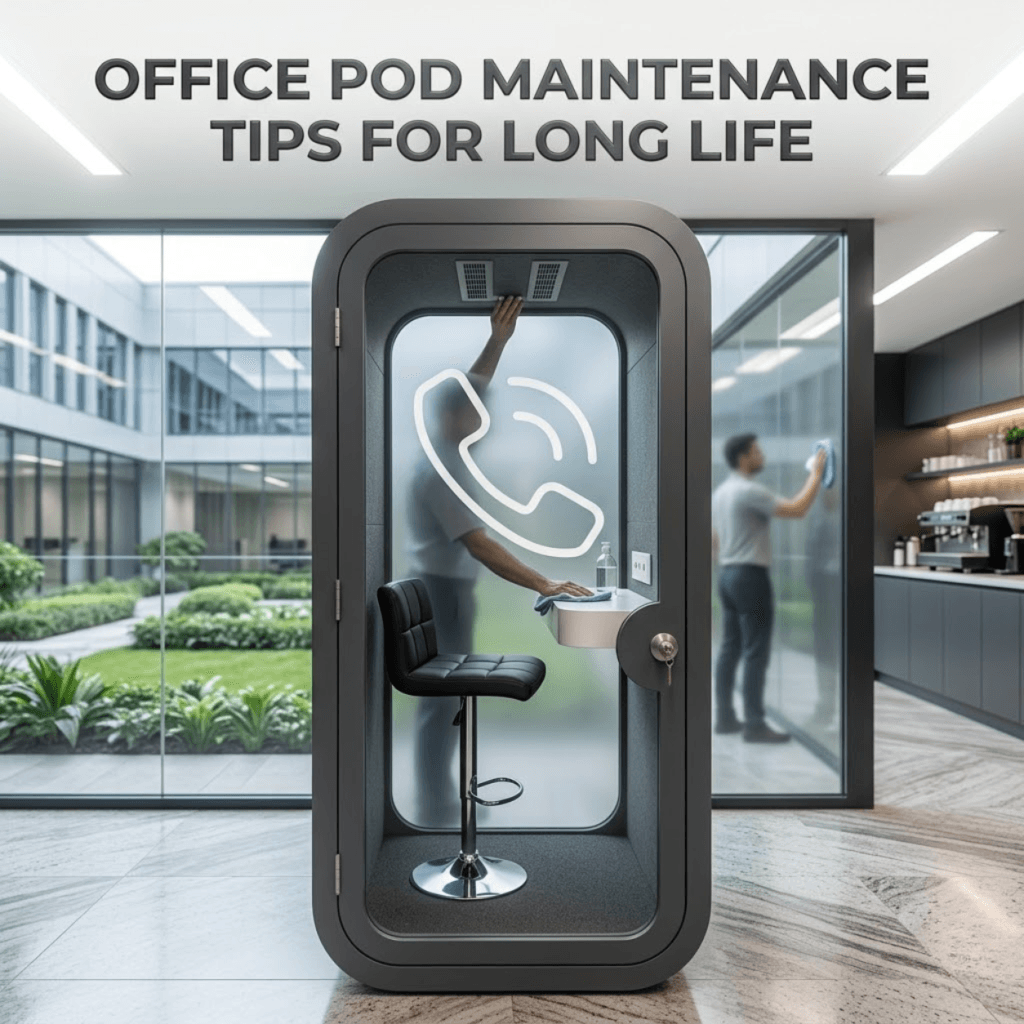
Why Maintenance Matters for Your Office Pod An office pod is one of the most valuable workspace investments your organisation can make. Whether you have installed a single-person phone booth or a multi-person meeting pod, regular upkeep ensures years of quiet, productive, and comfortable use. Like any precision-engineered product, acoustic pods are designed to perform at their best when maintained properly. At Kraft-Obench, India’s leading acoustic pod manufacturer, we have serviced thousands of pods across the country. The difference between a pod that lasts five years and one that lasts fifteen almost always comes down to maintenance discipline. Here are 11 actionable maintenance tips every pod owner in India should follow. 1. Clean Acoustic Panels Weekly Dust accumulates quickly on acoustic foam and fabric panels, especially in Indian office environments where open windows, foot traffic, and HVAC systems circulate significant amounts of airborne particles. Use a soft brush or low-suction vacuum cleaner weekly to remove surface dust without damaging the acoustic material. Avoid wet cloths on exposed acoustic foam. Moisture degrades the cellular structure of sound-absorbing foam over time, causing it to crumble and lose its noise reduction coefficient (NRC) rating. For fabric-covered panels, spot cleaning with a dry microfibre cloth is entirely safe and sufficient for day-to-day upkeep. If you own a Nano Pod, the interior fabric panels are designed for easy access cleaning. The fabric is stretched over a removable frame, allowing deep cleaning once every quarter without specialist tools or technical knowledge. 2. Inspect Door Seals Monthly The magnetic or rubber door seals on your acoustic pod are its first line of acoustic defence. These seals create the airtight boundary that prevents sound from leaking in or out of the pod. Inspect every seal for gaps, cracks, flattening, or peeling every month. Worn seals allow noise leakage that can reduce the pod’s STC rating by up to 30 percent. A pod with an STC 40 rating can effectively drop to STC 28 performance when door seals are compromised. Seal replacement is a low-cost, high-impact maintenance task that takes under 30 minutes but protects the acoustic integrity of your entire investment. This monthly check applies equally to all pod types from the compact Phone Booth to the larger Meeting Pod. Replacement seal kits are available directly from our service team. 3. Check Ventilation Filters Every 30 Days All Kraft-Obench pods come with built-in HVAC or passive ventilation systems. These systems circulate fresh air through filters that capture dust, allergens, and airborne particles before they enter the pod interior. Blocked filters raise CO2 levels and humidity inside the pod, reducing both comfort and air quality. Clean or replace filters every 30 days for pods in typical office environments. In dusty Indian industrial or warehouse environments, check filters fortnightly. A visible grey or black coating on the filter mesh, reduced airflow felt inside the pod, or a slight musty smell are the three clear indicators that the filter needs immediate attention. This is especially critical for the Work Pod when deployed in manufacturing, logistics, or construction-adjacent environments where airborne particulates are significantly higher than in standard offices. 4. Tighten All Bolts and Connectors Quarterly Modular pod panels are bolted and locked together with precision connectors. In environments where nearby machinery, HVAC systems, or heavy foot traffic generate vibrations, these connectors can gradually loosen over time. Loose connections create micro-gaps in the acoustic envelope, reducing the pod’s overall sound isolation performance. Conduct a quarterly bolt-check using a standard torque wrench. Work systematically from the base frame upward to the roof panels. This is particularly important for pods installed on factory floors or near mechanical plant rooms. Our Vocal Pod has especially precise panel-to-panel tolerances that should be verified quarterly to maintain its studio-grade acoustic performance. If you are not comfortable performing this check yourself, our annual professional service includes a full mechanical inspection. 5. Test Lighting and Power Points Monthly LED lighting strips and USB or power sockets inside pods face daily wear from repeated use. Test all electrical points monthly to identify any failing components before they cause problems. Replace failing LEDs promptly since overheating from a poorly performing LED driver can damage surrounding panels or create fire risk over time. For smart pods with app-based lighting and climate controls, check that all sensors and switches respond correctly during your monthly test. If you have used our 3D Configurator to specify a particular electrical configuration, compare your current setup against the original specification to ensure nothing has deteriorated. 6. Sanitise Interior Surfaces After Use High-touch surfaces desks, chairs, door handles, and power socket surrounds should be wiped with an isopropyl alcohol solution after use in shared pods. This applies especially in coworking environments, corporate offices, and anywhere multiple users access the same pod during a single day. Regular sanitisation extends the life of surface materials and prevents the build-up of grime that can permanently stain laminates or fabric. It also meets hygiene standards increasingly required by corporate facilities teams and health and safety auditors. Pods on our Rental programme receive professional deep cleaning as part of the monthly maintenance visit included in the rental agreement. 7. Avoid Overloading Power Circuits Most office pods are rated for standard office electrical loads: one or two laptops, a monitor, a phone charger, and LED lighting. This total load typically falls between 400W and 600W continuous draw. Plugging in high-draw devices such as space heaters, industrial fans, or multiple monitors without checking the pod’s electrical specification can trip circuit breakers or, in worst cases, damage internal wiring. This is an important consideration for pods installed in cities across India from our Delhi installations in high-density office towers to sites in Mumbai where older building electrical infrastructure may already be under load. 8. Monitor Humidity Levels Inside Excess humidity warps acoustic panels, promotes mould growth in foam layers, and can corrode electrical connectors over time. This is a particularly relevant maintenance consideration in coastal cities. Our customers in Bangalore during monsoon months and in

11 Office Pod Maintenance Tips for Long Life Read More »

Acoustic pod installed in open plan Indian office to reduce noise

How to Reduce Office Noise in Open Plan Offices India

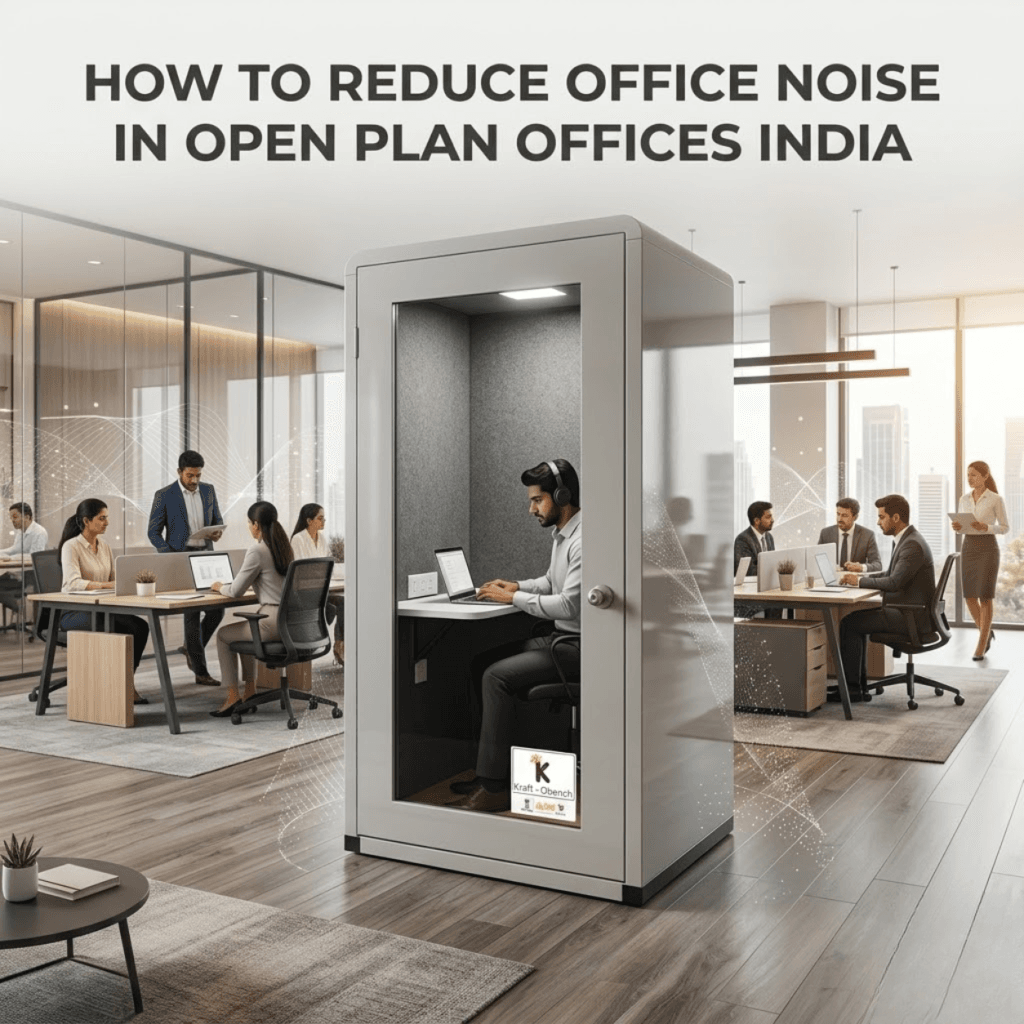
The Open Plan Office Noise Crisis in India India’s corporate offices from Mumbai’s BKC to Bengaluru’s Whitefield have embraced open plan layouts for the collaboration, flexibility, and cost efficiency they offer. Glass-fronted offices with high ceilings and minimal partition walls look excellent in architecture photography and perform well for informal team interactions. However, they create serious acoustic problems for the focused, private, and productive work that makes businesses successful. Research consistently shows that 65 percent of Indian office workers report noise as their top productivity killer. The situation worsens as organisations grow headcount within existing floor plates without adding acoustic infrastructure. Visit Kraft-Obench to explore India’s leading acoustic pod range and start building your noise reduction strategy today. Understand the Sources of Noise First Before investing in solutions, identify the dominant noise sources in your office. The three primary culprits in Indian open plan offices are speech noise from neighbouring workstations, HVAC system hum and vibration, and impact noise from hard floors and furniture movement. Speech noise is the most cognitively disruptive because the human brain automatically processes intelligible speech even when you are trying to ignore it. This is why a single loud conversation can derail the concentration of ten people. Your noise reduction strategy should target the highest-impact source first and work outward from there. Solution 1: Install Acoustic Office Pods Acoustic pods are the single most effective solution for open plan office noise because they directly address the source providing an enclosed space where conversations happen in isolation from the open floor. A Phone Booth provides an STC-rated enclosure for all private calls. The Nano Pod fits into tight floor plans and accommodates a full laptop workstation for focused solo work. For team collaboration, the Meeting Pod serves groups of up to four people in complete acoustic privacy. For individual heads-down work needing extended quiet time, the Work Pod is the most comprehensive solution, offering a full desk environment with power and ventilation. All models are available on flexible rental terms at our Rentals page for offices not ready to commit to outright purchase. Solution 2: Add Acoustic Panels to Walls and Ceilings Fabric-wrapped acoustic panels reduce reverberation time, measured as RT60 the time it takes for sound to decay by 60 dB after a source stops. In a hard-surfaced Indian office with tile floors, glass partitions, and concrete ceilings, RT60 can reach 1.5 to 2 seconds, causing speech to feel muddy, exhausting, and difficult to understand. Target an RT60 under 0.5 seconds for comfortable office speech intelligibility. Place panels at primary reflection points side walls at seated ear height and the ceiling directly above workstation clusters. Two well-placed 600mm x 1200mm panels per 10 workstations delivers a measurable improvement in most Indian office environments. Solution 3: Use Desk Dividers and Pod Clusters Height-adjustable acoustic desk dividers at a minimum of 900mm high reduce direct sound transmission between neighbouring workstations by interrupting the straight-line sound path between a speaker’s mouth and their neighbour’s ears. This is a low-cost intervention that complements pod installations rather than replacing them. For offices in Delhi and Gurgaon, pod clusters surrounded by desk dividers are the most popular configuration for large corporate floors. The cluster approach groups the noisiest activities calls and team discussions into pod-equipped zones while preserving the open character of collaboration areas. Solution 4: Introduce Soft Furnishings Strategically Hard surfaces reflect sound. Every glass wall, tile floor, and laminate desk in your office is a sound mirror that amplifies reverberation and increases the overall noise level. Adding soft furnishings carpets, upholstered seating, fabric curtains, and acoustic ceiling baffles in break zones absorbs ambient noise that hard surfaces would otherwise reflect. Even a 25 percent increase in soft surface area reduces reverberation measurably in typical Indian glass-and-tile office interiors. The effect is most dramatic in offices with high ceilings and extensive glass. Start with the break room and reception area where hard surfaces are most concentrated. Solution 5: Create an Acoustic Zoning Policy Physical acoustic treatment works best when supported by a clear office zoning policy. Designate specific zones for different noise levels: collaboration zones where 65 dB conversation is acceptable and focus zones where the target is under 45 dB. Place acoustic pods and phone booths at the boundary of focus zones so users have immediate access to an enclosed call environment without crossing the entire office floor. Offices in Bangalore and Mumbai have adopted formal acoustic zoning policies with measurable productivity improvements. The zoning policy costs nothing to implement and significantly amplifies the value of every physical acoustic investment you have already made. Solution 6: White Noise Systems Sound masking systems emit low-level, low-frequency broadband noise commonly called white noise or pink noise that raises the ambient noise floor in a controlled way. This makes individual conversations less intelligible from a distance, reducing the distraction caused by nearby speech without requiring everyone to use headphones. White noise systems are popular in Hyderabad and Pune tech campuses as a complement to pod installations. The combination of a sound masking system and acoustic pods delivers a layered approach where the masking system handles general ambient noise and the pods handle private conversations. Solution 7: Optimise Pod Placement for Maximum Coverage The placement of acoustic pods within the office floor plate significantly affects their utilisation and acoustic benefit. Place one phone booth per 8 to 10 employees based on average call frequency. Position pods near the workstation clusters that generate the most call activity rather than at the office perimeter where they are less convenient. For city-specific guidance on pod placement in large offices, see our pages for Noida, Chennai, Ahmedabad, and Kolkata. Our acoustic consultants conduct free floor plan reviews for orders of three or more pods. AI-Assisted Acoustic Design for Indian Offices Artificial intelligence tools are now being used in the acoustic design phase to predict noise propagation across office floor plans before any physical installation takes place. By inputting floor plan dimensions, surface materials, furniture layout, and

How to Reduce Office Noise in Open Plan Offices India Read More »

Vocal Booth Benefits

Vocal Booth Benefits for Voiceover Artists India

Vocal Booth Benefits for Voiceover Artists in India The Indian voiceover industry is growing fast. From OTT dubbing to e-learning narration, corporate videos to ad spots, the demand for professional voice talent in multiple Indian languages has never been higher. But for every talented voice artist losing work to competitors, the differentiator is rarely the voice itself it is the audio quality of the recording. A vocal booth is the single most impactful investment a voiceover artist can make. Here is why. The Noisy Reality of Recording Voiceovers in Indian Homes Ask any Indian VO artist about their recording setup and you will hear the same stories. The power cut at 2pm that fires up the generator and ruins three takes. The neighbour who starts drilling the moment you hit record. The dog that starts barking precisely during your most difficult line read. Indian urban environments are not quiet. Ambient noise levels in Delhi, Mumbai, Bangalore, and other cities regularly exceed 60 to 70 decibels well above the near-silent conditions required for professional voiceover recording. Most home studios without acoustic treatment add significant room reverb on top of that noise floor. The result is recordings that require extensive noise reduction processing processing that degrades audio quality and is immediately audible to professional clients. Many Indian VO artists are losing high-value work not because their voice or performance is inferior, but because their recording environment cannot compete with artists abroad or in dedicated studios. What Is a Vocal Booth and Do You Really Need One? A vocal booth is an acoustically treated enclosure designed to create a controlled, low-noise recording environment for the human voice. Unlike a general soundproofed room, a vocal booth is specifically optimised for voice with absorption tuned for the vocal frequency range, minimal internal reflections, and noise isolation that handles typical ambient noise sources. Modern purpose-built vocal booths like the Kraft-Obench Vocal Pod are freestanding, portable structures that you assemble inside your home. They include built-in acoustic treatment, a ventilation system, integrated lighting, and cable management for microphone and power everything a professional VO recording setup requires. Do you really need one? If you are doing voiceover work commercially for clients who are paying for professional output then yes. Absolutely. The question is not whether you need it, but how long you can afford to delay the investment while substandard audio limits your bookings. Benefit 1: Clean, Broadcast-Quality Audio Every Take A dedicated vocal booth eliminates the two main audio quality problems in Indian home recording: background noise and room reverb. Background noise traffic, neighbours, appliances, family is blocked by the booth’s acoustic shell before it reaches your microphone. A quality booth with an STC rating of 35 to 45 reduces typical urban ambient noise by enough to give you a clean, noise-free noise floor. Room reverb the echo of your voice bouncing off walls is eliminated by the booth’s internal acoustic treatment. Your voice is recorded direct and dry, giving clients and engineers a clean signal they can process exactly as the project requires. The result is audio that needs no noise reduction processing and minimal post-production intervention. It sounds natural, clear, and professional from the first take. Benefit 2: Win More Clients with Professional-Grade Demos Your demo reel is your most important business asset as a voiceover artist. It is the first and often only thing a potential client listens to before deciding whether to book you. A demo recorded in a proper vocal booth sounds fundamentally different from one recorded in an untreated room even to a non-professional listener. The clarity is immediate. The professional sound is evident. The confidence it gives the client that you can deliver consistent quality on real projects is worth more than any marketing. VO artists who upgrade to a dedicated booth consistently report an increase in booking rate from the same demo content because the audio quality itself becomes a selling point rather than a liability. On platforms like Fiverr, Voices.com, and Voice123, your audio quality is visible in your profile samples before a client even contacts you. A clean, professional booth recording stands out immediately in a crowded marketplace. Benefit 3: Fewer Retakes = More Projects Per Day Recording voiceover in an untreated or noisy environment is inefficient. You record a take, listen back, hear a truck passing in the background or a door slamming, and do it again. And again. A session that should take one hour stretches to three. You are exhausted. Your voice is fatigued. And you have still not achieved a clean recording. Inside a properly designed vocal booth, the environmental variables that force retakes disappear. You record the content, review it for performance, and move on. Sessions run to time. You can take more projects in the same day, deliver faster, and receive better reviews for professionalism and turnaround speed. For freelance VO artists, throughput is directly linked to income. A vocal booth is not just an acoustic tool it is an earnings multiplier. Benefit 4: Record Anytime – Even During Busy Hours One of the most significant practical benefits of a good vocal booth is temporal freedom. Without a booth, recording is dictated by the noise schedule around you. Early morning before the neighbourhood wakes up. Late at night after traffic dies down. Between the domestic help arriving and leaving. These windows are narrow, unpredictable, and incompatible with professional client deadlines. Inside a well-isolated vocal booth, you can record at 2pm on a Saturday when the building society is having its quarterly meeting outside. You can record with the kitchen running and the TV on in the next room. The booth handles the isolation. This transforms your ability to manage client deadlines, take urgent work, and maintain a professional recording schedule regardless of what is happening around you. It is a fundamental change in how you work. Best Vocal Booths for Indian VO Artists: Budget to Premium Entry level – Reflection filter setup (₹8,000 to ₹20,000): A desktop reflection filter

Vocal Booth Benefits for Voiceover Artists India Read More »

Acoustic Treatment for Home Studio in India

Acoustic Treatment for Home Studio India Complete Guide

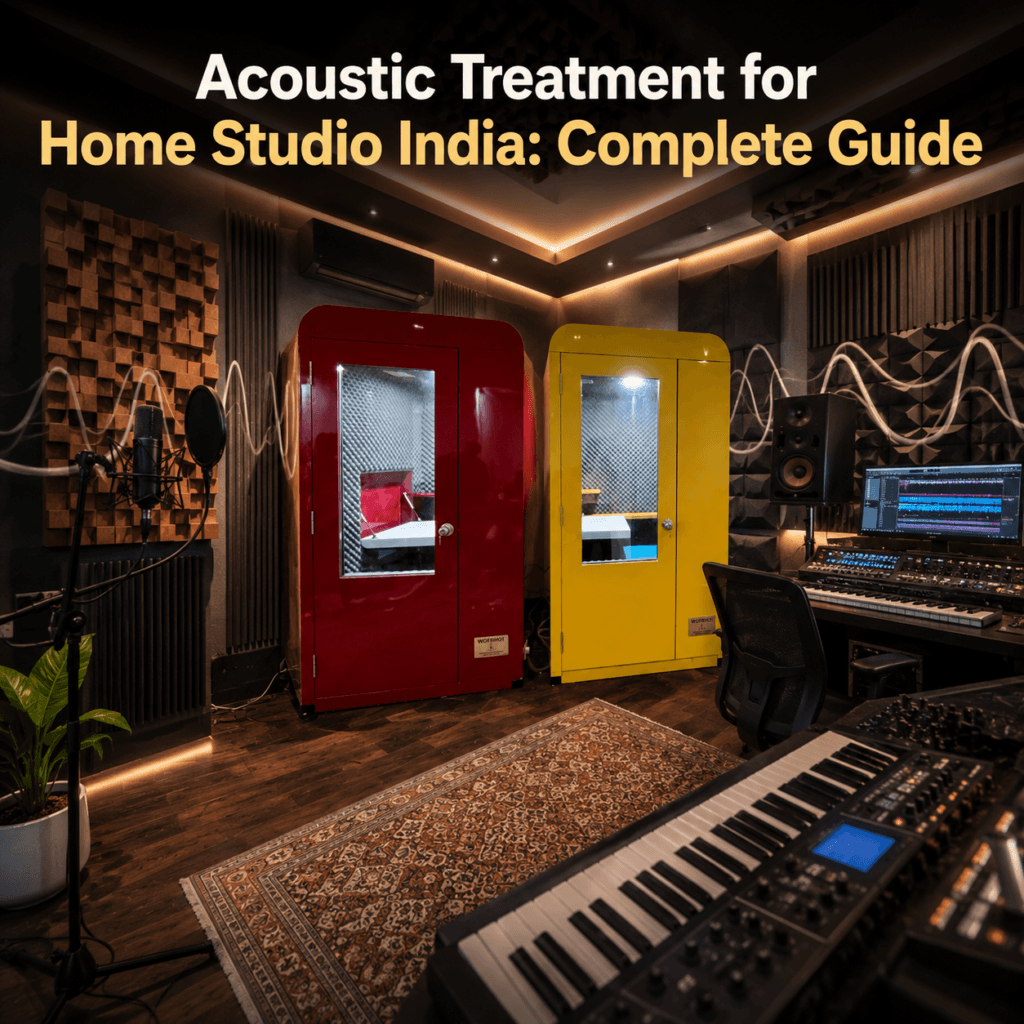
Acoustic Treatment for Your Home Studio in India: A Complete Guide You spent months choosing the right microphone, audio interface, and studio monitors. You have set everything up and your recordings still sound like they were made in a bathroom. This is the most common and most frustrating home studio problem in India, and the cause is almost always the same: untreated room acoustics. This guide explains exactly what acoustic treatment is, why Indian rooms need it urgently, and how to treat your space step by step from free changes to professional solutions. Why Acoustic Treatment Matters More Than Expensive Equipment Here is a truth that most gear-focused musicians learn the hard way: a ₹5,000 microphone recorded in a well-treated room will sound better than a ₹50,000 microphone recorded in an untreated room. Equipment captures what the room gives it. If your room is full of flutter echo, bass buildup in the corners, and harsh high-frequency reflections, your expensive microphone will capture all of that perfectly. No amount of EQ or processing in a DAW fully removes room sound once it is baked into a recording. Acoustic treatment changes what the room gives the microphone in the first place. It is the foundation that everything else sits on. Understanding Sound: Reflection, Absorption, and Diffusion Before treating a room, you need to understand what you are dealing with. Reflection happens when sound waves hit a hard surface a wall, floor, or ceiling and bounce back. In an untreated room, reflections from multiple surfaces arrive at your microphone milliseconds after your direct voice, creating echo and a smeared, unclear sound. Absorption is the process of converting sound energy into heat by forcing sound waves through porous material. Acoustic foam, mineral wool, and thick fabric all absorb sound to varying degrees. Heavy materials absorb low frequencies. Lighter materials absorb mid and high frequencies. Diffusion scatters sound waves in multiple directions rather than reflecting them back directly. Diffusers break up standing waves and flutter echo without deadening the room — they make the acoustic environment feel natural and alive rather than flat and dead. A well-treated room uses all three. Absorption at first reflection points. Bass traps in corners. Diffusion on rear walls. The Three Pillars of Acoustic Treatment Every home studio treatment plan is built on three elements: Bass traps address low-frequency buildup. In any rectangular room, low frequencies accumulate in corners and create resonant peaks that make bass sound uneven and muddy. Bass traps are thick, dense absorptive panels placed in corners floor to ceiling if possible. Absorption panels address mid and high-frequency reflections. These are the panels you see on walls in recording studios fabric-wrapped frames filled with mineral wool or open-cell foam. They are placed at the primary reflection points: the side walls adjacent to the listening position, the ceiling above, and the wall behind you. Diffusers go on the rear wall behind the listening position. They scatter remaining reflections rather than absorbing them, preserving some of the room’s natural energy and preventing the over-damped, airless sound that too much absorption creates. Bass Traps: Where to Place Them in Indian Rooms Indian rooms particularly tiled apartments have significant bass buildup problems. Hard, reflective surfaces on all sides, combined with room dimensions that create resonant frequencies, make bass management essential. Place your first bass traps in the four vertical corners of the room, from floor to ceiling if budget allows. These corner positions are where bass energy is highest filling them with thick absorptive material makes the biggest acoustic improvement per rupee spent. Second priority: the two horizontal corners where the ceiling meets the front wall and the ceiling meets the rear wall. These are also high-energy zones for low frequencies. For DIY bass traps in India, 100mm to 150mm thick rockwool (Saint-Gobain ISOVER is widely available) wrapped in acoustically transparent fabric is highly effective. A single 600 x 1200mm panel of 150mm rockwool, floor mounted in a corner, costs approximately ₹1,500 to ₹3,000 in materials. Acoustic Panels: DIY vs Ready-Made Options in India DIY panels are the most cost-effective option if you are comfortable with basic woodworking. You build a timber frame, fill it with rockwool or high-density acoustic foam, wrap it in fabric, and mount it on the wall. A 600 x 900mm DIY panel costs approximately ₹2,000 to ₹5,000 in materials. With ten to twelve panels for a modest room, total cost is ₹20,000 to ₹60,000. Ready-made acoustic panels from Indian suppliers save time and look more professional. They are available from acoustic treatment specialists in Delhi, Mumbai, and Bangalore, as well as online. Prices range from ₹3,000 to ₹10,000 per panel depending on size and quality. Acoustic pods as an alternative: If treating an entire room is not practical because you rent, share the space, or cannot commit to permanent wall fixings a dedicated acoustic pod like the Kraft-Obench Vocal Pod is a complete pre-treated acoustic environment in a single product. It is particularly practical for Indian homes where room treatment options are limited. Diffusers for a Natural-Sounding Room Diffusers are often neglected in Indian home studios because they are less intuitive than absorption panels you cannot easily hear the difference on a basic level. But without diffusion, a heavily absorbed room sounds unnaturally dead and fatiguing to work in for long sessions. The most common diffuser type for home studios is the quadratic residue diffuser (QRD) a panel with wells of varying depths that scatter sound at different frequencies. Wooden QRD diffusers are available from Indian acoustic suppliers, or can be built from timber with basic carpentry skills. Place diffusers on the rear wall of your studio, opposite the monitoring position. Ceiling cloud diffusers are also effective in rooms with parallel floor-ceiling reflections. Best Budget Acoustic Treatment Materials Available in India Saint-Gobain ISOVER glass wool / rockwool slabs: Available at building material suppliers across India. 75mm to 100mm thickness for panels, 150mm for bass traps. Excellent acoustic performance at low cost. Acoustic foam tiles: Available

Acoustic Treatment for Home Studio India Complete Guide Read More »

Portable vocal booth

Portable Vocal Booth vs Soundproof Room for Singers India

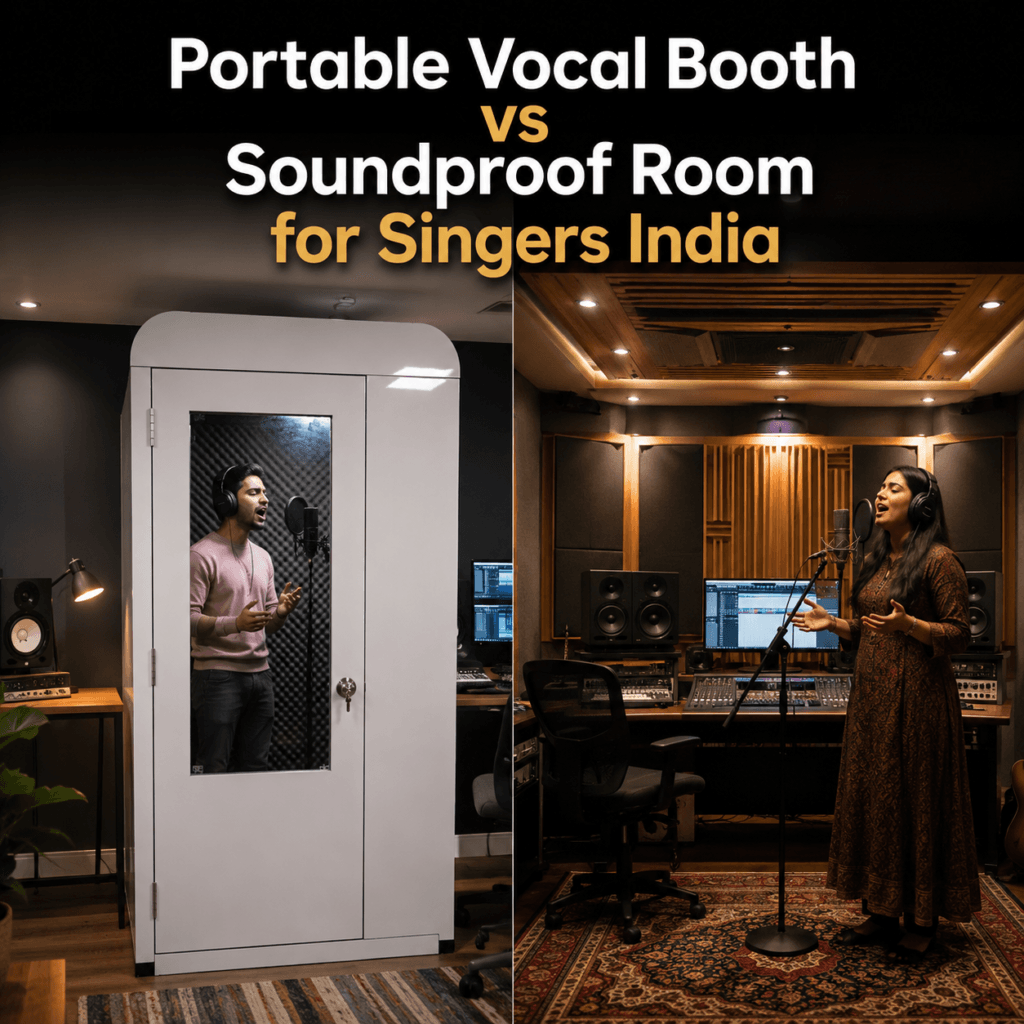
Portable Vocal Booth vs Soundproof Room for Singers in India: Which Is Right for You? Every Indian singer recording at home faces this decision eventually. Your current setup has too much room noise, too much reverb, or too much neighbourhood chaos leaking into your takes. You need a proper acoustic recording solution. But which one? A portable vocal booth or a fully soundproofed room? Both solve the problem but they do it differently, at different costs, and with very different implications for your living situation. This guide breaks it down completely. The Home Recording Dilemma Every Indian Singer Faces Recording vocals at home in India presents challenges that singers in quieter countries simply do not deal with at the same intensity. Urban noise traffic, construction, honking, generator hum is constant and unpredictable. Family environments mean someone is always moving, cooking, or speaking. The gaps of silence you need for clean takes are rare. Even when you get silence, most Indian rooms have hard walls, tiled floors, and minimal soft furnishings all of which create harsh reflections that make vocals sound amateur regardless of how good your microphone is. The solution is either to treat the whole room or to create a treated environment within the room. These are fundamentally different approaches. What Is a Portable Vocal Booth? How It Works A portable vocal booth is a freestanding acoustic enclosure typically lined with high-density acoustic foam — that you stand or sit inside while recording. It blocks a significant portion of external noise from reaching the microphone and absorbs internal reflections so your voice sounds direct and controlled. The best portable vocal booths for professional use in India are full-body enclosures rather than the small desktop shields you see at entry price points. A standing or seated full-body booth like the Kraft-Obench Vocal Pod creates a genuinely professional recording environment with ventilation, cable management, and acoustic performance that rivals a treated room. Portable booths can be assembled and disassembled. They do not require any modification to your home. They can be moved between rooms or properties. What Does a Proper Soundproof Room Require? A properly soundproofed room is a construction project. It involves adding mass to walls often a second layer of drywall with damping compound sealing all gaps and penetrations, decoupling the room’s structural elements to prevent vibration transfer, and adding acoustic treatment to all interior surfaces. In India, a professional soundproof room build typically costs ₹5,00,000 to ₹20,00,000 or more depending on the room size, the degree of isolation required, and the quality of finish. It takes several weeks to build, requires professional contractors with acoustic construction experience, and permanently modifies the property. For renters which is the majority of urban Indian singers a proper soundproof room is simply not an option. Even owners must weigh the cost, the permanence, and whether they want a significant portion of their home given over permanently to a recording space. Sound Quality Comparison: Booth vs Room Honestly a properly built soundproof room with full acoustic treatment will outperform any portable booth on both isolation and internal acoustics. This is simply the physics of construction mass versus portable panels. However, the gap in real-world performance is smaller than you might expect. A quality portable vocal booth like the Kraft-Obench Vocal Pod achieves STC ratings that block the majority of ambient urban noise. The internal acoustic treatment in a quality pod delivers NRC performance comparable to a professionally treated room. For most vocal recording singles, album tracks, voiceovers, demo reels a top-tier portable booth is indistinguishable from a treated room in the final mix. Where a room outperforms a booth is at the extremes: very low frequencies (bass and room modes), very high isolation requirements (recording next to a busy road with heavy construction), and recording full ensembles or instruments. For solo vocals and voice, the booth closes the gap significantly. Cost Breakdown for Indian Musicians Portable vocal booth (professional grade): Kraft-Obench Vocal Pod approximately ₹1,00,000 to ₹2,50,000 depending on specification. Includes delivery and assembly. No additional construction cost. Fully reversible can be sold or moved. DIY soundproof room (basic): Additional drywall layer, Green Glue damping compound, acoustic panels for interior, and professional labour ₹3,00,000 to ₹6,00,000 for a small room. Permanent modification. No resale value of the construction. Professional soundproof room: ₹8,00,000 to ₹20,00,000 for serious isolation with proper acoustic treatment. Professional-grade result but a major capital commitment. For the vast majority of Indian singers, the portable booth delivers 80 to 90% of the acoustic performance at 20 to 30% of the cost. Space and Portability: A Major Factor in Indian Homes Indian homes particularly rental apartments in metro cities are not large. Dedicating an entire room to a soundproof recording space is a luxury very few can afford. A portable vocal booth occupies the footprint of a wardrobe. When you are not recording, it is simply a piece of furniture. If you move which renters in Indian cities do frequently it comes with you. You are not starting over with your acoustic environment every time you change address. A soundproofed room stays behind when you move. All the investment stays in the walls of a property you no longer live in. Our Recommendation: Independent Artists vs Professionals For independent artists, home studio creators, voiceover artists, and musicians at any level below a full professional recording contract a portable acoustic vocal booth is the right choice. The cost is manageable, the performance is professional, and the flexibility is essential for India’s mobile urban lifestyle. For professional recording studios, film score composers, or artists for whom absolute sonic perfection is a commercial requirement a properly built soundproof room is the long-term investment that makes sense. But this is a very small minority of India’s recording community. Professional recording quality without construction. See the Kraft-Obench Vocal Pod India’s leading portable vocal booth.

Portable Vocal Booth vs Soundproof Room for Singers India Read More »

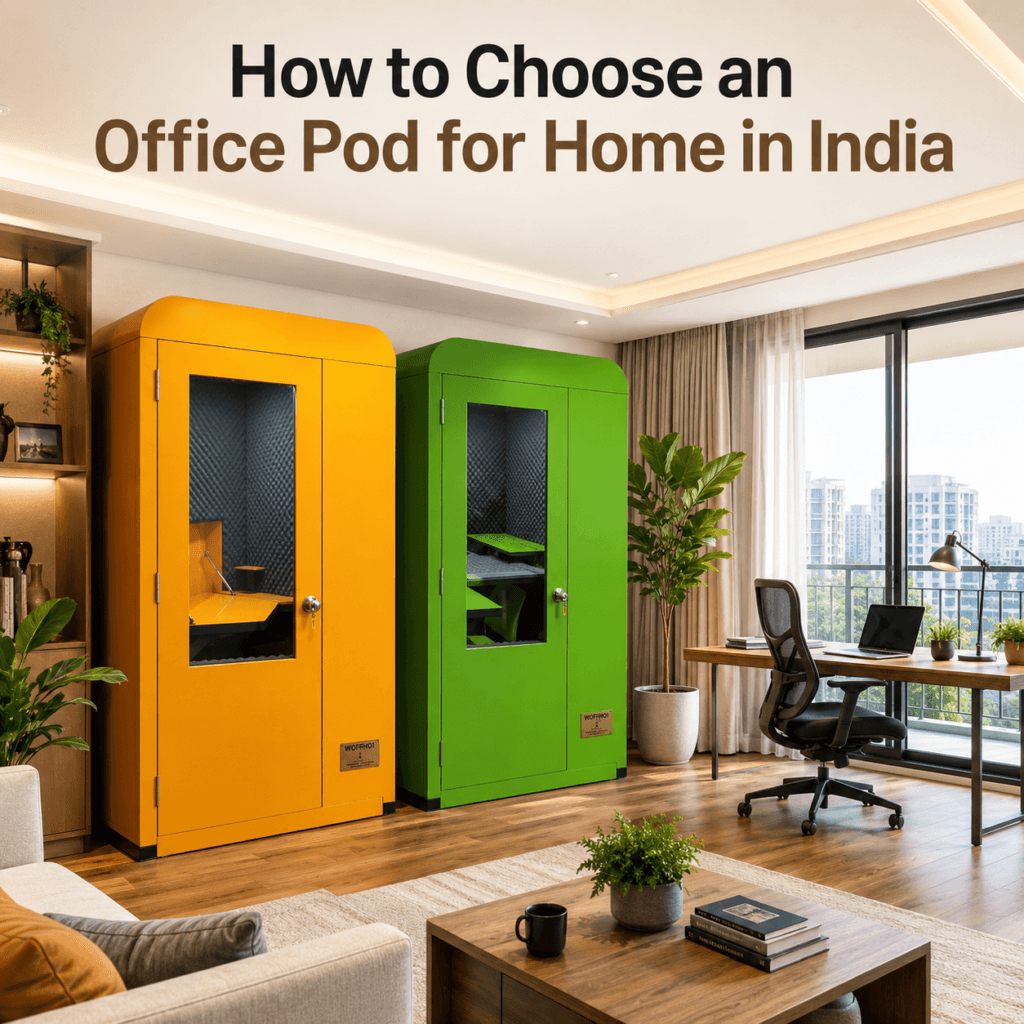
How to Choose an Office Pod for Home India

How to Choose the Right Office Pod for Your Home in India The Indian market for home office pods has grown rapidly. Where two years ago there were almost no options, today there are pods at multiple price points, sizes, and specifications and choosing the wrong one is an expensive mistake. This guide walks you through the five decisions that matter most, so you buy the right pod the first time. Why More Indians Are Buying Home Office Pods in 2026 Hybrid and remote work is now the permanent reality for a large portion of India’s professional workforce. IT professionals, consultants, lawyers, designers, educators, and coaches are all spending significant portions of their working week at home and discovering that Indian homes were never designed for this. The problems are structural. Apartments in Indian cities are dense, noisy, and shared. The work-from-home professional is competing with family noise, construction, traffic, and neighbours. Standard acoustic fixes headphones, closed doors, Do Not Disturb signs work for a while, but they are not sustainable for someone whose livelihood depends on concentration and clear communication. Office pods solve this at the source. Instead of trying to control an entire home environment, you create a controlled private space inside it. Demand has surged across Delhi, Mumbai, Bangalore, Hyderabad, and Pune and is growing in Tier 2 cities as well. Step 1: Measure Your Available Space This is where most people make their first mistake. They find a pod they like online, order it, and then discover it does not fit through their door, cannot fit in the room they planned, or requires ceiling clearance they do not have. Before you look at any pod specifications, measure the following: The floor area where you plan to place the pod in square feet. Account for the pod footprint plus at least 60cm clearance on at least two sides for comfortable entry and exit. The ceiling height of that room. Most pods require a ceiling of at least 230 to 240cm. If you have a low-ceiling room or a mezzanine setup, confirm dimensions before ordering. The width of your main door, staircase, and any corridors the pod components will need to pass through during delivery. Pod components come in flat-pack sections, but the largest panel sections can be 120cm wide. The Kraft-Obench Nano Pod is the most compact option for tight spaces, while the Work Pod suits larger rooms with more space to work with. Step 2: Understand Soundproofing Ratings (NRC vs STC Explained) Pods use two key acoustic measurements. Understanding them prevents you from buying based on marketing language rather than actual performance. STC (Sound Transmission Class) measures how much airborne sound is blocked from passing through the pod walls. A standard interior wall has an STC of around 33 to 40. A quality acoustic pod should achieve STC 30 to 45. The higher the STC, the less outside noise reaches you inside the pod. NRC (Noise Reduction Coefficient) measures how much sound is absorbed by the internal surfaces rather than reflected. A value of 0 means total reflection, 1.0 means total absorption. For recording and call quality, you want NRC as close to 1.0 as possible inside the pod. When comparing pods, ask manufacturers for both figures. Vague language like “highly soundproofed” without numbers is a warning sign. Step 3: Check Ventilation and Comfort Features A poorly ventilated pod becomes uncomfortable within twenty minutes, especially in Indian summer conditions where ambient temperatures can exceed 35°C. Look for a built-in ventilation system with at least two air exchange points ideally an inlet and an exhaust fan. The fan should have a noise rating below 35 decibels so it does not appear as background hum in your recordings or calls. Check whether the pod has interior lighting. Working in a dim pod strains your eyes quickly. LED panel lighting at the right colour temperature (4000K to 5000K for focused work) makes a significant difference to comfort over a long day. Check the floor. A padded or raised floor is more comfortable for long sitting sessions than a bare wooden panel. Kraft-Obench pods include ventilation, integrated lighting, and thoughtfully designed interiors these are not afterthoughts in their design. Step 4: Compare Assembly Requirements Some pods require two to four people to assemble and take a full day. Others are designed for one to two people and assemble in two to three hours. Before purchasing, ask the manufacturer for a realistic assembly time estimate and whether they provide installation support. Confirm whether you need any tools beyond what is provided in the kit. Most quality pods include all required hardware and provide clear instruction manuals or video guides. Ask whether the pod can be disassembled and reassembled if you move. Portability is one of the key advantages of pods over construction but only if the pod is genuinely designed to be moved. Step 5: Set a Realistic Budget Home office pods in India range from approximately ₹80,000 for a compact phone booth style pod to ₹3,00,000 or more for a full-size work pod with premium finishes. Do not fall into the trap of buying the cheapest option available. Very low-cost pods often cut corners on acoustic lining density, ventilation quality, and structural rigidity which means they do not deliver the acoustic performance you are paying for. Set your budget based on how much of your working day you will spend inside the pod. If it is more than four hours per day, invest in a quality pod with proper ventilation and comfort features. If you are using it primarily for calls two to three per day a more compact option may be sufficient. Top Questions to Ask Before You Buy What is the STC and NRC rating of this pod? Any reputable manufacturer should be able to provide both figures. STC measures how much external noise is blocked, while NRC measures how much sound is absorbed inside the pod. For home office use, look for STC ratings between 30–45

How to Choose an Office Pod for Home India Read More »

Soundproof Your Home Office for Zoom Calls

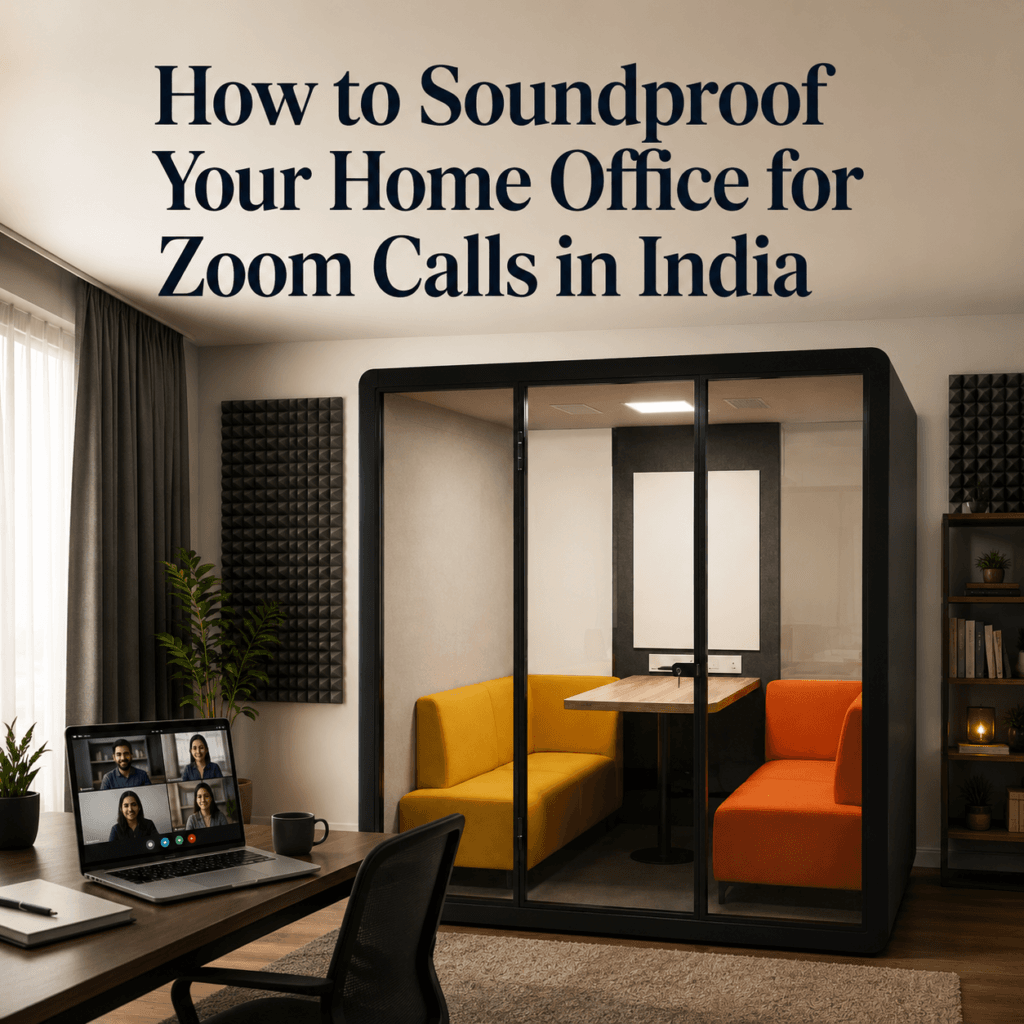
How to Soundproof Your Home Office for Zoom Calls in India

How to Soundproof Your Home Office for Zoom Calls in India You are mid-presentation, your client is listening, and suddenly a pressure cooker whistles, a neighbour blasts music, or a family member walks in. Sound familiar? For millions of work-from-home professionals in India, noise is the number one enemy of productive Zoom calls. The good news: you do not need to gut your flat or spend lakhs on construction. With the right soundproofing strategy or a purpose-built acoustic pod you can sound like you are sitting in a professional studio, even from a 1BHK in Mumbai or a noisy colony in Delhi. This guide covers everything from free DIY tricks to the most effective long-term solution: an acoustic office pod. Why Noise Ruins Your Zoom Calls (And Your Professional Image) Sound quality on video calls is not just a comfort issue it is a professional one. Research consistently shows that people judge the competence of a speaker based on audio clarity. If your audio crackles, echoes, or picks up background sounds, clients and colleagues mentally downgrade your credibility. In India, home soundproofing is especially challenging because of: High ambient noise from traffic, construction, and neighbours Thin walls in apartments and builder floors Shared living spaces with family members and domestic help Hard floors and bare walls that reflect sound and cause echo The two problems you need to solve are different. Soundproofing stops outside noise from entering. Acoustic treatment stops your voice from bouncing around inside the room and causing echo. Most people need a combination of both. DIY Soundproofing Techniques for Indian Homes Before investing in a product, try these no-cost and low-cost fixes: Use heavy curtains. Thick curtains on windows block a surprising amount of street noise. Velvet or blackout curtains work best. Double-layer them for more effect. Add a bookshelf. A bookshelf filled with books on a shared wall absorbs and breaks up sound. It is one of the easiest passive soundproofing tricks available. Put rugs on the floor. Hard floors reflect sound and add echo to your voice. A thick rug under your desk area reduces this significantly. Seal door gaps. Use adhesive foam tape or a door sweep to seal the gap under your door. A large percentage of noise enters through these gaps. Record in a closet temporarily. Clothes absorb sound brilliantly. Many podcasters and voice artists record inside wardrobes when they need a quick fix. It is not glamorous, but it works. Rearrange furniture. Position your desk against the wall that has the least noise coming through it. If your neighbour is on the left, sit facing right. These methods help but have real limits. For professionals who are on calls all day, they are not enough. Acoustic Panels vs Office Pods: Which Works Better? Once you have exhausted the free fixes, you have two main options: acoustic panels or an office pod. Acoustic panels are foam or fabric-wrapped boards that you mount on walls. They absorb sound reflections and reduce echo inside your room. They are affordable a basic set costs ₹3,000 to ₹12,000 and they make a noticeable difference to your voice quality on calls. However, they do nothing to block outside noise from entering your room. Acoustic office pods are self-contained structures that you assemble inside your home. They solve both problems at once: they block external noise from entering, and they control the acoustics inside. You step in, close the door, and you are in a completely different sonic environment. Products like the Kraft-Obench Work Pod and Nano Pod are designed exactly for this use case. If you are on calls for more than two to three hours a day, or if your home noise situation is severe, an acoustic pod gives you results that panels simply cannot match. Top Soundproofing Materials Available in India If you are going the DIY route, here are the materials to look for: Acoustic foam panels are widely available on Amazon India and local hardware stores. Look for wedge-cut or pyramid-cut foam with a thickness of at least 50mm for meaningful absorption. Mass Loaded Vinyl (MLV) is a dense, flexible material you can attach to walls, doors, or ceilings. It blocks sound transmission rather than just absorbing it. Less common in India but available through specialty acoustic suppliers in Delhi, Mumbai, and Bangalore. Green Glue is a damping compound applied between two layers of drywall. It converts sound energy into heat. Excellent for renovations but impractical for renters. Mineral wool or rockwool is used inside wall cavities and DIY acoustic panels. Brands like Saint-Gobain ISOVER are available in India and work very well. Weatherstripping foam tape costs under ₹200 and is one of the highest-return investments for reducing noise through gaps around doors and windows. When to Invest in a Dedicated Acoustic Office Pod You should seriously consider an acoustic office pod if any of these apply to you: You work from home full time and your income depends on call quality. You are a freelancer, consultant, coach, or online teacher whose clients judge you on professionalism. You live in a loud urban area with no quiet room available. You share your home with family and cannot ask everyone to be quiet during your calls. You record audio or video content and need consistent, clean sound. An office pod is not a luxury for these situations it is a productivity and income tool. The Kraft-Obench Work Pod is designed specifically for Indian home office setups, with thoughtful ventilation, cable management, and assembly that does not require tools or drilling. Budget Breakdown: Soundproofing for Every Price Range Under ₹5,000 Quick Fixes: Heavy curtains, door gap seals, a desk rug, and repositioning furniture. This reduces echo and blocks some external noise. Good enough for occasional calls. ₹5,000 to ₹20,000 DIY Acoustic Treatment: A set of acoustic foam panels for your wall and ceiling above your desk, a microphone arm, and a dynamic microphone that rejects background noise. Voice quality improves noticeably. ₹20,000 to ₹60,000

How to Soundproof Your Home Office for Zoom Calls in India Read More »