The Factory Office Challenge in India
Indian manufacturing facilities face a challenge that is unique among commercial real estate contexts. Supervisors, quality control teams, HR managers, and procurement staff all need quiet, private office space to perform their roles effectively yet they must be physically present on the factory floor or in close proximity to production. Traditional office construction cannot keep pace with the operational demands of modern Indian manufacturing. Visit Kraft-Obench to explore modular solutions built for industrial environments.
The noise environment of a typical Indian factory floor presents a particular problem. Ambient noise levels of 85 to 95 dB are standard in light manufacturing. Heavy manufacturing environments stamping, casting, and large-scale assembly routinely exceed 100 dB. Creating a functional office workspace in this environment requires serious acoustic engineering, not just a partitioned room.
What Is a Modular Office Cabin?
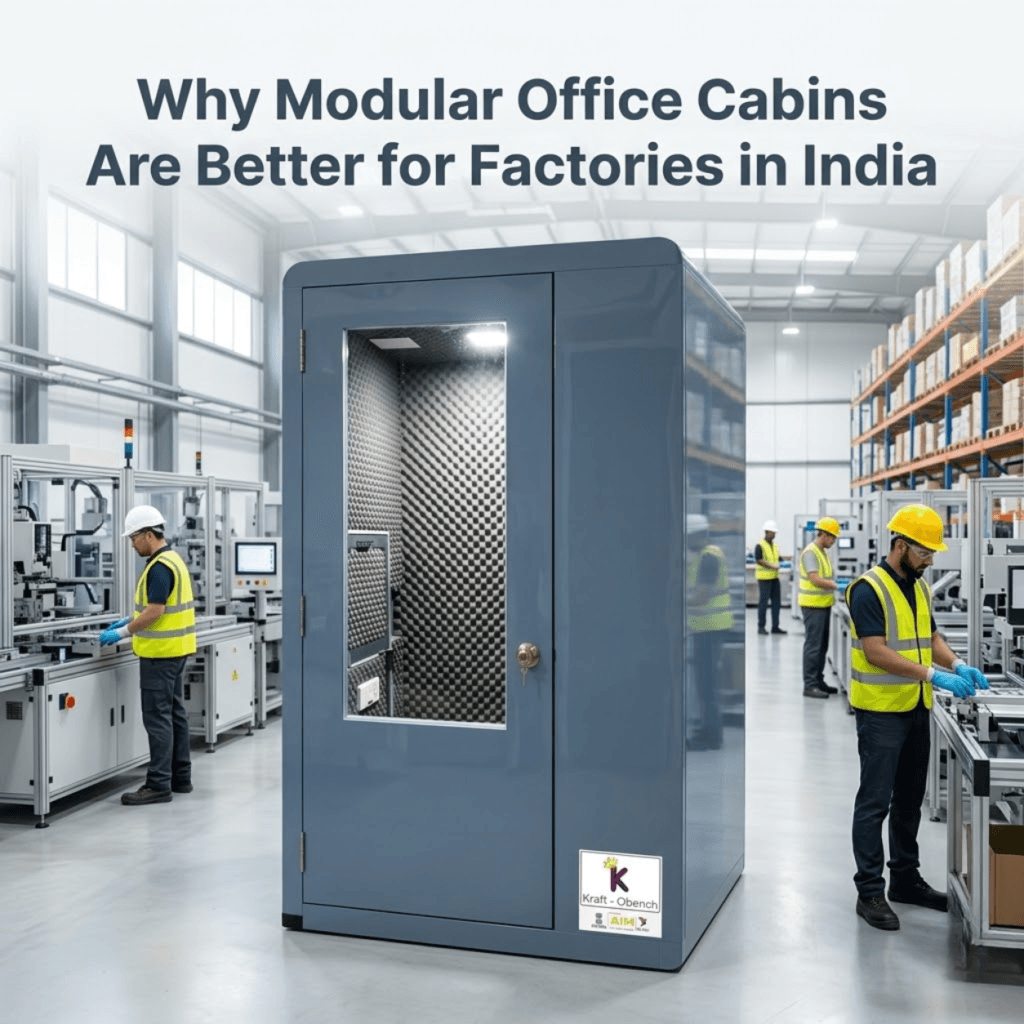
A modular office cabin is a pre-engineered, fully factory-assembled workspace unit that can be placed directly on a factory floor, in a warehouse, or in an outdoor industrial compound. It requires no civil construction work, no building permits in most Indian industrial zones, and can be relocated when production layouts change as they inevitably do.
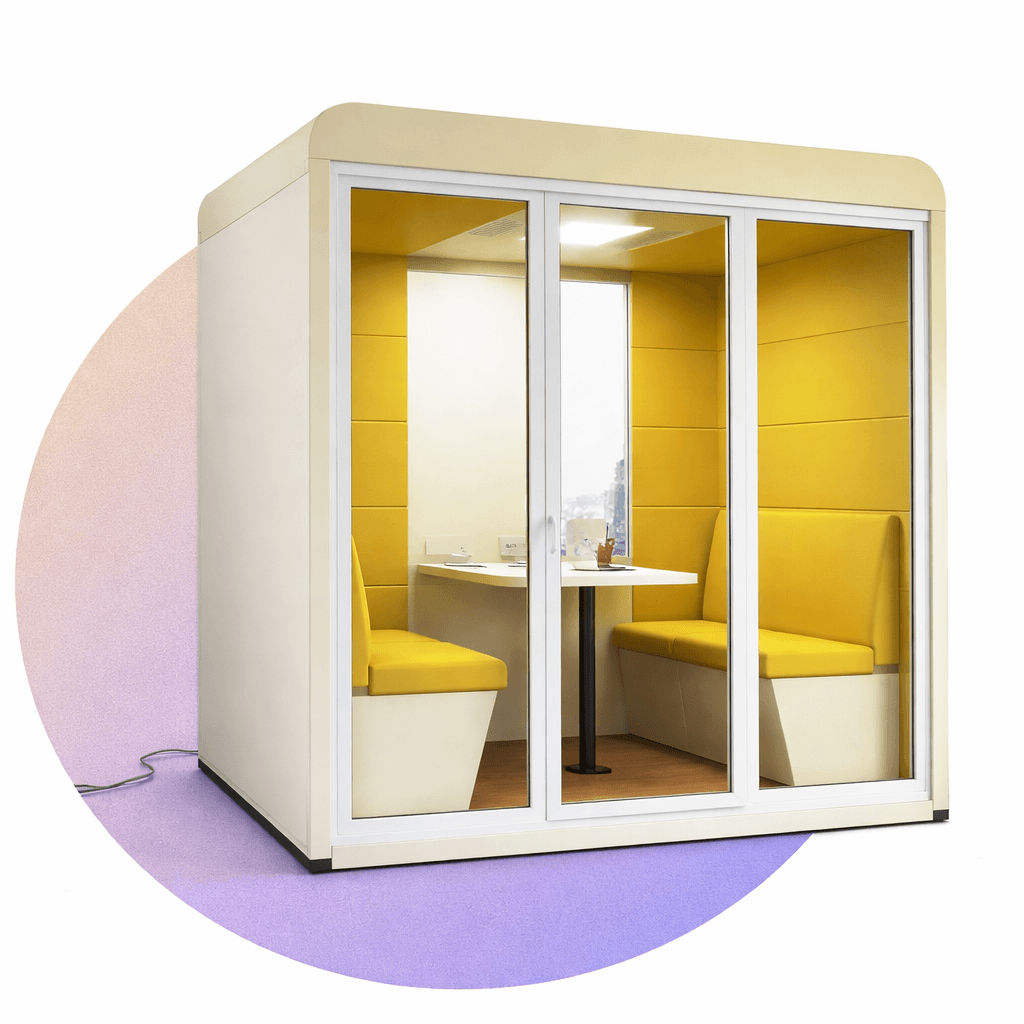
The Work Pod and Nano Pod are both popular choices for factory floor installations depending on the space available. For factories needing supervisor offices with space for two to three people, the Meeting Pod provides the right configuration. All models can be specified with industrial-grade exterior finishes and enhanced ventilation for demanding factory environments.
Advantage 1: Speed of Installation
Traditional cabin construction on a factory floor takes 4 to 8 weeks minimum, including civils, plastering, electrical fit-out, and finishing. During this period, the surrounding production area is disrupted by construction activity, contractor access, and material storage. A Kraft-Obench modular office cabin installs in 1 to 3 days with zero production downtime.
Our installation teams across India including Pune, Ahmedabad, and Surat have completed factory installations at weekends and during planned maintenance shutdowns to ensure that production schedules are never affected by workspace improvements.
Advantage 2: Acoustic Isolation from Factory Noise
Factory floors commonly reach 85 to 95 dB in light manufacturing environments. This level of noise makes telephone calls effectively impossible without acoustic protection, causes hearing fatigue and stress in anyone exposed for extended periods, and makes concentration on detailed documentation work extremely difficult.
Kraft-Obench pods achieve STC 38 to 42, reducing interior noise levels by 35 to 40 dB. A factory floor at 90 dB becomes approximately 50 to 55 dB inside the pod comparable to a quiet office environment. This protects both hearing health under occupational health legislation and call quality for customer-facing staff. Compare models at Kraft-Obench including the Phone Booth for call-focused factory office use.
Advantage 3: Relocatability When Production Layouts Change
Factory layouts are not static. Production lines expand, contract, and reconfigure as product mixes change, new equipment arrives, or lean manufacturing improvements are implemented. Traditional constructed offices become permanent obstacles to this flexibility. They cannot be moved and demolishing them is costly and creates construction waste.
All Kraft-Obench pods can be disassembled and reassembled in under 8 hours by a two-person team. Our clients in Vadodara and Nagpur regularly relocate pods as factory layouts evolve with new machinery installations and production expansion projects. The pod retains its full acoustic performance and original appearance after relocation.
Advantage 4: Dust and Chemical Resistance
Indian factory environments expose office structures to dust, metallic particles, chemical vapours, and in coastal locations, salt-laden humid air. Kraft-Obench pods use powder-coated steel frames with a minimum 80-micron coating thickness, industrial-grade high-pressure laminate surfaces, and sealed acoustic panels with moisture-resistant facings.
This is especially important for factories in Visakhapatnam and Kochi where coastal salt air significantly accelerates corrosion of unprotected metal surfaces. All Kraft-Obench pods used in coastal industrial applications are available with an enhanced anti-corrosion specification.
Advantage 5: Cost Comparison
Constructing a 100 square foot office within a factory building costs ₹3,00,000 to ₹6,00,000 when all civil, electrical, HVAC, and finishing costs are included. This investment is fixed to the property and has zero resale value if the factory moves or the space is reconfigured.
A comparable Kraft-Obench Work Pod costs ₹2,00,000 to ₹4,00,000 installed and retains 40 to 60 percent of its original value after five years. It can be sold through our pre-owned programme or relocated to a new facility. The total cost of ownership over a 5-year period strongly favours the modular pod. View real factory installations in our Gallery.
AI-Powered Factory Floor Management and Pod Integration
Modern Indian manufacturers are implementing AI-powered factory management systems that monitor production metrics, quality data, and operational KPIs in real time. The supervisor and manager offices created by Kraft-Obench modular cabins are increasingly serving as the physical command centres for these AI systems.
A modular office cabin placed at the floor level of a production line rather than in a remote second-floor office allows supervisors to interact directly with AI dashboards and immediately cross-reference digital data with physical production reality. This integration of intelligent digital systems with practical, acoustically isolated workspace represents a major operational improvement over both traditional factory office arrangements and remote office management models.
Frequently Asked Questions
Q1: Do modular office cabins in factories require fire safety approval? Freestanding pods that do not connect to building services typically do not require separate fire NOC amendments. Kraft-Obench pods are manufactured with fire-retardant materials. Verify with your factory’s fire safety officer.
Q2: Can a modular cabin be installed on a raised factory floor or mezzanine? Yes, with a structural assessment. Kraft-Obench’s installation team conducts a load-bearing assessment before installation on elevated surfaces. Our Work Pod weighs approximately 400 kg.
Q3: How do factory workers charge devices inside the pod? All Kraft-Obench pods come with a built-in power distribution unit offering multiple sockets and USB-A/C charging points connected to a standard 15A electrical supply.
Q4: Are modular factory cabins suitable for QC labs? Yes. Many Kraft-Obench factory clients use pods as QC inspection rooms, sample evaluation spaces, and documentation areas where concentration is essential.
Q5: What is the maximum temperature rating for factory-installed pods? Kraft-Obench pods are rated for ambient operating temperatures up to 45°C. For installations adjacent to furnaces or foundry equipment above 45°C, an enhanced thermal insulation package is recommended.
Q6: Can the pod exterior be painted to match factory safety colour coding? Yes. All Kraft-Obench pods are available in custom RAL colours including safety yellow, industrial grey, and corporate brand colours.
Q7: Is there a minimum order quantity for factory pod deployments? No minimum order. Single-pod factory installations are common for supervisor offices. Volume discounts apply for orders of 5 or more units.