The Startup Dilemma: Rent or Buy?
Indian startups move fast, pivot frequently, and operate under financial constraints that make every capital allocation decision consequential. Committing to office equipment particularly at the scale of acoustic pods and phone booths requires careful analysis of cash flow, lease duration, growth trajectory, and tax position.
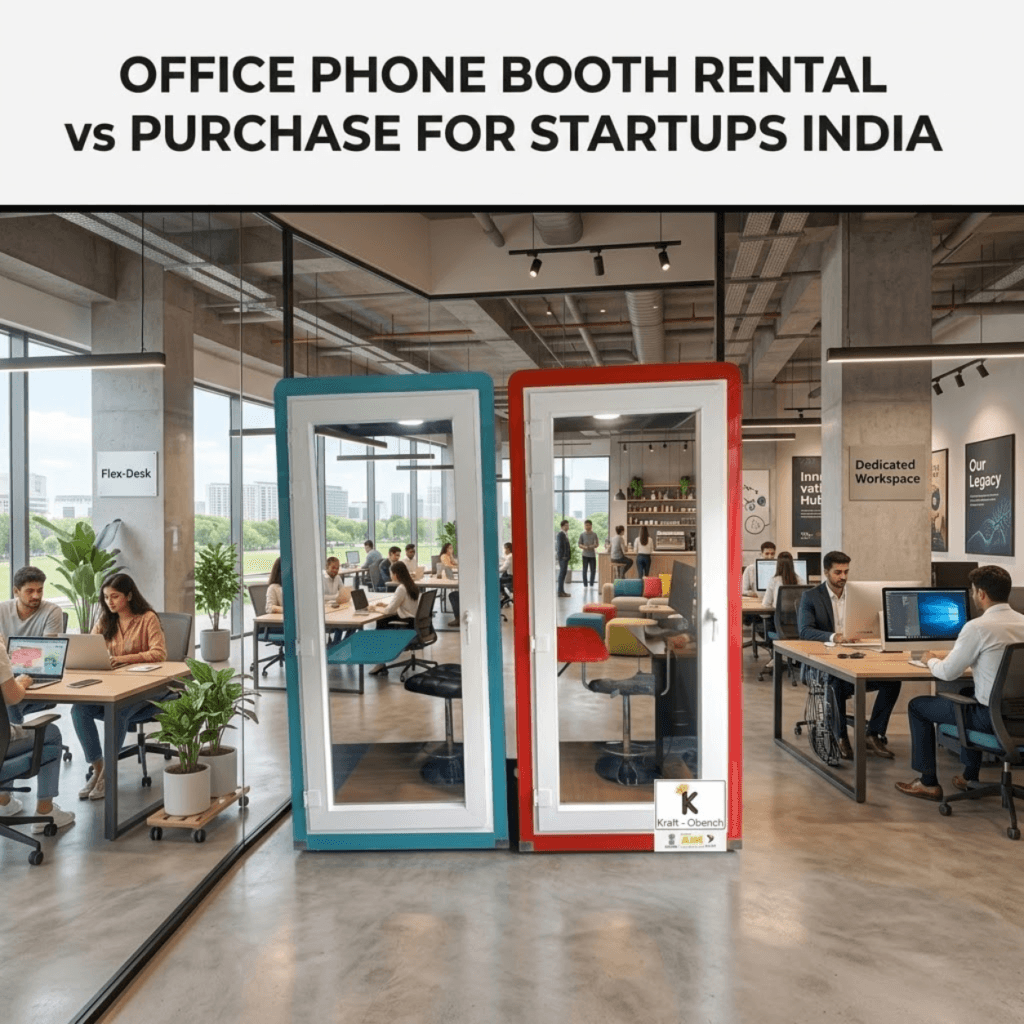
Kraft-Obench offers both rental and purchase options for phone booths and acoustic pods across India. This guide provides a structured comparison to help startup founders and operations managers make the right decision for their stage of growth. Explore the full range including the Phone Booth, Nano Pod, and Work Pod before deciding.
The Case for Renting an Office Phone Booth
Renting makes strong financial and operational sense for startups in specific situations: companies on 12 to 24-month office leases where long-term space commitment is uncertain, early-stage teams under 20 people where pod utilisation may be unpredictable, pilot programmes testing pod productivity before scaling, and companies in coworking spaces where permanent installation may not be permitted.
Rental also makes sense as a risk management strategy. If a startup pivots, downsizes, or moves offices, a rented pod is returned with no residual obligation. A purchased pod in the same situation must be relocated, sold, or written off. Rental options for all major pod models are available at our Rentals page with flexible monthly and annual terms.
Rental Cost Analysis
Kraft-Obench phone booth rentals typically range from ₹8,000 to ₹15,000 per month depending on model and rental duration. A 12-month rental costs ₹96,000 to ₹1,80,000. This is significantly more accessible than the upfront purchase price for seed or early Series A startups in cities like Bangalore, Mumbai, and Delhi, where operating capital is typically stretched across hiring, product development, and marketing simultaneously.
The monthly rental payment is a predictable operating expense that flows through the profit and loss account with no balance sheet impact, which is a significant benefit for startups managing investor-monitored financial KPIs.
The Case for Purchasing
Purchase makes compelling sense when the startup has achieved product-market fit and is scaling rapidly, the team has grown beyond 30 people with a correspondingly higher pod utilisation, the office lease is 3 years or longer providing stability for a capital asset, and funding has been secured at Series A or beyond providing the capital for a considered fixed asset investment.
At this growth stage, the Meeting Pod and Work Pod are the most commonly purchased units. The meeting pod addresses the collaboration and client-facing needs of a growing team, while the work pod provides the focused solo workspace that senior individual contributors and managers require for deep work.
Total Cost of Ownership Analysis
Over a 5-year period, the economics of purchase versus rental are clear. A purchased phone booth costs ₹1,50,000 to ₹2,80,000 including installation plus minimal maintenance costs of approximately ₹15,000 per year. Total 5-year cost: approximately ₹2,25,000 to ₹3,55,000. The same pod on rental over 5 years at ₹10,000 per month costs ₹6,00,000 nearly double the purchase cost.
Purchase wins decisively on total cost of ownership. See real-world examples from our Clients page and Gallery for reference cases across different startup stages.
Tax Considerations in India
The Indian tax treatment of acoustic pods differs significantly between rental and purchase, and the difference matters for your effective cost calculation. Purchased pods depreciate at 25 percent per annum under the Income Tax Act under the furniture and fixtures block. This provides a declining tax shield over the asset’s life. In the first year of a ₹2,00,000 pod purchase, the depreciation deduction of ₹50,000 reduces your tax liability meaningfully.
Rental payments are 100 percent deductible as operating expenses in the year they are incurred, with no depreciation schedule to manage. Startups in Hyderabad and Pune have successfully used both tax treatments depending on their specific profitability and cash flow position. Consult your chartered accountant for the optimal approach given your startup’s financial position.
Flexibility Factor
Uncertainty about office location is the strongest argument for renting over purchasing. If there is any meaningful probability that your startup will move offices, raise additional funding and expand into a larger space, or explore geographic expansion in the next 24 months, renting eliminates the friction and cost of relocating or disposing of owned pod assets.
Startups in Noida and Gurgaon commonly begin with rentals and transition to purchase once their office lease is confirmed and headcount trajectory is established. This staged approach allows startups to benefit from pod productivity without committing capital before the organisation’s spatial needs are fully understood.
Hybrid Strategy: Rent-to-Own
Kraft-Obench offers a Rent-to-Own programme that bridges the gap between rental and purchase. Under this programme, monthly rental payments accumulate credits that reduce the eventual purchase price. After 18 to 24 months of rental, a qualifying startup can convert to ownership with rental credits applied against the purchase price.
This approach gives early-stage startups the flexibility of rental while providing a defined path to ownership once growth and financial stability are established. Ask our team via the Contact page about the Rent-to-Own programme available for qualifying startups. Our team in Chandigarh and Jaipur can also advise on Tier 2 city rental and purchase options.
Frequently Asked Questions
Q1: What is the minimum rental duration for a phone booth? Kraft-Obench offers a minimum rental duration of 3 months for most pod models. Month-to-month rentals are available at a premium rate. Visit our Rentals page for current rental terms.
Q2: Can a rented pod be returned if the startup downsizes or closes? Yes. Kraft-Obench’s rental agreement includes a defined return clause. Pods are collected by our installation team at no charge when the rental period ends.
Q3: Does the rental price include maintenance and repairs? Yes. All Kraft-Obench rental pods include maintenance, filter replacement, and repairs as part of the monthly fee.
Q4: Is there a security deposit for rental pods? A refundable security deposit equivalent to 2 to 3 months’ rental is typically required and is returned in full upon pod return in satisfactory condition.
Q5: Can a startup buy the pod after the rental period? Yes, through the Rent-to-Own programme. Contact our sales team at the Contact page for current credit terms.
Q6: Are pods available for rent in Tier 2 Indian cities? Yes. Rental delivery is available to cities including Lucknow, Indore, and Mysore.
Q7: Does renting a pod include installation and deinstallation? Yes. All Kraft-Obench rental agreements include professional installation at the start and deinstallation at the end of the rental period.