The Open Plan Office Noise Crisis in India
India’s corporate offices from Mumbai’s BKC to Bengaluru’s Whitefield have embraced open plan layouts for the collaboration, flexibility, and cost efficiency they offer. Glass-fronted offices with high ceilings and minimal partition walls look excellent in architecture photography and perform well for informal team interactions. However, they create serious acoustic problems for the focused, private, and productive work that makes businesses successful.
Research consistently shows that 65 percent of Indian office workers report noise as their top productivity killer. The situation worsens as organisations grow headcount within existing floor plates without adding acoustic infrastructure. Visit Kraft-Obench to explore India’s leading acoustic pod range and start building your noise reduction strategy today.
Understand the Sources of Noise First
Before investing in solutions, identify the dominant noise sources in your office. The three primary culprits in Indian open plan offices are speech noise from neighbouring workstations, HVAC system hum and vibration, and impact noise from hard floors and furniture movement.
Speech noise is the most cognitively disruptive because the human brain automatically processes intelligible speech even when you are trying to ignore it. This is why a single loud conversation can derail the concentration of ten people. Your noise reduction strategy should target the highest-impact source first and work outward from there.
Solution 1: Install Acoustic Office Pods
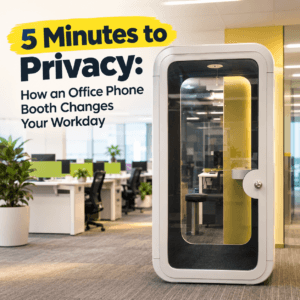
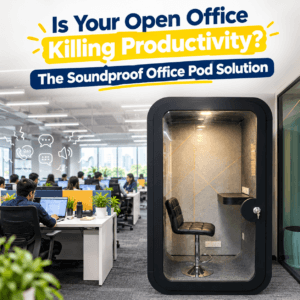
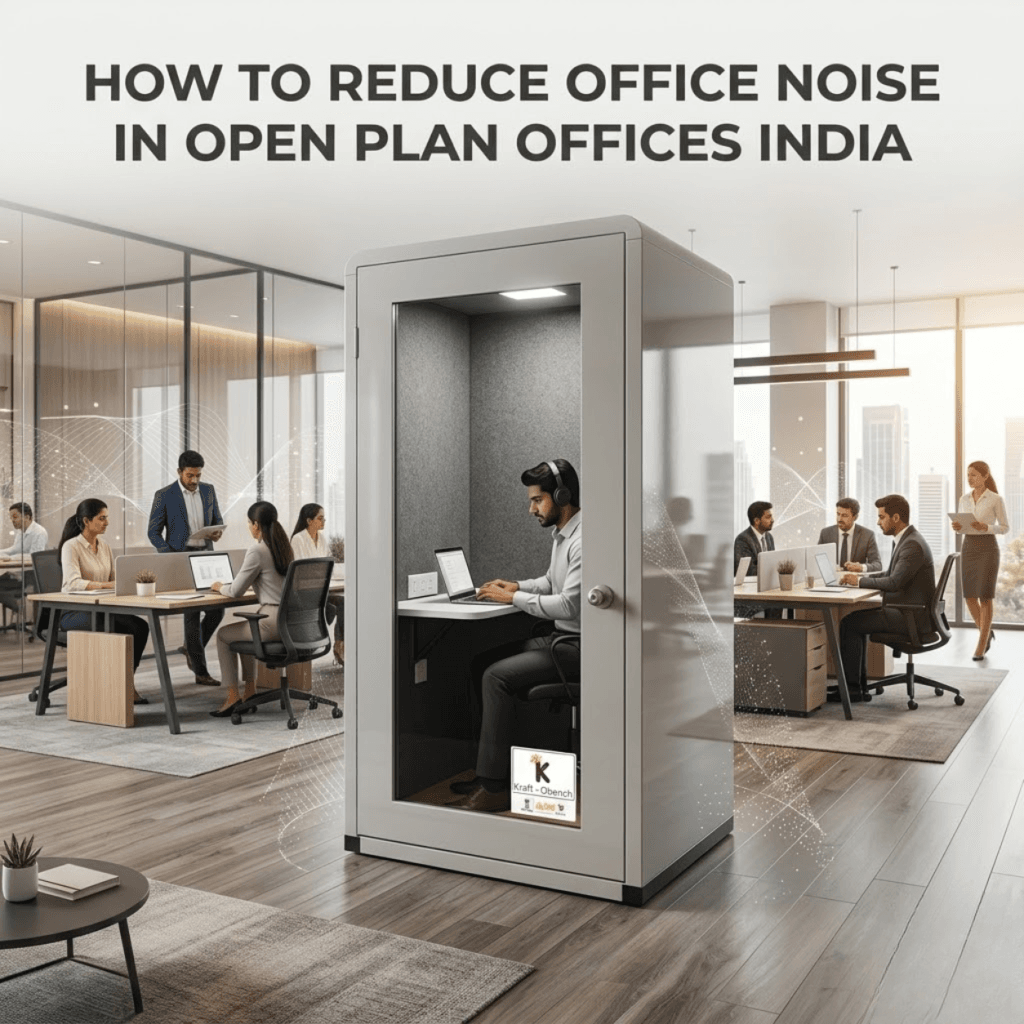
Acoustic pods are the single most effective solution for open plan office noise because they directly address the source providing an enclosed space where conversations happen in isolation from the open floor. A Phone Booth provides an STC-rated enclosure for all private calls. The Nano Pod fits into tight floor plans and accommodates a full laptop workstation for focused solo work.
For team collaboration, the Meeting Pod serves groups of up to four people in complete acoustic privacy. For individual heads-down work needing extended quiet time, the Work Pod is the most comprehensive solution, offering a full desk environment with power and ventilation. All models are available on flexible rental terms at our Rentals page for offices not ready to commit to outright purchase.
Solution 2: Add Acoustic Panels to Walls and Ceilings
Fabric-wrapped acoustic panels reduce reverberation time, measured as RT60 the time it takes for sound to decay by 60 dB after a source stops. In a hard-surfaced Indian office with tile floors, glass partitions, and concrete ceilings, RT60 can reach 1.5 to 2 seconds, causing speech to feel muddy, exhausting, and difficult to understand.
Target an RT60 under 0.5 seconds for comfortable office speech intelligibility. Place panels at primary reflection points side walls at seated ear height and the ceiling directly above workstation clusters. Two well-placed 600mm x 1200mm panels per 10 workstations delivers a measurable improvement in most Indian office environments.
Solution 3: Use Desk Dividers and Pod Clusters
Height-adjustable acoustic desk dividers at a minimum of 900mm high reduce direct sound transmission between neighbouring workstations by interrupting the straight-line sound path between a speaker’s mouth and their neighbour’s ears. This is a low-cost intervention that complements pod installations rather than replacing them.
For offices in Delhi and Gurgaon, pod clusters surrounded by desk dividers are the most popular configuration for large corporate floors. The cluster approach groups the noisiest activities calls and team discussions into pod-equipped zones while preserving the open character of collaboration areas.
Solution 4: Introduce Soft Furnishings Strategically
Hard surfaces reflect sound. Every glass wall, tile floor, and laminate desk in your office is a sound mirror that amplifies reverberation and increases the overall noise level. Adding soft furnishings carpets, upholstered seating, fabric curtains, and acoustic ceiling baffles in break zones absorbs ambient noise that hard surfaces would otherwise reflect.
Even a 25 percent increase in soft surface area reduces reverberation measurably in typical Indian glass-and-tile office interiors. The effect is most dramatic in offices with high ceilings and extensive glass. Start with the break room and reception area where hard surfaces are most concentrated.
Solution 5: Create an Acoustic Zoning Policy
Physical acoustic treatment works best when supported by a clear office zoning policy. Designate specific zones for different noise levels: collaboration zones where 65 dB conversation is acceptable and focus zones where the target is under 45 dB. Place acoustic pods and phone booths at the boundary of focus zones so users have immediate access to an enclosed call environment without crossing the entire office floor.
Offices in Bangalore and Mumbai have adopted formal acoustic zoning policies with measurable productivity improvements. The zoning policy costs nothing to implement and significantly amplifies the value of every physical acoustic investment you have already made.
Solution 6: White Noise Systems
Sound masking systems emit low-level, low-frequency broadband noise commonly called white noise or pink noise that raises the ambient noise floor in a controlled way. This makes individual conversations less intelligible from a distance, reducing the distraction caused by nearby speech without requiring everyone to use headphones.
White noise systems are popular in Hyderabad and Pune tech campuses as a complement to pod installations. The combination of a sound masking system and acoustic pods delivers a layered approach where the masking system handles general ambient noise and the pods handle private conversations.
Solution 7: Optimise Pod Placement for Maximum Coverage
The placement of acoustic pods within the office floor plate significantly affects their utilisation and acoustic benefit. Place one phone booth per 8 to 10 employees based on average call frequency. Position pods near the workstation clusters that generate the most call activity rather than at the office perimeter where they are less convenient.
For city-specific guidance on pod placement in large offices, see our pages for Noida, Chennai, Ahmedabad, and Kolkata. Our acoustic consultants conduct free floor plan reviews for orders of three or more pods.
AI-Assisted Acoustic Design for Indian Offices
Artificial intelligence tools are now being used in the acoustic design phase to predict noise propagation across office floor plans before any physical installation takes place. By inputting floor plan dimensions, surface materials, furniture layout, and headcount, AI acoustic modelling software generates heatmaps showing predicted noise levels across every square metre of the office.
This allows facilities managers and designers to identify problem zones, test the impact of different pod placements virtually, and optimise their acoustic investment before spending a rupee on physical products. Kraft-Obench’s design team uses AI-assisted acoustic modelling to deliver pod placement recommendations that are grounded in simulation data rather than guesswork.
Budget Guide for Indian Offices
Understanding the cost of noise reduction helps you build a business case for the investment. Acoustic panels range from ₹1,500 to ₹4,000 per square foot installed. A single phone booth ranges from ₹1.5 lakh to ₹3 lakh. A 4-person meeting pod ranges from ₹4 lakh to ₹10 lakh. A complete white noise system for a 50-person office costs ₹80,000 to ₹2,50,000. Return on investment from productivity improvements is typically recovered within 6 to 12 months.
Visit our Gallery for real installation examples from Indian offices across every sector and city.

Frequently Asked Questions
Q1: What is the most cost-effective first step to reduce office noise? The single most cost-effective first step is enforcing a policy of taking all calls in a dedicated phone booth. A Kraft-Obench Phone Booth serves 10 to 15 employees and eliminates the most disruptive noise source in most open offices.
Q2: How many acoustic pods does a 50-person office need? A 50-person office typically needs 4 to 6 single-person phone booths or Nano Pods, plus one 4-person meeting pod. This ratio ensures pod availability throughout the working day without queuing.
Q3: Do acoustic pods require building permission in India? In most cases, no. Kraft-Obench freestanding pods require no civil work and therefore no building plan approval or landlord NOC. Verify with your specific building management.
Q4: Will acoustic panels alone solve my office noise problem? Acoustic panels reduce reverberation but do not block noise transmission between people. For true privacy and noise isolation, you need acoustic pods. Panels and pods work best in combination.
Q5: Can acoustic pods be installed on any floor type? Yes. Kraft-Obench pods use non-marking rubber levelling feet and require no floor anchoring. They work on tiles, marble, wood, carpet, and raised access floors.
Q6: How loud is it inside a Kraft-Obench pod when the office outside is at 70 dB? With an STC 38 rating, a pod reduces a 70 dB external environment to approximately 32 to 35 dB inside — quieter than a library.
Q7: Are there acoustic pod options for coworking spaces? Yes. Kraft-Obench offers volume pricing for coworking operators. See our Jaipur and Indore pages for region-specific coworking solutions.
Create a quieter, more productive workplace. Discover Kraft-Obench Acoustic Pods trusted by leading Indian companies to reduce office noise and improve focus.