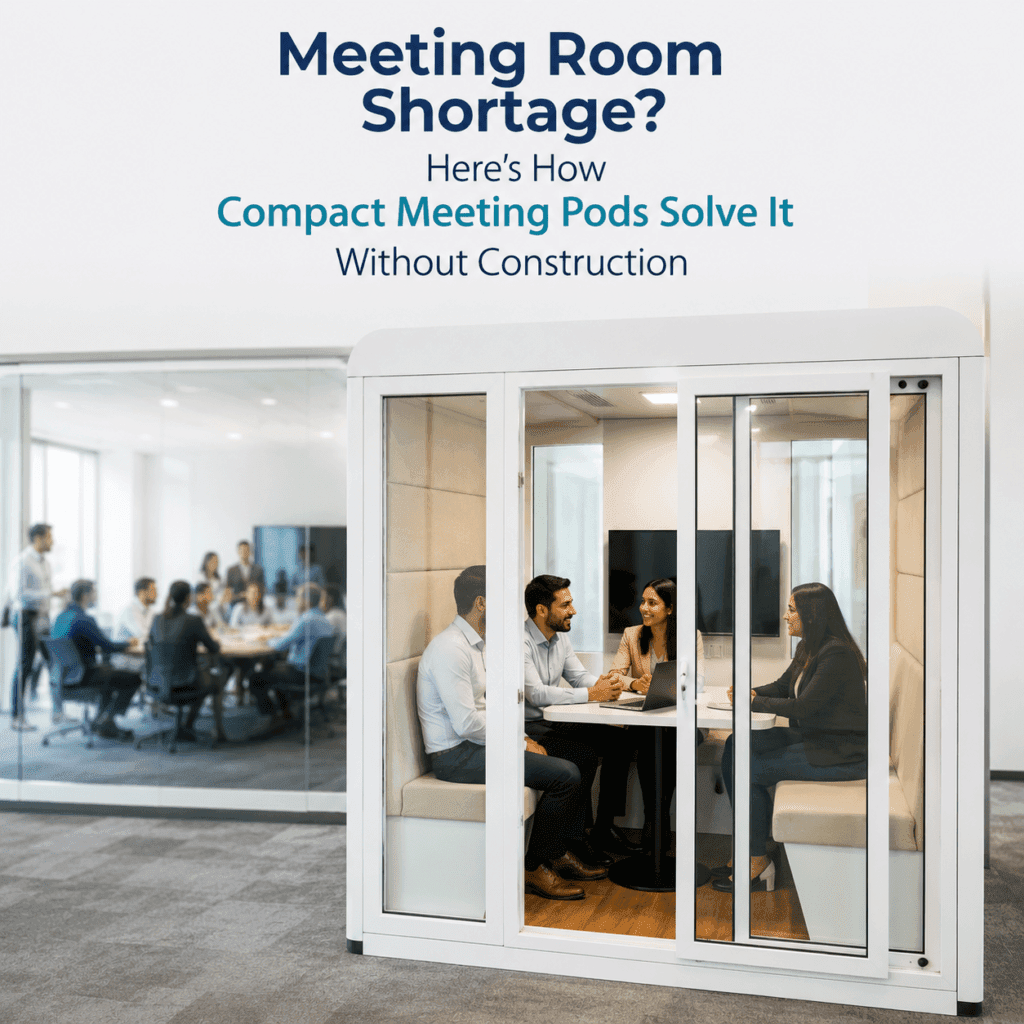
Meeting Room Shortage? Here’s How Compact Meeting Pods Solve It Without Construction
Walk into almost any growing office in India today and you’ll notice the same pattern: too many people, not enough rooms. Calendars are booked out days in advance for a single conference room. Teams huddle around a laptop at someone’s desk because nothing else is free. Client calls get pushed back by twenty minutes simply because there’s nowhere quiet to take them. HR conversations happen in hushed tones near the pantry because every enclosed space on the floor is already occupied. The meeting room shortage isn’t a hypothetical problem, it’s one of the most common complaints in offices that have grown faster than their floor plan, and it tends to get worse quietly, over months, until it suddenly feels urgent.The instinctive response is to build more rooms. But construction is slow, expensive, and permanent in a way that doesn’t suit how quickly modern teams change shape. A room built today for a team of twelve may be the wrong size entirely once that team splits into two, merges with another, or shifts to a hybrid schedule. This is where compact meeting pods offer a genuinely different solution one that doesn’t involve a single wall being knocked down, and one that can be resized or relocated as the team’s needs change.Why Offices Keep Running Out of Meeting SpaceMeeting room shortages rarely happen because a company planned poorly. They happen because offices change faster than physical space can keep up.1. Headcount Grows Faster Than Square FootageA team of fifteen might have been comfortably served by two meeting rooms. At forty people, those same two rooms are hopelessly inadequate but by the time that becomes obvious, moving to a bigger office or building new rooms is a multi-month project, not a quick fix.2. Hybrid Work Changed What a “Meeting” Looks LikeA few years ago, meetings mostly meant a group of people sitting around a table in the same room. Today, most meetings involve at least one remote participant, which means every meeting room also needs to double as a video-call space with decent acoustics, lighting, and a camera angle that doesn’t look like a hostage video. Many older conference rooms simply weren’t built with this in mind.3. Small Meetings Are Competing for Big RoomsA quick 15-minute sync between two people often ends up booked into a room designed for ten, simply because it’s the only private space available. This is an inefficient use of space that makes the shortage feel worse than it actually is the office may have enough total meeting capacity, just not the right size and shape of it.4. Construction Isn’t a Realistic Short-Term FixAdding a new meeting room the traditional way means architectural planning, contractors, permissions, weeks of dust and noise, and a room that once built can’t easily be resized, relocated, or removed if the company’s needs change again in a year. For most businesses, this is simply too slow and too rigid to solve an immediate, growing problem.The Case for Compact Meeting PodsThis is exactly the gap that modular meeting pods are designed to fill. Instead of a construction project, a meeting pod is a self-contained, prefabricated unit that can be placed directly onto an existing floor no walls, no permits, no months of disruption.A few things make this approach genuinely practical rather than just a trendy alternative:They arrive ready to use. A meeting pod comes with acoustic panelling, lighting, ventilation, and power built in. There’s no separate phase of “furnishing” the room after construction it’s functional from day one.Installation is measured in hours, not weeks. Following a structured installation process including a site survey for floor space, ceiling height, and cable routing most pods are fully operational within the same working day, without shutting down the surrounding office.They’re genuinely soundproof. Traditional meeting rooms, especially ones with glass walls or thin partitions, often leak sound both ways. A properly engineered acoustics booth is built specifically to block sound transfer, which matters enormously for confidential discussions, HR conversations, or client negotiations.They can move when the company does. Unlike a built room, a pod can be relocated, resized, or removed if the office layout changes, the lease changes, or the team simply outgrows its current configuration. This flexibility is difficult to overstate it means a meeting room decision made today doesn’t have to be a five-year commitment.Matching Pod Size to Actual Meeting NeedsOne of the more overlooked reasons offices run short on meeting space is a mismatch between room size and typical meeting size. Most meetings involve two to four people, yet many offices only have large conference rooms available. Compact meeting pods solve this by letting companies size their space to match reality:For quick one-on-ones or solo confidential calls, a phone booth-style unit is often more practical than booking an entire conference room.For two to four person discussions, a properly sized meeting pod provides enough room for a real conversation without wasting space that could serve another team.For office-wide flexibility, a mix of workspace pods across different sizes lets a company distribute private space across the floor rather than concentrating it all in two or three large rooms.For businesses testing this approach for the first time, a compact soundproof phone booth or a nano pod is often a low-risk way to add private space in a corner that would otherwise sit unused.Reviewing the full product-category listing for phone booths or browsing the complete shop catalogue makes it easier to see the range of sizes available before deciding what mix best fits a specific floor plan.Beyond Meetings: Solving Adjacent Problems TooOnce a company starts thinking about compact, modular spaces instead of fixed rooms, it becomes clear that the same approach solves several related problems at once.Confidential one-on-ones. Performance conversations, HR discussions, and sensitive negotiations benefit from a dedicated office booth rather than a glass-walled room where body language, if not words, is visible to the rest of the floor.Overflow for hybrid meetings. As more meetings include remote participants, having several smaller pods equipped for clean audio and video…
Meeting Room Shortage? Here’s How Compact Meeting Pods Solve It Without Construction Read More »