Uncategorized

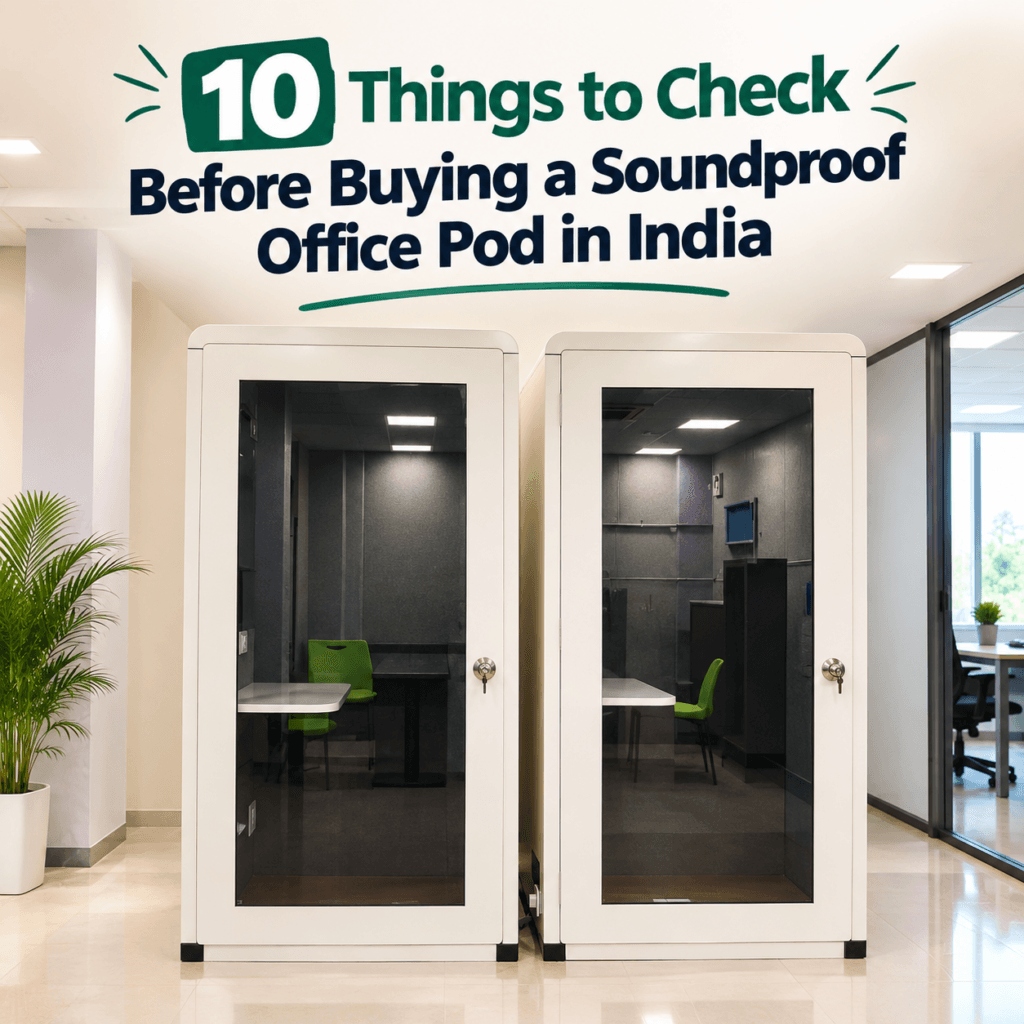
10 Things to Check Before Buying a Soundproof Office Pod in India

10 Things to Check Before Buying a Soundproof Office Pod in India

Buying a soundproof office pod is a bigger decision than most furniture purchases it’s closer to buying a small room. With more Indian brands entering the work pod category, it’s easy to get overwhelmed by specs, prices, and marketing claims. Here are the 10 things worth checking carefully before you commit.Why This Purchase Deserves Extra DiligenceUnlike a desk or a chair, a pod is a multi-part structure with electrical components, glazing, insulation, and ventilation systems that all need to work together reliably for years. A mistake here isn’t a minor inconvenience. it can mean an uncomfortable, poorly performing space that gets used less and less until it becomes an expensive storage room. Spending an extra hour comparing specifications before ordering can save months of frustration afterward.1. Actual acoustic performance, not just “soundproof” claims. Every brand says “soundproof,” but ask for the real sound absorption percentage. A quality soundproof office pod should absorb around 80–85% of ambient noise using materials like rockwool insulation. If a seller can’t quote a number, that’s a red flag. Vague marketing language like “ultra-quiet” or “studio-grade” without a supporting figure usually means the manufacturer either doesn’t have the data or doesn’t want to share it.2. Material quality: rockwool and DGU glass. The best-performing vocal booth and office pods use rockwool sound insulation combined with soundproof DGU (double-glazed unit) glass. Cheaper alternatives use basic foam panels that degrade faster and perform worse over time. Foam panels also tend to absorb odours and degrade with humidity, a real concern in much of India’s climate whereas rockwool holds its acoustic performance far longer.3. Ventilation and air conditioning. A pod without proper airflow becomes uncomfortable within 20–30 minutes. Check whether the unit includes a functioning A.C. or ventilation system not just a sealed box with a fan. This matters even more for a work from home pod used for full working days, since anyone spending six or more hours a day inside will notice poor airflow almost immediately, no matter how good the acoustics are.4. Size vs. available space. Most portable office pods fit within 15 sq ft, but measure your actual space, including door clearance and ceiling height, before ordering. A Nano Pod suits tighter apartments, while larger meeting pods need more floor space. It’s worth physically measuring the delivery path too stairwells, lift dimensions, and doorway widths have all caused installation headaches for buyers who only measured the final room.5. Number of occupants needed. Are you buying for solo focus work, calls, or team meetings? A compact phone booth is built for one person, while an enclosed meeting booth supports up to four. Buying the wrong capacity is one of the most common regrets we hear about either a solo user ends up with an oversized, underused pod, or a team crams into something built for one person.6. Delivery and installation support. Pods are heavy, multi-part structures. Confirm whether the price includes home delivery and professional installation, or whether you’ll need to arrange this separately. Check the FAQ page for standard timelines before ordering. Self-assembly is rarely advisable given the weight and precision required for glazing and panel alignment.7. Customisation options. If you need a specific colour, branding, or interior configuration, ask upfront whether customisation is available. Some buyers who purchased a workspace pod were able to get panel finishes and interior layouts adjusted to match their office branding. For corporate buyers especially, matching a pod’s exterior to brand colours or office design language can be the difference between it looking like an integrated fixture versus an obvious add-on.8. Warranty and after-sales support. Ask specifically about warranty coverage on electrical components (lighting, A.C., LAN ports) versus structural elements (panels, glass, frame). After-sales support matters more for pods than most furniture, since repairs often require specialised parts. A generic furniture warranty that doesn’t distinguish between these categories is a sign the seller may not be equipped to service the product long-term.9. Pricing transparency. Pod prices in India typically start around ₹69,999–₹99,999 for base models, with configuration, customisation, and delivery location affecting the final cost. Get an itemised quote rather than a single bundled number, and compare it against similar listings in the shop. An itemised quote also makes it far easier to see exactly what you’re paying extra for delivery, installation, customisation rather than guessing at what’s included.10. Real customer reviews and installations. Marketing photos rarely tell the full story. Look for real installation photos in a gallery, and read reviews from actual buyers — voice artists, remote workers, and businesses — rather than relying on product page copy alone. Reviews from buyers with a similar use case to yours (a voice artist, a remote employee, a facilities manager) will tell you far more than a generic five-star rating.A Quick Buyer’s Checklist by Use CaseSolo focused work at home: Office Pods for Home or a Nano PodPrivate calls in an open office: Compact Phone Booth PodTeam discussions: Enclosed Meeting Booth or Portable Meeting PodVoice recording or podcasting: Modular Vocal Recording Booth or Dubbing Artist Studio PodGeneral office privacy: Office Booths and PodsCategories Worth Browsing Before You DecideRather than settling on the first product page you land on, compare across categories: Work Pod, Phone Booth, Meeting Pod, and Vocal Booth. Each is engineered slightly differently for its primary use case, and browsing all four often clarifies which configuration actually matches your daily routine.Common Mistakes First-Time Buyers MakeBeyond the ten checkpoints above, a few patterns show up repeatedly among first-time buyers: choosing based on price alone without checking acoustic specs, underestimating how much daily use time the pod will get (and therefore skimping on ventilation), and failing to plan for the delivery path into the building. Each of these is avoidable with the checklist above, but they’re worth calling out specifically because they’re the mistakes that turn up most often in after-sales conversations. FAQs 1. What should I check before buying a soundproof office pod in India?Check acoustic performance, insulation materials, ventilation, pod size, occupant capacity, installation support, customisation options,…

10 Things to Check Before Buying a Soundproof Office Pod in India Read More »
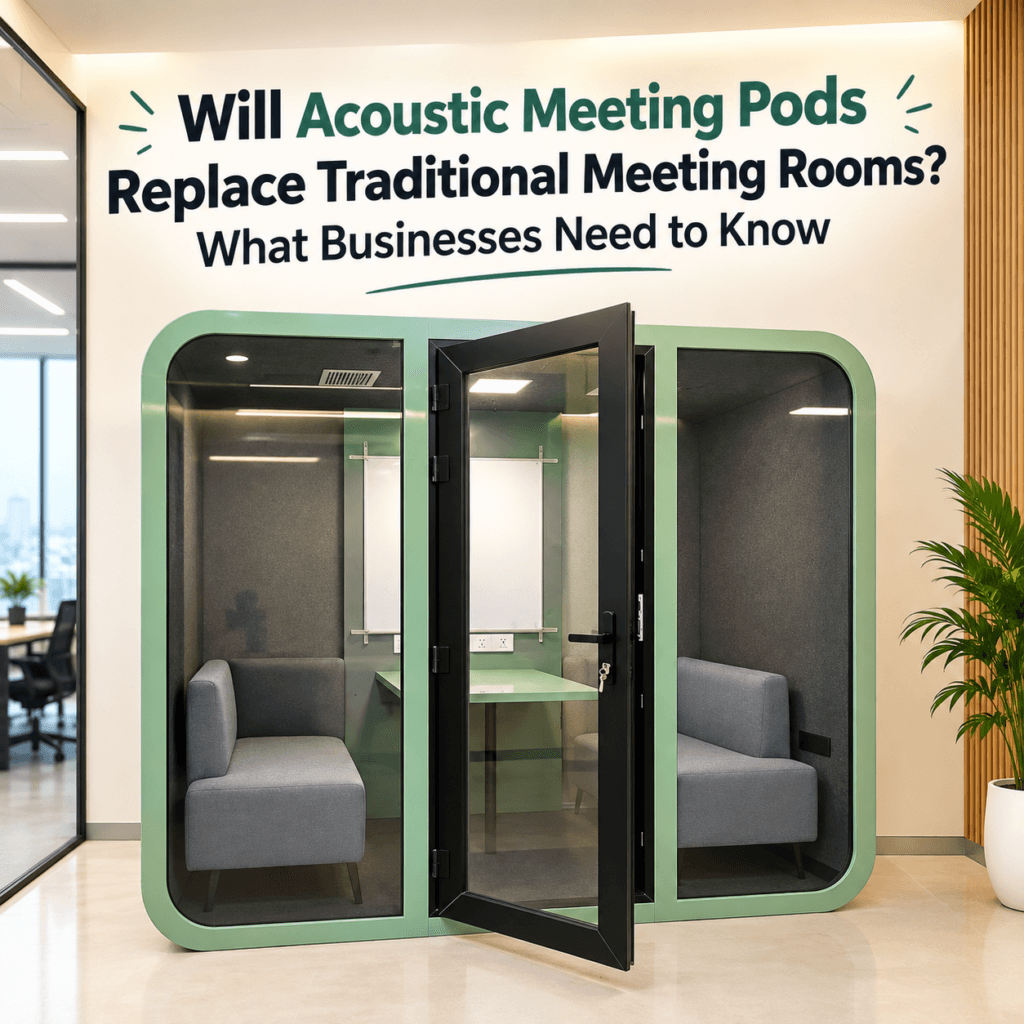
Will Acoustic Meeting Pods Replace Traditional Meeting Rooms? What Businesses Need to Know

Will Acoustic Meeting Pods Replace Traditional Meeting Rooms? What Businesses Need to Know

Every facilities manager has faced the same problem: too many meetings, not enough meeting rooms. As offices shrink and hybrid work grows, businesses are increasingly turning to the acoustic meeting pod as a faster, cheaper alternative to building new conference rooms. But does that mean traditional meeting rooms are on their way out? Here’s an honest look at where pods win, where rooms still make sense, and how to decide for your own office.Why This Question Keeps Coming UpOffice space planning has changed dramatically over the last few years. Headcounts fluctuate quarter to quarter, hybrid schedules mean occupancy is unpredictable day to day, and the cost of unused square footage has become impossible to ignore. Traditional meeting rooms were designed for a world where everyone came into the office five days a week and meeting demand was relatively stable. That world doesn’t exist for most companies anymore, which is exactly why pods have moved from a novelty to a serious line item in office planning budgets.The Case for Acoustic Meeting PodsSpeed of Deployment. A meeting pod can be installed in days, not months. Unlike a conventional meeting room, there’s no need for construction permits, drywall, or electrical rewiring in most cases. A portable meeting pod can even be relocated if your office layout changes. For facilities teams under pressure to solve a meeting room shortage quickly, this speed alone often settles the decision, a construction project measured in months simply can’t compete with a pod that’s operational the same week it arrives.Lower Cost Per Square Foot. Building a soundproofed conference room from scratch involves acoustic treatment, HVAC extension, and dedicated wiring costs that add up quickly. An enclosed meeting booth arrives pre-engineered with acoustic panels, ventilation, and power outlets already integrated, often at a fraction of the cost. When you factor in architect fees, permits, and the opportunity cost of space sitting unusable during construction, the gap widens even further in the pod’s favour.Flexibility for Hybrid Teams. Hybrid offices rarely need the same number of meeting rooms every day. A work pod setup lets facilities teams add capacity incrementally one pod this quarter, two more next quarter rather than over-building a fixed number of rooms upfront. This incremental approach matters enormously for budget planning, since it converts what used to be a large, irreversible capital decision into a series of smaller, reversible ones.Better Acoustic Performance in Open Offices. Ironically, many traditional meeting rooms in open-plan offices weren’t designed with real acoustic isolation in mind just glass walls and a door. A properly built acoustic meeting pod using rockwool insulation and soundproof glazing often outperforms a converted glass-walled room. Anyone who has sat in a glass-walled “quiet room” and still heard every word of the conversation happening outside it knows exactly how common this problem is.Where Traditional Meeting Rooms Still WinCapacity for Large Groups. Most pods, including our enclosed meeting booth, are designed for up to four people. For all-hands meetings, board sessions, or large client presentations, a traditional room remains necessary. No amount of pod flexibility solves the physical constraint of needing to seat fifteen or twenty people in one space.Permanent AV Infrastructure. Rooms with built-in large-screen displays, dedicated conferencing hardware, and fixed seating still make sense for spaces used the same way every day. If a room hosts the same recurring leadership sync every week with the same AV setup, there’s little reason to disrupt that with a smaller, more flexible format.Long-Term Fixed Departments. If a department has a stable headcount and predictable meeting patterns, a permanent room can sometimes be more cost-effective over a 5–10 year horizon than multiple pods. Pods shine in unpredictability; fixed, high-utilisation spaces don’t have that variable to solve for.The Realistic Answer: A Hybrid ModelMost businesses we work with don’t fully replace meeting rooms. they supplement them. A typical modern floor plan now includes 1–2 large traditional meeting rooms for big groups, several meeting pods for 2–4 person discussions, multiple phone booths for one-person calls, and a few flexible work pods for solo focus work. Businesses moving toward this model typically start with a portable meeting pod, test usage patterns for a month, then scale.This staged approach also reduces risk. Rather than guessing at the right room-to-pod ratio for an entire office redesign, companies get real usage data from a single pod before committing budget to a larger rollout, a far more defensible approach when justifying spend to finance or leadership.What to Consider Before SwitchingMeasure actual usage patterns. Track how many meetings are 1:1, small-group, or large-group. If 70% of your meetings involve two to four people, pods will likely deliver better ROI than an equivalent number of traditional rooms. Most calendar and room-booking software can generate this data without any additional tooling, it’s simply a matter of pulling the report and looking at it honestly.Consider acoustic ratings, not just appearance. Not all “soundproof” pods perform equally. Ask about sound absorption percentages Kraft-Obench pods, for instance, absorb up to 85% of ambient noise, a meaningful benchmark to compare against. A pod that looks sleek in marketing photos but underperforms acoustically will undermine the entire point of the purchase.Plan for power and ventilation. Even portable options like the portable meeting pod need reliable power access and airflow. Confirm this during office planning, not after installation. A pod installed without adequate ventilation becomes uncomfortable within half an hour, which quietly kills adoption no matter how good the acoustics are.Think about employee experience. Pods can feel more private and less intimidating than a glass-walled room in the middle of an open office useful for sensitive one-on-ones or HR conversations. This is a softer benefit than cost or speed, but it consistently shows up in employee feedback once pods are in daily use.Where Vocal and Phone Booths Fit InMeeting pods aren’t the only category worth considering. If your team also needs private space for solo calls, a compact phone booth solves a different problem than a meeting pod. And for content or media teams, a vocal recording…

Will Acoustic Meeting Pods Replace Traditional Meeting Rooms? What Businesses Need to Know Read More »

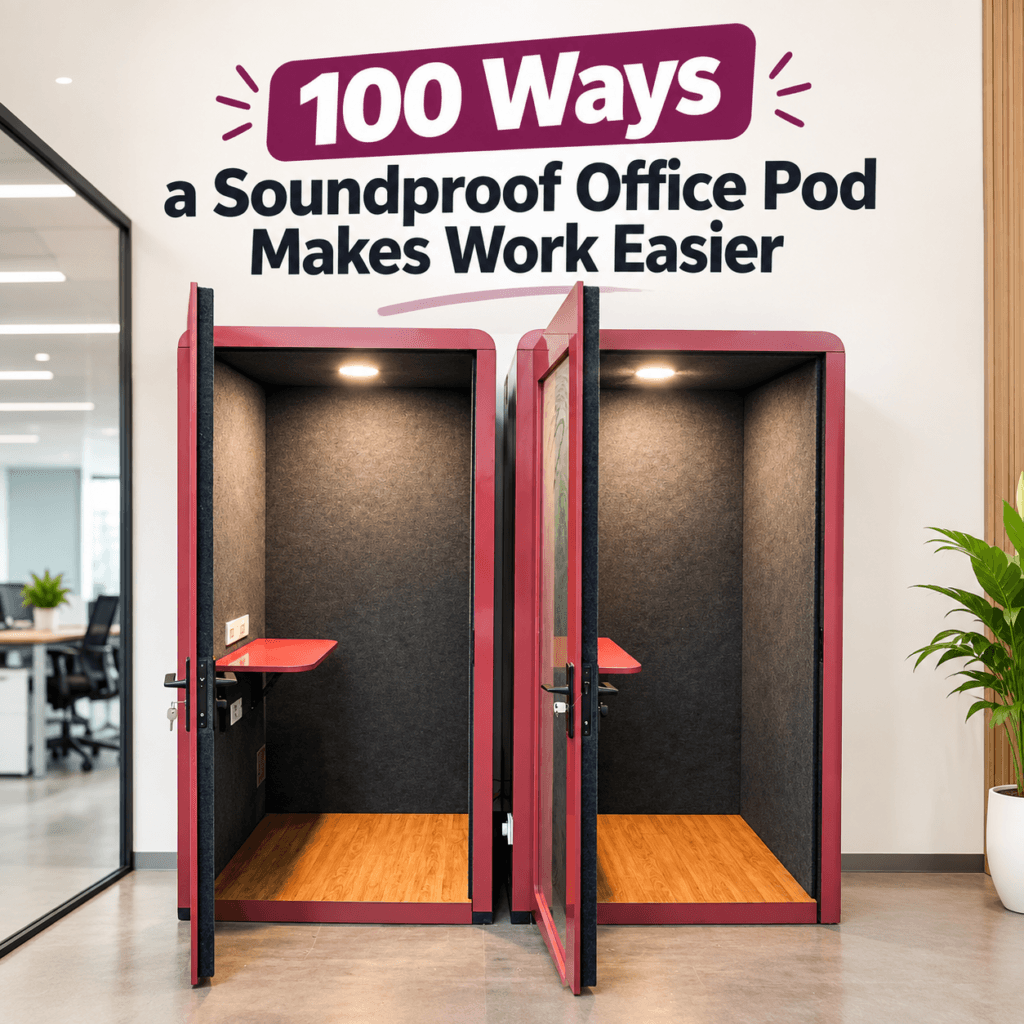
100 Ways a Soundproof Office Pod Makes Work Easier

100 Ways a Soundproof Office Pod Makes Work Easier

A soundproof office pod sounds like a single-purpose product until you actually own one then you realise it quietly rewires almost every part of your workday. What starts as “a quiet place to take calls” ends up handling client meetings, focused deep work, podcast recording, therapy sessions, and even the occasional power nap. We put together 100 real ways professionals use their work pod, grouped into five categories, based on patterns we see across home offices, coworking spaces, and corporate installs.The list below isn’t theoretical. It’s drawn from actual usage logs, customer interviews, and installation feedback across hundreds of pods from a single Nano Pod in a one-bedroom apartment to multi-pod corporate rollouts. What you’ll notice as you read through it is that no two owners use their pod the same way. A freelance voice artist and a finance director might buy the exact same model and end up using it for completely different reasons within the first month.Why One Product Ends Up Doing So MuchMost furniture is single-purpose. A desk is for working, a chair is for sitting, a filing cabinet is for storing documents. A soundproof office pod breaks that pattern because it isn’t really “furniture” in the traditional sense — it’s a controlled environment. Once you have a space that reliably blocks out noise, gives you privacy, and includes power, lighting, and ventilation, you start bringing every task that benefits from those three things into the pod. That’s why the list below spans everything from HR conversations to vocal warm-ups.Focus & Deep Work (1–20)Blocking out kitchen and household noise during work from home hoursCreating a dedicated “focus zone” separate from your bedroom or living roomReducing traffic and construction noise from outsideSignalling to family members that you’re “at work,” not availableImproving concentration during writing or coding sessionsReducing eye strain with adjustable smart lightingGiving your brain a consistent cue that it’s time to workCutting down on multitasking triggered by visual clutterCreating an ergonomic setup with a proper chair and foldable tableReducing fatigue from noise-induced stress over long daysMaking early-morning or late-night work sessions less disruptive to familyAllowing uninterrupted studying for exams or certificationsSupporting freelancers who bill by focused hoursGiving students a quiet space for online classesReducing the urge to check phones triggered by ambient noiseImproving memory retention during reading-heavy tasksEnabling “flow state” work sessions without external triggersCreating a psychological boundary for work-life balanceReducing decision fatigue by having one dedicated workspaceMaking the portable office pod a permanent productivity ritualDeep work is where most owners first notice the return on investment. Remote workers consistently report that the biggest productivity killer isn’t a single loud interruption — it’s the constant, low-level awareness of household noise: a dishwasher running, someone on a call in the next room, a delivery at the door. A pod removes that background hum entirely, which lets your brain settle into sustained concentration faster and stay there longer. Many owners also describe a psychological effect that goes beyond acoustics — stepping into the pod becomes a ritual that tells the brain “it’s time to work” the same way putting on running shoes signals “it’s time to exercise.”Calls & Meetings (21–40)Taking client calls without background noise apologiesHosting video interviews with a clean, professional backdropRunning one-on-one performance reviews privatelyMaking sales calls with better vocal clarityJoining town halls without shushing the householdRecording internal training calls with a compact phone boothTaking HR or legal calls that require confidentialityReducing “can you repeat that?” moments on ZoomHosting podcast-style interviews for internal commsRunning vendor negotiation calls privatelyMaking international calls without time-zone household disruptionHosting webinars from a controlled acoustic spaceUsing a portable meeting pod in coworking spaces for client meetingsConducting exit interviews discreetlyTaking emergency calls without disturbing the open officeRunning quick stand-ups in an acoustic meeting podHosting board-level video calls with visual privacyRecording voice memos for meeting minutesPractising presentations aloud before the real thingDoing mock interviews for job seekersThis is the category most businesses associate with pods first, and for good reason — video calls have become the default meeting format, and audio quality is now judged as closely as content. A clean, echo-free background says more about professionalism than most people realise. Sales teams in particular report that call clarity directly affects how prospects perceive credibility, especially on calls where trust needs to be built quickly. For confidential conversations — HR matters, legal calls, performance reviews — a pod offers something an open office glass room can’t: true acoustic isolation, not just visual privacy.Privacy & Confidentiality (41–55)Reviewing sensitive financial documents away from prying eyesDiscussing salary or compensation matters privatelyHandling legal contracts without interruptionProtecting client data during screen-sharesTaking therapy or counselling sessions onlineManaging HR grievance conversationsReviewing performance data without office visibilityConducting internal audits confidentiallyHandling recruitment calls discreetlyWorking on unreleased product plans securelyTaking personal medical consultations during work hoursReviewing legal case files in a meeting podDiscussing M&A or investment matters privatelyProtecting IP discussions from open-plan eavesdroppingRunning compliance training sessionsConfidentiality is often the least anticipated benefit and the one that ends up mattering most once a pod is installed. Open-plan offices were designed for collaboration, not privacy, which creates constant friction whenever a conversation needs to be genuinely confidential. Legal, HR, and compliance teams in particular gravitate toward booking pods for exactly this reason — not because they need soundproofing for noise, but because sensitive conversations require a space where nothing leaks past the walls, literally or figuratively. Even individual employees find themselves booking a pod for a personal medical call or salary conversation they’d never want overheard in an open office.Content Creation & Recording (56–75)Recording podcasts inside a vocal recording podProducing voiceovers for ads and explainer videosRecording audiobooks with studio-level clarityDoing ADR and dubbing work in a dubbing artist studio podRecording YouTube voiceovers without room echoPractising singing or vocal warm-ups privatelyHosting live-streamed webinars with clean audioRecording internal e-learning modulesProducing corporate training narrationRecording language-learning contentDoing character voice work for games or animationProducing radio-style ad readsRecording customer testimonial voiceoversEditing audio with reference-quality monitoringPractising public speaking or TEDx-style talksRecording standup comedy sets for reviewProducing meditation or wellness audio contentHosting Twitch…

100 Ways a Soundproof Office Pod Makes Work Easier Read More »

How YouTubers Can Get Studio-Quality Sound at Home with Acoustic Pods

How YouTubers Can Get Studio-Quality Sound at Home with Acoustic Pods

India’s content creator economy has grown at a pace few industries can match, and with that growth has come a quieter but equally important shift: audience expectations around production quality. Viewers scroll past videos with noisy, echo-filled audio in seconds, no matter how good the content is. For a growing number of creators, acoustic recording pods have become as essential to a home setup as the camera or the ring light.Why Creators Need Acoustic PodsBackground noise is one of the top complaints in creator content. Traffic outside a window, a ceiling fan, an air conditioner, family members moving around the house none of it is dramatic on its own, but all of it shows up on a microphone far more than the human ear notices in the moment. A vocal pod is built specifically to cut this out at the source, rather than relying on post-production noise reduction that degrades voice quality.Home environments rarely offer studio-level sound isolation. Most creators whether based in Delhi, Mumbai, or Chennai are recording out of a bedroom, spare room, or a corner of an apartment. Renting a professional studio for every session isn’t realistic for most channels, especially those posting multiple times a week.Portable pods allow recording without permanent room conversion. Converting an entire room into a soundproofed studio means foam panels, bass traps, and often structural changes — expensive, semi-permanent, and a problem if the creator ever moves. A portable pod delivers the same core benefit without any of that commitment.Key Features for Content CreatorsStrong sound isolation for clean voice recording, which matters more for a creator than almost any other feature audio quality is what separates amateur content from professional-feeling content.Enough interior space for camera and lighting setups, since most creators aren’t just recording audio they’re filming talking-head videos, tutorials, or podcast-style video content that needs room for equipment.Ventilation for longer recording sessions, since a sealed acoustic space without airflow becomes uncomfortable fast, especially during multi-take recording sessions or long-form podcast episodes.Portability, in case the creator relocates or wants to move the pod between a home studio setup and a different room.Kraft-Obench’s Vocal Booth range is purpose-built for this designed for voice-over artists, musicians, and creators who need superior noise isolation and a professional recording environment on demand, without booking studio time.What Kind of Creator Benefits MostYouTubers and video creators recording talking-head content, tutorials, or reviews who need both clean audio and enough space for a basic camera and lighting rig.Podcasters, where consistent, echo-free audio across every episode is non-negotiable for retaining an audience.Voice-over artists, who often need the highest level of acoustic isolation since their entire output is audio-only.Musicians and singers, recording vocals or scratch tracks at home before finishing production in a professional studio.Streamers and live-content creators, who need predictable, repeatable audio quality every single session, not just for pre-recorded content.Setting Up a Pod at HomeOne of the biggest advantages of a portable pod over a DIY foam-panel setup is that it works in any room shape or size a spare bedroom, a corner of a living room, even a balcony space in some configurations. This matters in Indian cities where apartment sizes are often tighter than what a “home studio” concept assumes, particularly in metros like Hyderabad, Pune, and Kolkata, where creators are frequently working out of compact flats.Creators who are still testing whether a dedicated recording setup is worth the investment for instance, someone early in their channel growth can also look at rental options before committing to a full purchase.Why Audio Quality Outweighs Video Quality More Often Than Creators ExpectMost new creators over-invest in camera gear and under-invest in audio a pattern that shows up consistently in viewer drop-off data across platforms. Viewers tend to forgive a slightly soft picture; they rarely forgive audio that’s echoey, muffled, or full of background noise, because it’s tiring to listen to in a way that’s hard to consciously articulate but easy to feel within the first few seconds of a video. A dedicated acoustic pod is, in that sense, one of the highest-leverage upgrades a growing channel can make, often ahead of a camera or lighting upgrade.What to Check Before You BuyAcoustic isolation rating, since this is the single most important spec for anyone recording voice content professionally.Interior dimensions, especially if you plan to record video with camera and lighting equipment inside, not just audio.Ventilation and noise from internal fans or vents, since a pod with a noisy internal fan defeats part of the purpose.Material quality, particularly Rockwool insulation and soundproof glazing, which are widely regarded as the best combination for both sound absorption and interior comfort.Portability, if you expect to move homes or reconfigure your recording space in the next year or two. Frequently Asked QuestionsQ: Can acoustic pods handle both video and audio recording? Yes pods can accommodate cameras, ring lights, and microphones alongside the acoustic treatment, making them suitable for both audio-only and video-based content creation.Q: Are these pods suitable for daily content creation use? Yes, they’re built for regular, sustained use in home studio setups, unlike temporary DIY solutions that tend to degrade with frequent use.Q: How much outside noise does a vocal booth actually block? Portable vocal booths aren’t fully soundproof but can absorb up to roughly 85% of external sound, which is enough to create a genuinely high-intensity noise-canceling space for most recording needs.Q: What’s the difference between a vocal booth and a general work pod? A vocal booth is specifically engineered for audio clarity and recording privacy, while a general work pod is built for versatility across calls, meetings, and focused work creators specifically benefit from the vocal booth’s audio-first design.Q: Are vocal booths worth the investment for a growing channel? Yes, audio quality is one of the most common reasons viewers drop off early in a video, and consistent, clean sound is one of the more cost-effective production upgrades a creator can make.Real Creators, Real ResultsKraft-Obench’s vocal booths have been used by voice-over artists, YouTubers, and musicians across the country for…

How YouTubers Can Get Studio-Quality Sound at Home with Acoustic Pods Read More »

Soundproof Study Pods for Students in India | Kraft-Obench

How Students in Shared Apartments Can Get a Quiet Space to Study

Anyone who has lived in a shared apartment or a PG during exam season knows the problem well: the roommate on a video call, the kitchen noise drifting through a thin wall, the neighbour’s TV at full volume during the exact hour you need to concentrate. Students living in shared apartments or PGs across student hubs like Pune, Bangalore, and Kota-adjacent hostels in Jaipur often struggle to find quiet space for focused study, especially during exams or online classes. A soundproof study pod is a surprisingly practical fix — one that doesn’t require negotiating for a bigger room or moving apartments altogether.Why Students Need Study PodsShared living spaces rarely offer true quiet. Even a well-behaved flat has multiple people with different schedules — someone’s always cooking, calling, or watching something, and thin walls mean none of it stays contained. A dedicated study pod solves this without requiring every roommate to change their habits.Online classes and exams require stable, distraction-free environments. Since the shift to hybrid and online learning, students are expected to attend live classes, take proctored exams, and sit for video interviews — all of which demand a controlled environment that a shared living room simply can’t guarantee. Background noise during a proctored exam can even trigger flags in some exam-monitoring software, making acoustic control a practical necessity, not just a comfort.Compact pods fit even small shared rooms. This is the detail that makes the difference for students specifically — unlike an office work pod, a study pod needs to work inside a bedroom that might already be shared with another person, so footprint matters enormously.Key Features for Student UseBudget-friendly, single-person sizing students don’t need the multi-person footprint of a corporate meeting pod; a compact Nano Pod is usually the right fit.Good ventilation for extended study sessions, since students may spend several hours at a stretch inside during exam preparation.Simple, sturdy construction suited to shared housing, where the pod might move between rooms or get used by more than one flatmate.Quick setup, since most students are renting rather than owning the property and need something that installs without any structural changes to the flat.Where a Study Pod Makes the Most SensePG accommodations, where residents typically share a room and have no private study space at all.Shared 2BHK or 3BHK flats, common in cities with large student and young-professional populations, where a pod placed in a living room or unused corner benefits everyone in the flat.Hostel common areas, if institutions want to offer a shared quiet-study amenity rather than equipping every room individually.Exam season setups, where even a temporary or rented pod can make a measurable difference during a few critical weeks of preparation.The Real Cost of Not Having Quiet SpaceIt’s easy to underestimate how much lost focus actually costs a student over a semester. Constant interruptions don’t just waste the interrupted minute they add the extra time it takes to re-focus afterward, which studies on deep work consistently show can run into several extra minutes per interruption. Multiply that across a single evening of studying in a noisy shared flat, and the lost time adds up to something far more significant than the cost of a compact pod. Many students end up paying for a café seat, a co-working day-pass, or a library membership just to get a few uninterrupted hours — recurring costs that a one-time or rented pod setup can often undercut over a semester.Renting vs Buying: What Makes Sense for StudentsGiven that most students are in a city temporarily for a degree, an internship, or a work assignment a full purchase isn’t always practical. This is exactly the situation Kraft-Obench’s rental options are designed for: short-to-medium-term access to a study pod without the commitment of ownership, which works particularly well for students who know their lease (and their need for the pod) has a defined end date.For PG and hostel operators, on the other hand, an outright purchase often makes more sense, since the pod becomes a shared, long-term amenity that helps differentiate the property much like how co-living operators are already using work pods to attract residents.What to Check Before You Buy or RentFootprint confirm the pod fits the actual room dimensions before committing, especially in compact PG rooms.Noise isolation level, particularly important if the flat is on a busy street or near a construction site.Rental flexibility, if the plan is to use the pod only through a semester or exam season.Portability, in case the student moves flats or cities mid-course, which is common during internships and placement seasons.Ventilation and lighting, since long study sessions demand comfort, not just quiet.Frequently Asked QuestionsQ: Are study pods affordable for student budgets? Compact, entry-level pods are priced accessibly compared to renting additional private space, and rental plans make them even more accessible for shorter-term needs like a single semester or exam season.Q: Can a study pod fit in a small PG room? Yes, single-person pods typically require under 15 sq ft, which is small enough to fit into most PG rooms or a corner of a shared flat.Q: Is a study pod useful outside of exam season too? Yes, beyond exams, students increasingly need quiet space for online classes, interviews, group project calls, and focused assignment work throughout the year.Q: Can multiple students in a shared flat use the same pod? Yes, most study pods are built for single-person use at a time, but flatmates typically share access on a schedule, similar to how a shared kitchen or bathroom is managed.Q: Do PG or hostel operators buy these, or do individual students? Both happen individual students often rent a pod for a semester, while PG and hostel operators increasingly purchase pods outright as a shared amenity to attract residents, similar to the trend seen in co-living properties. See Real SetupsKraft-Obench has installed compact pods in homes, shared flats, and institutional settings across India, including cities like Lucknow, Kochi, and Vadodara. Browse real installations in our gallery, and if you’re weighing a study pod against a broader work-from-home…

How Students in Shared Apartments Can Get a Quiet Space to Study Read More »

Office Pods for Co-Living Spaces India

Why Co-Living Spaces Are Adding Office Pods And How They Work

Co-living has grown fast across Indian metros — Bangalore, Pune, Gurgaon, and Noida in particular — as young professionals trade long commutes and expensive one-bedroom rentals for shared, amenity-rich properties. But there’s a gap most co-living operators eventually run into: residents increasingly work from home, at least part of the week, and shared common areas simply aren’t built for focused work or private calls. That’s why more operators are adding office pods for co-living spaces instead of trying to solve the problem with bigger private rooms.Why Co-Living Operators Are Adding PodsResidents increasingly expect work-ready amenities. The profile of a typical co-living resident has shifted — many are working professionals or freelancers who need somewhere quiet to take a client call, not just a bed and a common kitchen. Properties that can’t offer this are quietly losing out to ones that can.Shared common areas are often too noisy for calls. Lounges, dining areas, and rooftop hangouts are designed for socialising, which is exactly what makes them unsuitable for a focused video call or deep work session. Residents end up either working from their bedroom cramped and not designed for it or leaving the property altogether to find a café or co-working space.Pods differentiate premium co-living properties from basic ones. In a crowded market, the amenities a property offers matter as much as the rent it charges. A dedicated work pod or phone booth is a visible, tangible amenity that shows up well in listing photos and resident reviews and it’s the kind of feature that gets mentioned in word-of-mouth referrals.Where Pods Work Best in a Co-Living PropertyCommon lounges and shared work areas, where a single pod can absorb overflow demand during peak WFH hours.Rooftop or terrace zones, with weatherproofing considered for outdoor placement a popular spot in properties across Chennai and Hyderabad.Dedicated “focus zones” within larger properties, positioned away from high-traffic common areas so residents can genuinely concentrate.Co-working corners near reception, giving new residents an immediate sense of the property’s work-friendly positioning during a site tour.Choosing the Right Pod for a Co-Living SetupUnlike a corporate office, a co-living property has to think about shared, high-frequency use across many different residents rather than a single team. That changes what matters most:Durability under continuous, varied use the pod needs to hold up to multiple residents cycling through it every day, not the lighter use pattern of a single-owner office.Simple, intuitive design, since residents won’t get an onboarding session on how to use the amenity.A booking-friendly footprint, so pods can be paired with scheduling systems without needing a dedicated staff member to manage access.A compact size that works within shared lounges the Nano Pod is a strong fit for single-person calls, while the Work Pod range suits residents who need longer, focused work sessions.For operators wanting to test the concept before rolling it out across multiple properties, rental options are worth exploring a lower-commitment way to gauge resident demand before a larger investment.The Business Case for OperatorsAdding a pod isn’t just about resident satisfaction it’s a retention and pricing lever. Co-living operators compete heavily on amenities, and “private workspace” is increasingly a line item residents actively search for when comparing properties, alongside gym access and food service. A single pod placed in a common area can serve dozens of residents across a day without requiring the operator to sacrifice an entire room that could otherwise be rented out.There’s also a simple math argument. Converting even one small bedroom into a dedicated “business centre” removes that unit from the rentable inventory entirely a real, recurring revenue cost. A pod placed in an already-shared common area adds the amenity without touching rentable square footage, which is exactly the trade-off most co-living operators are looking for.What Residents Actually Say They WantAsk co-living residents what would make them stay longer at a property, and “somewhere quiet to take a call” comes up more often than operators expect right alongside food quality and Wi-Fi speed. It’s a small, unglamorous amenity compared to a rooftop lounge or a gym, but it’s also one of the few that directly affects whether a resident can actually get their workday done from the property, which matters enormously for the working-professional segment co-living properties increasingly compete for.What to Check Before You BuyUsage capacity how many residents realistically need this amenity, and does one pod cover peak demand or are two needed?Placement flexibility can the pod be moved between properties or relocated within a property as usage patterns change?Maintenance requirements, since shared amenities see heavier wear than a single-owner office pod.Booking integration, if the property already uses an app or system for managing shared resources.Weatherproofing, if the intended placement is a terrace or semi-outdoor common area.Frequently Asked QuestionsQ: How many pods should a co-living property with 50 residents have? A common starting ratio is one to two pods per 20–25 residents, based on expected usage, though this varies with how many residents are working professionals versus students.Q: Can pods be booked or scheduled by residents? Yes, many operators pair pods with simple booking systems for fair access, similar to how gyms or common-area amenities are typically managed.Q: Are pods suitable for outdoor or semi-outdoor placement, like a terrace? Yes, with appropriate weatherproofing this is a popular option for properties that want to make use of rooftop or terrace common areas.Q: Do pods require ongoing maintenance in a high-traffic shared setting? Minimal, the construction is designed for durability, though operators should factor in periodic checks on ventilation and lighting given the higher frequency of use compared to a single-owner office.Q: Can the same pod work for both calls and focused solo work? Yes, most co-living operators use the same pod interchangeably for private calls, video meetings, and quiet work sessions, since the core need (privacy and quiet) is the same across all three.Real Installations Across IndiaKraft-Obench has installed work pods and phone booths in corporate, co-working, and residential settings across cities including Thane, Mysore, and Visakhapatnam see completed projects in our gallery. If you’re exploring…

Why Co-Living Spaces Are Adding Office Pods And How They Work Read More »

Private Patient Counselling Pods for Hospitals India

How Hospitals Are Using Private Patient Counselling Pods to Protect Patient Privacy

Healthcare settings are under growing pressure to offer genuinely private spaces for patient counselling, sensitive diagnosis conversations, and a rising volume of telemedicine consultations all without the time and cost of new construction. Most Indian hospitals, whether a large multi-specialty campus in Mumbai or a mid-size facility in Indore, simply weren’t built with this level of privacy in mind. Corridors, waiting areas, and nursing stations were designed for throughput, not confidential conversation. That’s exactly the gap private patient counselling pods are built to close.Why Hospitals Need Private PodsPatient privacy is both a compliance and a trust requirement. A patient receiving a difficult diagnosis, discussing a mental health concern, or going through pre-surgical counselling needs to know the conversation isn’t audible to the person in the next chair. This isn’t just about comfort it directly affects how much a patient is willing to disclose, which in turn affects the quality of care they receive.Hospital space is expensive and almost always fully utilised. Unlike a corporate office, a hospital rarely has a spare room sitting empty that can be converted into a counselling suite. Every square foot is already earmarked for beds, equipment, or patient flow. A compact acoustic pod solves this without touching the existing floor plan.Telemedicine consultations require quiet, controlled environments. As more hospitals including facilities in Chennai, Ahmedabad, and Vadodara add video consultation as a standard offering, doctors need a dedicated space with stable acoustics and lighting, not a shared staff room with background noise.Key Requirements for Healthcare EnvironmentsHospitals have needs that differ meaningfully from a typical corporate office, so it’s worth being specific about what to look for:Easy-to-clean, hygienic surface materials. Surfaces need to withstand frequent disinfection without degrading a non-negotiable in any clinical environment.Strong acoustic isolation for sensitive conversations around diagnosis, mental health, or end-of-life care.A compact footprint that fits within existing hospital corridors, waiting areas, or repurposed alcoves without requiring structural change.Good ventilation, since counselling sessions and telemedicine calls often run longer than a typical phone call.Simple, durable construction that can handle continuous use across shifts, unlike furniture designed for occasional office use.For hospitals evaluating options, the Meeting Pod range works well for family counselling sessions involving more than one person, while a single-doctor telemedicine station is often better served by a compact Nano Pod or Phone Booth.Where Pods Work Best in a Hospital SettingOutpatient corridors, where a quick, private conversation is needed before or after a consultation.Waiting areas, repurposed with a single pod so patients don’t need to be walked to a separate wing for a private discussion.Nursing stations, for staff conducting sensitive follow-up calls with patients or families.Administrative wings, where telemedicine consultations are increasingly being centralised.Facilities across Surat, Kochi, and Nagpur have started adopting this same approach treating acoustic pods as clinical infrastructure rather than office furniture, which reflects a broader shift in how healthcare facilities are thinking about space.Why Construction Isn’t the Right Answer HereBuilding a dedicated counselling room in a hospital involves far more friction than in a typical office: infection-control protocols, disruption to patient flow, and the simple fact that hospitals rarely have downtime to accommodate weeks of construction. A pre-built, modular pod sidesteps all of this. It arrives finished, is installed in hours rather than weeks, and can be repositioned if the hospital’s layout changes something a fixed wall simply cannot do.There’s also a cost dimension worth flagging. A full room conversion means new walls, a door, electrical work, and finishing a project that can run into weeks of planning and approvals in a live clinical facility. A modular pod compresses all of that into a single delivery and setup, which matters enormously when hospital administrators are trying to solve a privacy gap without pulling staff or space away from patient care for an extended period.The Patient Experience AngleIt’s worth pausing on why this matters beyond compliance. Patients who feel overheard during a diagnosis conversation are measurably less forthcoming with details that affect their own care they may downplay symptoms, skip questions they’d otherwise ask, or rush through a conversation they’d rather not have in a semi-public space. A private pod removes that hesitation almost entirely, simply by giving the patient visible, physical confirmation that the conversation is contained. For hospital administrators focused on patient satisfaction scores, this is a low-cost intervention with an outsized effect on how care is experienced, not just delivered.What to Check Before You BuyMaterial hygiene certification. Confirm the pod’s surfaces are rated for the kind of repeated cleaning a clinical environment demands.Acoustic performance data. Ask for actual sound-isolation figures rather than general claims.Ventilation specifications, since patients and doctors may spend extended periods inside during counselling sessions.Size options, matched to whether the pod will host one-on-one consultations, family counselling, or telemedicine calls.Installation logistics, especially in a live hospital where corridors and access points are tightly controlled.Hospitals unsure about committing to a full purchase can also explore rental options to trial a pod in a single ward before a facility-wide rollout.Frequently Asked QuestionsQ: Can pods be installed within existing hospital floor plans? Yes, their compact, modular design allows placement in corridors, waiting areas, or repurposed spaces without any structural work.Q: Are the materials used hygienic and easy to maintain? Yes. Surfaces are selected for easy cleaning and durability in high-traffic healthcare settings, which is essential given how frequently these spaces are used across a hospital day.Q: Can a single pod support telemedicine video calls? Yes, compact single-person pods provide the quiet, controlled lighting and stable acoustics that video consultations need.Q: How many pods does a mid-size hospital typically need? This depends on patient volume and the number of departments running counselling or telemedicine sessions, but most facilities start with two or three pods placed near high-traffic outpatient areas and expand from there.Q: Can pods be relocated if the hospital’s layout changes? Yes, this is one of the biggest advantages over a built room. A pod can be moved to a different wing or floor as the hospital’s needs evolve.See It in ActionKraft-Obench has installed acoustic pods…

How Hospitals Are Using Private Patient Counselling Pods to Protect Patient Privacy Read More »

soundproof meeting pods for law firms

Why Law Firms Need Soundproof Meeting Pods for Confidential Client Meetings

Client confidentiality isn’t a nice-to-have for a law firm it’s the foundation the entire practice is built on. Attorney-client privilege only means something if the conversation actually stays private, and that’s exactly where most modern legal offices fall short. Open floor plans, glass-walled cabins, and shared conference rooms look impressive on a website, but they rarely deliver the acoustic privacy a real client conversation needs. This is where soundproof meeting pods for law firms have quietly become one of the fastest-growing categories of office infrastructure across Indian legal practices.If you run a law office in Delhi, a chamber in Mumbai, or a growing litigation team in Bangalore, you’ve probably already felt this problem first-hand: a client walks in for a sensitive consultation, and the only “private” space available is a meeting room with glass walls and a door that doesn’t quite seal sound. An acoustic meeting pod solves this in a way that renovation simply can’t no construction, no downtime, no waiting on a contractor’s schedule.Why Law Firms Specifically Need Acoustic PodsAttorney-client privilege requires genuinely private conversations. This is a professional and, in many cases, an ethical obligation not a preference. A client discussing a divorce, a criminal matter, or a high-value commercial dispute needs to know their voice isn’t traveling past the cabin door. Standard drywall partitions and glass cabins were never designed with acoustic isolation in mind; they were designed to look good in a floor plan.Client-facing spaces need a professional, polished appearance. Every client who walks into your office is silently evaluating whether this firm is credible enough to handle their case. A meeting pod with clean finishes does double duty it protects the conversation and it signals that the firm invests in doing things properly.Growing firms need flexible meeting infrastructure without construction delays. Law firms scale unevenly. You might add three associates and a partner in a single quarter, and suddenly you’re short two private meeting spaces. Traditional construction means weeks of disruption; a portable work pod or meeting pod can be installed in a day.Key Features Legal Practices Should Look ForHigh acoustic isolation sound-dampened panels and sealed glazing so conversations stay contained, even in an open-plan office.Professional finishes that match the firm’s branding and interior design, from wood-tone panels to muted, corporate colour palettes.Comfortable seating for longer client meetings, deposition prep, or multi-hour negotiation sessions.Good ventilation and lighting, since client meetings in a law firm often run well past the length of a typical phone call.A compact, non-disruptive footprint, so the pod fits into an existing floor plan — a corner of a cabin, a corridor nook, or a section of the reception area — without a redesign.For solo practitioners or smaller chambers where every square foot matters, a Nano Pod can work well for one-on-one client calls, while growing firms with regular in-person client meetings usually gravitate toward the Meeting Pod range, which comfortably seats a client and one or two associates.Where Pods Fit Best in a Law OfficeMost firms don’t have the luxury of redesigning their entire office around privacy. That’s the real advantage of a pod-based approach it drops into the floor plan you already have.Reception areas, for the initial consultation before a client is walked back to a partner’s cabin.Open-plan associate bays, where junior lawyers need somewhere private to take a client call without booking a full conference room.Corridors and underused corners, which a fixed cabin could never use but a compact phone booth can.Shared workspaces or co-working chambers, common in cities like Pune, Gurgaon, and Noida, where independent lawyers rent a desk but still need private client-facing infrastructure.A Quick Look at ROIRenovating a cabin for better sound insulation typically means new drywall, acoustic treatment, a new door, and days of disruption to a live office easily a multi-week project with real cost uncertainty. A portable pod arrives pre-built, is installed in hours, and can be relocated if the firm moves offices or restructures its floor plan. For firms in expansion mode say, a practice adding a second office in Chandigarh or Hyderabad that portability matters more than it seems on paper.There’s also a client-perception dividend that’s harder to put a number on but easy to notice in practice. Clients discussing sensitive matters — custody arrangements, financial disputes, criminal defence — are more forthcoming and more comfortable when they can see, physically, that the room is designed to contain sound. That translates into better information for the lawyer and a smoother case overall.What to Check Before You BuyAcoustic rating. Ask for sound transmission figures, not just marketing language like “soundproof.” Reputable manufacturers will share how much external noise the pod actually blocks.Materials and hygiene. Legal offices see a steady flow of visitors, so surfaces should be easy to wipe down and maintain.Size versus use case. A pod for solo calls doesn’t need to be the same size as one meant for client consultations with two or three lawyers present.Installation timeline. Confirm delivery and setup windows, especially if you’re opening a new branch or relocating.After-sales support. Ventilation, lighting, and electrical fittings inside a pod need occasional servicing check what’s covered.If you’re comparing pod types, it’s worth browsing the full work pod and meeting pod ranges side by side, and if budget is a concern before a longer-term purchase decision, rental options are also available useful for firms testing whether pods fit their workflow before committing to a full office-wide rollout.Frequently Asked QuestionsQ: Are pods secure enough for confidential legal discussions? Yes. With proper acoustic insulation, conversations are effectively contained within the pod, which is exactly why acoustic pods have become a practical alternative to constructing a fully soundproofed cabin.Q: Can pods be customised to match a law firm’s office aesthetic? Yes — finishes and colours can be tailored to your firm’s branding, so the pod feels like a natural extension of the office rather than an add-on.Q: How long does installation take? Unlike a construction-based renovation, most pods are installed within a day, with minimal disruption to an active office.Q: Can…

Why Law Firms Need Soundproof Meeting Pods for Confidential Client Meetings Read More »

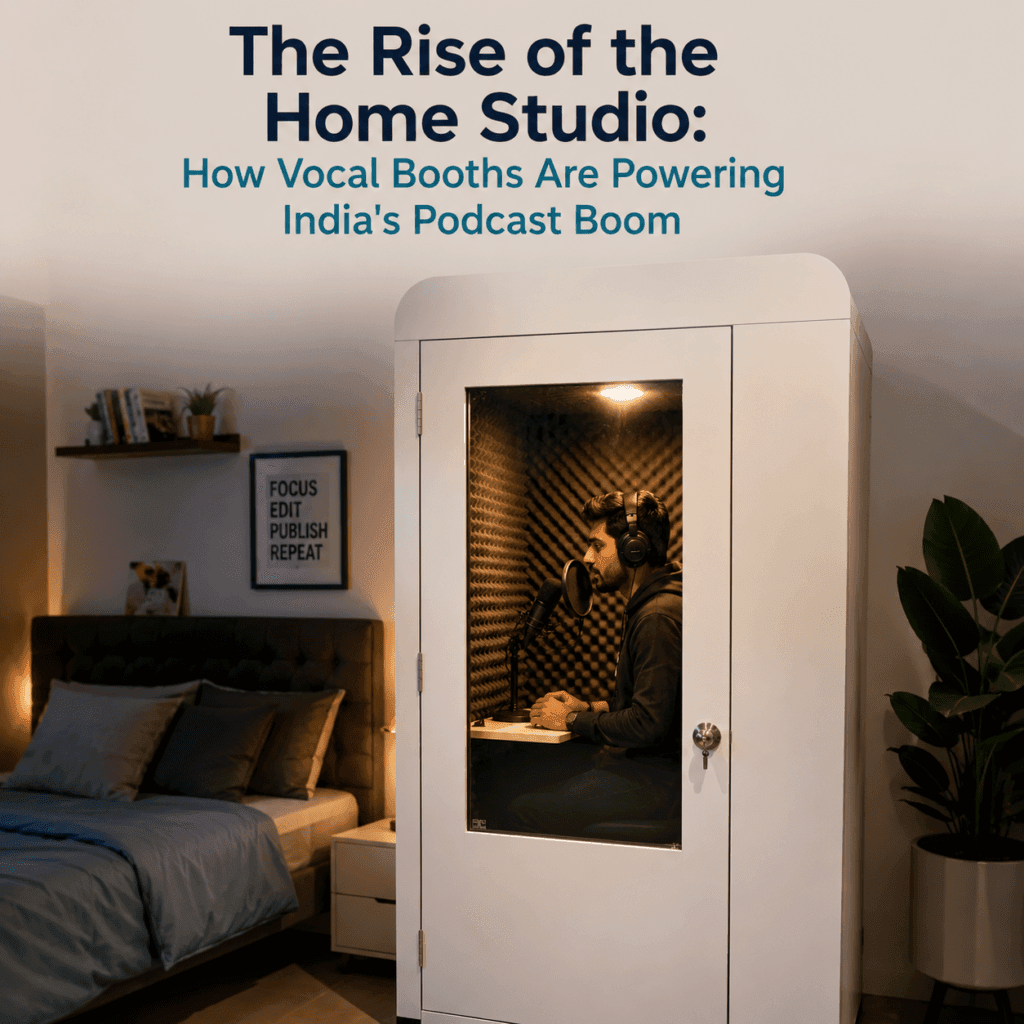
The Rise of the Home Studio: How Vocal Booths Are Powering India's Podcast Boom

The Rise of the Home Studio: How Vocal Booths Are Powering India’s Podcast Boom

A few years ago, starting a podcast in India usually meant borrowing time in a rented studio, working around someone else’s schedule, and paying by the hour for a space that may or may not have had decent acoustics. Today, a growing number of podcasters, voice-over artists, and content creators are recording entirely from home and doing it at a quality level that would have required a professional studio not long ago. The single biggest reason for this shift isn’t a change in microphones or software. It’s the arrival of affordable, compact vocal booths that bring studio-grade acoustics into a bedroom, a spare corner, or even a small apartment.Why Home Recording Used to Be So HardAnyone who has tried recording audio at home without proper treatment knows the problem immediately: rooms are not built for sound. Hard walls, bare floors, and large windows all reflect sound rather than absorbing it, creating echo and reverb that make even a decent microphone sound amateurish. On top of that, most homes are full of ambient noise traffic outside, an air conditioner humming, a neighbour’s television, a family member’s footsteps upstairs all of which a sensitive microphone picks up far more than the human ear notices in the moment.This left creators with a narrow set of options: invest heavily in treating an entire room with foam panels and bass traps, rent studio time by the hour, or simply accept lower audio quality and hope listeners wouldn’t mind. None of these were great long-term solutions for someone recording regularly.What Changed: Purpose-Built Portable BoothsThe alternative that’s changed the equation is the portable vocal booth a self-contained, acoustically treated enclosure that can be set up in an existing room without renovating it. Instead of treating an entire bedroom or living room, a creator treats a much smaller volume of space specifically designed for sound isolation, which is both cheaper and far more effective per square foot.A few features make this approach work particularly well for podcasters and voice artists:Acoustic foam interiors that actually do their job. Rather than generic foam stuck to a wall, a properly designed portable vocal booth uses foam specifically arranged to minimise reflections and capture clean, dry vocals the kind of sound that doesn’t need heavy post-production editing to sound professional.No permanent installation required. Many portable sound booths are designed for quick setup with no tools or complex assembly, which matters enormously for renters, creators who move frequently, or anyone who doesn’t want to commit to permanently altering a room.Genuine noise isolation, not just noise reduction. A soundproof vocal session booth is built to block external noise rather than simply dampen echo within the room meaning traffic, air conditioning, and household activity stay outside the recording.Options built for singers, voice artists, and podcasters specifically. Products like the personal vocal booth for singers and voice artists are designed around the specific acoustic needs of vocal performance, rather than being a generic quiet box.Why Podcasting Specifically BenefitsPodcasting has a particular set of demands that make a dedicated vocal booth especially valuable, more so than for some other kinds of recording.1. Long Recording SessionsA podcast episode often runs 30 to 90 minutes, sometimes longer with multiple guests. Unlike a quick voiceover, there’s no room for a stray noise to force a re-take halfway through every interruption means editing around it or, worse, re-recording an entire section. A properly isolated booth removes this risk almost entirely.2. Consistency Across EpisodesListeners notice inconsistency. If one episode sounds crisp and another has noticeable room echo because it was recorded in a different part of the house, it affects the show’s perceived quality. A dedicated vocal booth for home studios ensures every episode is recorded in the same acoustic environment, which keeps sound quality consistent from episode to episode.3. Multiple Voices, One SetupMany Indian podcasts feature co-hosts or recurring guests, often recording remotely and mixing tracks together in post-production. When each person records with the same level of acoustic isolation, mixing becomes far easier there’s no fighting to match the “roominess” of one track against the cleanliness of another.4. Apartment Living RealitiesA large share of India’s podcast creators record from apartments, where full-room acoustic treatment isn’t practical or even permitted by building rules. A soundproof vocal booth for apartments is specifically designed for this constraint — compact enough to fit in a bedroom or a spare corner, without any need for renovation or permanent fixtures.Beyond Podcasting: Voiceover, Music, and Content CreationWhile podcasting is a major driver of this trend, the same booths serve a much wider range of creators:Voiceover artists recording commercial, e-learning, or audiobook content benefit from the clean, echo-free capture a home vocal booth with acoustic panels provides, without the recurring cost of studio rental.Musicians tracking vocals or scratch takes at home get a controlled environment through a properly built portable vocal booth, useful for demoing ideas before a full studio session.YouTube creators recording voiceovers for videos often cite exactly this improvement — cleaner audio recorded in a small dedicated space rather than a noisy, echo-prone room.Corporate content teams producing internal training videos or narration increasingly use the same acoustics booth technology originally designed for office privacy, repurposed for clean audio capture.Choosing the Right Booth for Your SetupNot every creator needs the same size or type of booth, and picking the wrong one is a common early mistake. A few practical questions help narrow it down:How much space is actually available? A creator working from a shared apartment bedroom has very different constraints than someone with a spare room to dedicate entirely to recording. For the former, a compact option built specifically for tight spaces, like the soundproof vocal booth for apartments, tends to be the more realistic starting point.Is the booth staying put, or does it need to travel? Creators who record on location, at events, or in hotel rooms while travelling benefit more from something explicitly designed for portability, such as the ultimate portable sound booth for creators, rather than a bulkier fixed installation.What’s actually being…

The Rise of the Home Studio: How Vocal Booths Are Powering India’s Podcast Boom Read More »

Acoustic Pods: The Fix for Failing Open-Plan Offices

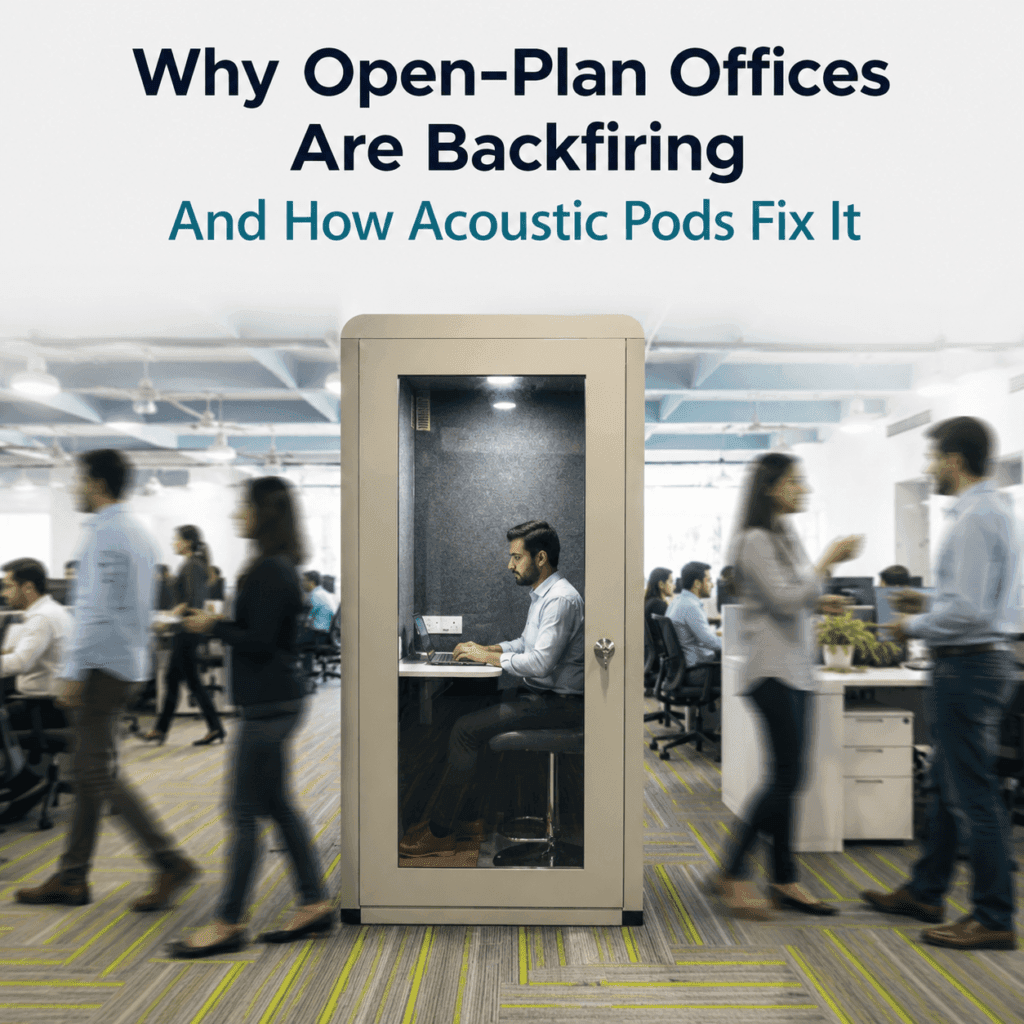
Why Open-Plan Offices Are Backfiring And How Acoustic Pods Fix It

Open-plan offices were supposed to be the future. Knock down the cubicle walls, put everyone in one shared space, and collaboration would flourish. For a while, it seemed to work or at least, it looked good in photos and made for a compelling pitch to prospective hires. Years later, the evidence tells a more complicated story: open-plan layouts, in practice, often reduce the very collaboration they were designed to encourage, while making noise, privacy, and focus significantly worse.This isn’t a case against openness or collaboration. It’s a case for rethinking how offices handle the two things open-plan layouts consistently fail to provide: acoustic privacy and a place to concentrate. That’s exactly the gap acoustic pods are built to close.The Open-Plan Promise vs. The Open-Plan RealityThe theory behind open-plan design was straightforward: remove physical barriers, and people will talk to each other more, share ideas more freely, and build a stronger team culture. In practice, several things went differently than expected.1. People Don’t Talk More They WithdrawMultiple workplace studies have found that when physical walls come down, employees don’t necessarily have more spontaneous conversations. Instead, many retreat into headphones, messaging apps, and email effectively rebuilding privacy digitally because the physical environment no longer offers any. The intended collaboration boost often doesn’t materialise, while the downsides of noise and distraction very much do.2. Noise Becomes the Default BackgroundWithout walls or partitions to absorb and block sound, every conversation, call, and keyboard click travels across the entire floor. Even normal-volume conversations become a constant hum that never fully goes away. For employees doing focused, detail-oriented work, this background noise is a continuous tax on concentration.3. Confidential Conversations Have Nowhere to GoPerformance reviews, HR matters, client negotiations, salary discussions none of these belong in a space where anyone walking by can hear them. Open offices routinely force these conversations into stairwells, parking lots, or awkwardly quiet corners, undermining the professionalism the meeting actually requires.4. “Quiet Zones” Rarely Stay QuietMany open-plan offices try to designate certain areas as quiet or focus zones. In practice, these zones are hard to enforce without physical boundaries someone eventually takes a call there, or a quick conversation turns into a ten-minute discussion, and the zone stops functioning as intended.5. The Cost Shows Up in Retention, Not Just ProductivityBeyond the obvious productivity hit, constant noise and lack of privacy contribute to stress and job dissatisfaction over time. Employees who feel like they can never get a moment of quiet or privacy at work are more likely to disengage a cost that rarely shows up on a spreadsheet until it becomes a retention problem.6. Open-Plan’s Popularity Was Partly About Cost, Not Just CultureIt’s worth being honest about one more factor: open-plan offices weren’t only adopted because companies believed in collaboration. They were also, quite simply, cheaper to build and easier to reconfigure than a floor full of individual offices. That cost advantage is real and worth preserving which is exactly why the fix for open-plan’s downsides shouldn’t mean abandoning the format entirely, but rather adding privacy back in a way that doesn’t sacrifice that original cost efficiency. This is part of why the same modular approach has spread to offices in markets like Visakhapatnam as well as larger metros it solves the problem without undoing the economics that made open-plan attractive in the first place.Why the Fix Isn’t Going Back to CubiclesIt would be easy to conclude that the solution is simply reversing course building walls again, going back to individual offices. But that throws away the genuine benefits open-plan layouts do offer: flexibility, natural light, easier team visibility, and lower long-term construction costs. The smarter fix isn’t abandoning open-plan design it’s adding targeted, modular privacy back into it, exactly where it’s needed, without rebuilding the whole floor.This is where acoustic pods come in. Rather than choosing between “fully open” and “fully closed,” pods let a company keep the open floor plan’s benefits while adding pockets of acoustic privacy wherever the team actually needs them.How Acoustic Pods Actually Solve the ProblemThey block sound in both directions. A well-engineered acoustics booth is built with high-density acoustic panels specifically designed to stop sound from leaking in or out. This means a confidential call inside the pod stays confidential, and the rest of the floor doesn’t have to hear it either.They create real focus zones, not aspirational ones. Unlike a “quiet corner” that depends on people’s goodwill, a physical work pod enforces its own boundary. Once the door is closed, the outside noise genuinely drops no policing required.They’re sized for how people actually work. Most workplace interactions are one-on-one or small-group, not full-team meetings. A compact phone booth suits a quick call, while a meeting pod covers small-group discussions matching the space to the actual need rather than forcing every interaction into either a desk or a large conference room.They install without disrupting the open floor plan. Because pods are prefabricated, they don’t require construction. A structured installation process covering floor space, ceiling height, and power routing — typically gets a pod fully operational within hours, without shutting down the surrounding office.They can be redistributed as needs change. If one team grows and another shrinks, pods can move with them. This modularity is something permanent walls simply can’t offer, and it matters enormously in offices where headcount and team structure shift regularly.What This Looks Like in PracticePicture a typical open-plan floor with fifty desks and two large conference rooms. Instead of trying to solve every privacy and noise problem by scheduling around those two rooms, a company can distribute several smaller pods across the floor:A few phone booths placed near clusters of desks, for quick calls that don’t need a full meeting roomA couple of meeting pods for small-group discussions that don’t require the big conference roomsOne or two nano pods tucked into underused corners, for solo focus work or confidential conversationsThis distributed approach solves the noise and privacy problem at the point where it actually occurs near people’s desks rather than centralising…

Why Open-Plan Offices Are Backfiring And How Acoustic Pods Fix It Read More »

Kraft-Obench · Vocal Booth Rentals
Soundproof Vocal Booths for Rent

Noise-free calls, focused work & a professional recording booth for work from home.

Flat 10% OFF on Rentals⏱ Limited-time offer
  • Professional recording booth
  • Ideal for WFH, meetings & recordings
  • Easy installation & flexible rentals

Available only in Delhi NCR, Mumbai, Chennai, Bengaluru & Hyderabad

Soundproof vocal booth available for rent