
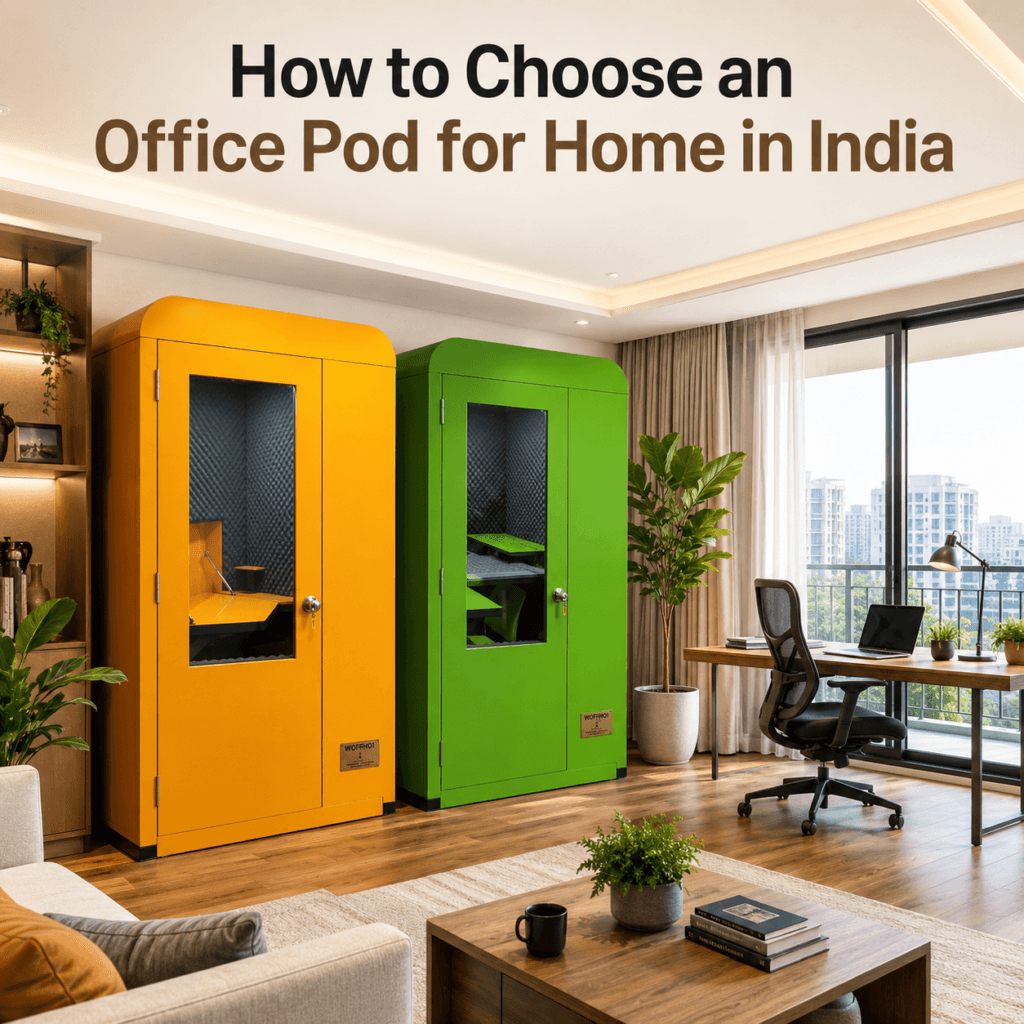
How to Choose the Right Office Pod for Your Home in India
The Indian market for home office pods has grown rapidly. Where two years ago there were almost no options, today there are pods at multiple price points, sizes, and specifications and choosing the wrong one is an expensive mistake.
This guide walks you through the five decisions that matter most, so you buy the right pod the first time.
Why More Indians Are Buying Home Office Pods in 2026
Hybrid and remote work is now the permanent reality for a large portion of India’s professional workforce. IT professionals, consultants, lawyers, designers, educators, and coaches are all spending significant portions of their working week at home and discovering that Indian homes were never designed for this.
The problems are structural. Apartments in Indian cities are dense, noisy, and shared. The work-from-home professional is competing with family noise, construction, traffic, and neighbours. Standard acoustic fixes headphones, closed doors, Do Not Disturb signs work for a while, but they are not sustainable for someone whose livelihood depends on concentration and clear communication.
Office pods solve this at the source. Instead of trying to control an entire home environment, you create a controlled private space inside it. Demand has surged across Delhi, Mumbai, Bangalore, Hyderabad, and Pune and is growing in Tier 2 cities as well.
Step 1: Measure Your Available Space
This is where most people make their first mistake. They find a pod they like online, order it, and then discover it does not fit through their door, cannot fit in the room they planned, or requires ceiling clearance they do not have.
Before you look at any pod specifications, measure the following:
The floor area where you plan to place the pod in square feet. Account for the pod footprint plus at least 60cm clearance on at least two sides for comfortable entry and exit.
The ceiling height of that room. Most pods require a ceiling of at least 230 to 240cm. If you have a low-ceiling room or a mezzanine setup, confirm dimensions before ordering.
The width of your main door, staircase, and any corridors the pod components will need to pass through during delivery. Pod components come in flat-pack sections, but the largest panel sections can be 120cm wide.
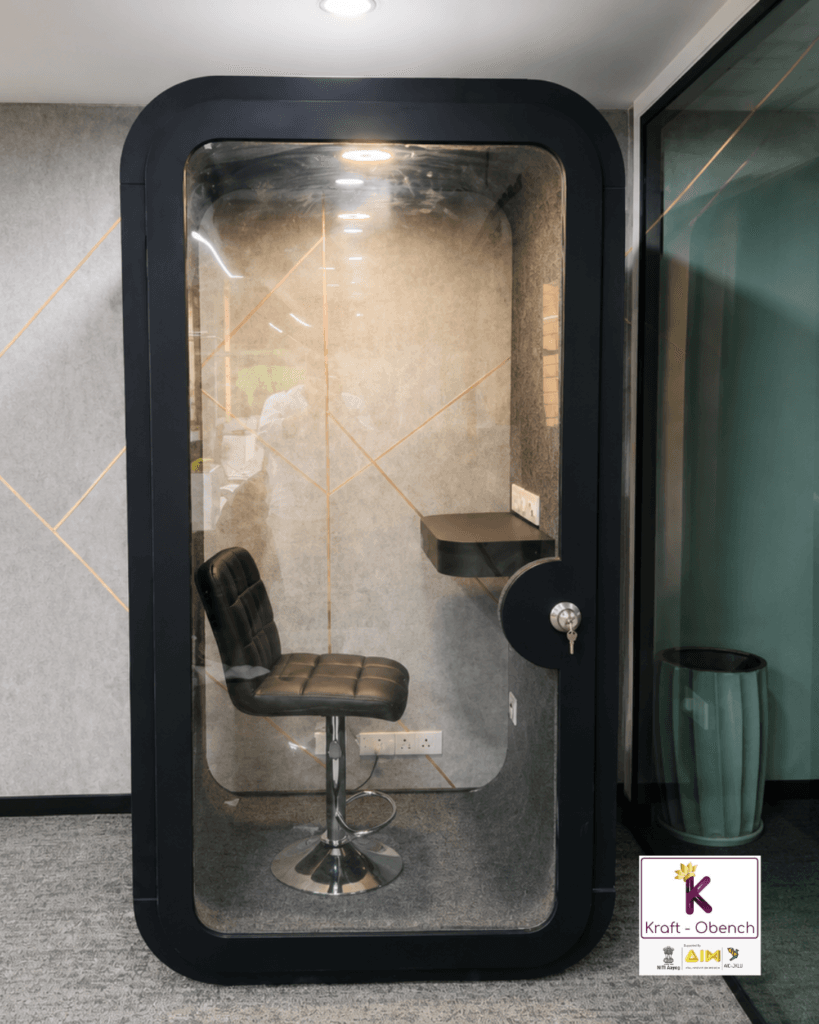
The Kraft-Obench Nano Pod is the most compact option for tight spaces, while the Work Pod suits larger rooms with more space to work with.
Step 2: Understand Soundproofing Ratings (NRC vs STC Explained)
Pods use two key acoustic measurements. Understanding them prevents you from buying based on marketing language rather than actual performance.
STC (Sound Transmission Class) measures how much airborne sound is blocked from passing through the pod walls. A standard interior wall has an STC of around 33 to 40. A quality acoustic pod should achieve STC 30 to 45. The higher the STC, the less outside noise reaches you inside the pod.
NRC (Noise Reduction Coefficient) measures how much sound is absorbed by the internal surfaces rather than reflected. A value of 0 means total reflection, 1.0 means total absorption. For recording and call quality, you want NRC as close to 1.0 as possible inside the pod.
When comparing pods, ask manufacturers for both figures. Vague language like “highly soundproofed” without numbers is a warning sign.
Step 3: Check Ventilation and Comfort Features
A poorly ventilated pod becomes uncomfortable within twenty minutes, especially in Indian summer conditions where ambient temperatures can exceed 35°C.
Look for a built-in ventilation system with at least two air exchange points ideally an inlet and an exhaust fan. The fan should have a noise rating below 35 decibels so it does not appear as background hum in your recordings or calls.
Check whether the pod has interior lighting. Working in a dim pod strains your eyes quickly. LED panel lighting at the right colour temperature (4000K to 5000K for focused work) makes a significant difference to comfort over a long day.
Check the floor. A padded or raised floor is more comfortable for long sitting sessions than a bare wooden panel.
Kraft-Obench pods include ventilation, integrated lighting, and thoughtfully designed interiors these are not afterthoughts in their design.
Step 4: Compare Assembly Requirements
Some pods require two to four people to assemble and take a full day. Others are designed for one to two people and assemble in two to three hours. Before purchasing, ask the manufacturer for a realistic assembly time estimate and whether they provide installation support.
Confirm whether you need any tools beyond what is provided in the kit. Most quality pods include all required hardware and provide clear instruction manuals or video guides.
Ask whether the pod can be disassembled and reassembled if you move. Portability is one of the key advantages of pods over construction but only if the pod is genuinely designed to be moved.
Step 5: Set a Realistic Budget
Home office pods in India range from approximately ₹80,000 for a compact phone booth style pod to ₹3,00,000 or more for a full-size work pod with premium finishes.
Do not fall into the trap of buying the cheapest option available. Very low-cost pods often cut corners on acoustic lining density, ventilation quality, and structural rigidity which means they do not deliver the acoustic performance you are paying for.
Set your budget based on how much of your working day you will spend inside the pod. If it is more than four hours per day, invest in a quality pod with proper ventilation and comfort features. If you are using it primarily for calls two to three per day a more compact option may be sufficient.
Top Questions to Ask Before You Buy
What is the STC and NRC rating of this pod?
Any reputable manufacturer should be able to provide both figures. STC measures how much external noise is blocked, while NRC measures how much sound is absorbed inside the pod. For home office use, look for STC ratings between 30–45 and NRC values close to 1.0 for the best balance of privacy and call quality.
What is the ventilation airflow rate in cubic metres per hour?
Ventilation determines how comfortable the pod remains during long work sessions. A good office pod should continuously refresh air using intake and exhaust fans. Higher airflow rates generally provide better comfort, especially in warmer Indian climates.
What is the warranty on the acoustic lining, ventilation system, and structure?
A quality office pod is a long-term investment. Check whether the manufacturer provides separate warranties for the structural frame, acoustic materials, electrical components, and ventilation system. Comprehensive warranty coverage indicates confidence in product quality.
Does the manufacturer provide assembly support or do I need to arrange this separately?
Some manufacturers include professional installation, while others provide only assembly instructions. Confirm what is included before purchasing, especially if you live in an apartment or need the pod assembled in a difficult-to-access location.
Can I see a showroom or demo unit before purchasing?
Seeing a pod in person helps you evaluate soundproofing, ventilation, comfort, and build quality. If possible, visit a showroom or request a live demonstration before making a final decision.
How much space should I leave around the pod?
Most office pods require additional clearance beyond their footprint. Leave at least 60cm of space around entry points to ensure comfortable access, proper ventilation, and easier maintenance.
Can the pod be moved if I relocate in the future?
Many modern office pods are designed with portability in mind. Ask whether the pod can be disassembled and reassembled without damaging its acoustic performance. This is particularly important for renters and professionals who may move homes in the future.
Is a compact pod enough for my needs?
If you mainly attend video meetings and phone calls, a compact pod such as a single-person work booth may be sufficient. If you spend several hours daily working, recording content, or handling client meetings, a larger pod will provide greater comfort and productivity.
Final Thoughts
Choosing the right home office pod is less about finding the most expensive model and more about matching the pod to your space, work style, and daily usage. By evaluating dimensions, acoustic performance, ventilation, assembly requirements, and budget, you can confidently invest in a solution that improves productivity and creates a professional workspace at home.
Whether you need a compact pod for occasional meetings or a fully equipped workspace for full-time remote work, taking the time to compare specifications now can save significant cost and frustration later.
Need help selecting the right pod? Browse Kraft-Obench Home Work Pods or schedule a showroom visit in Delhi to experience the pods firsthand and get expert recommendations based on your space and requirements.


