Uncategorized

office pod installation

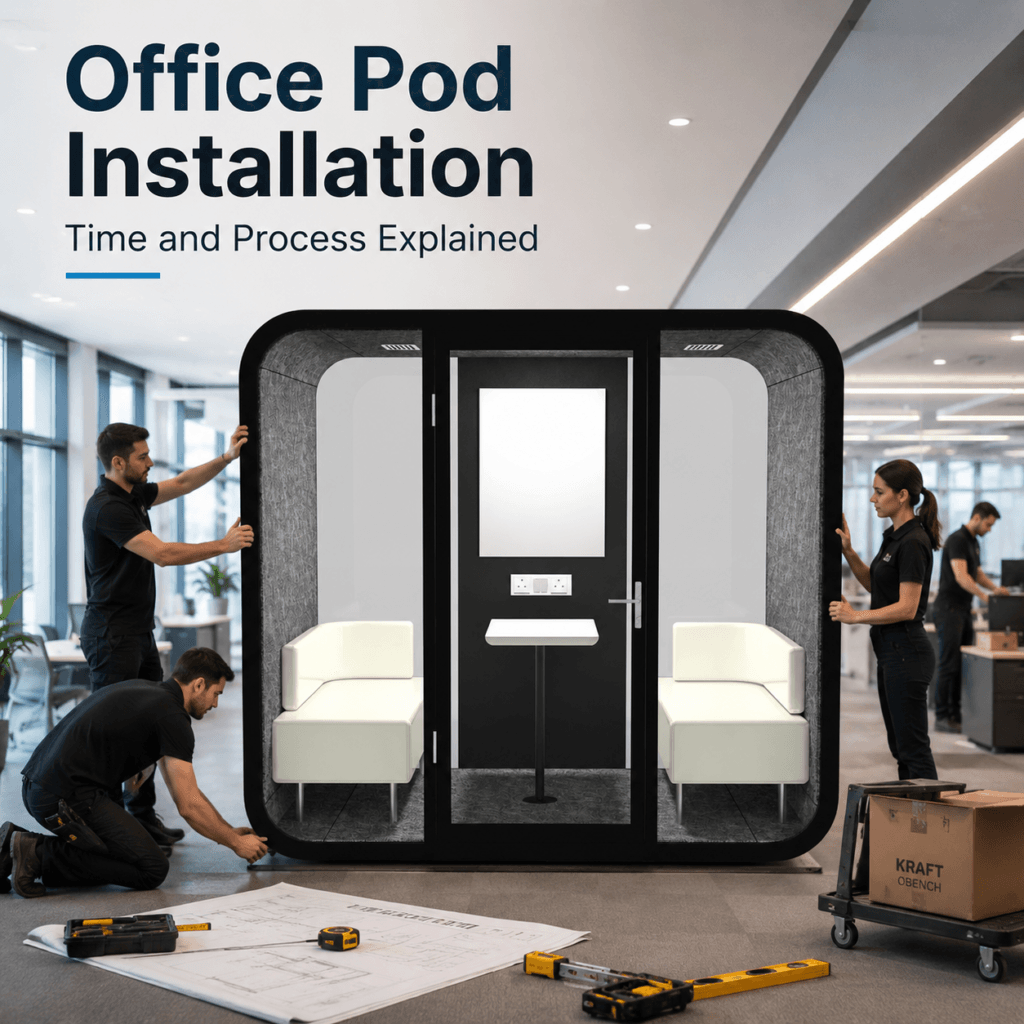
Office Pod Installation Time and Process Explained

One of the most common questions from first-time pod buyers is about installation: how long does it take, what does the process involve, and how disruptive will it be to ongoing office operations? These are entirely reasonable concerns for facilities managers and office operations teams responsible for minimising workplace disruption.The short answer is that most single-person pods install in 4 to 6 hours and a 4-person Meeting Pod takes 6 to 10 hours. The process is clean, quiet, and minimally disruptive fundamentally different from any construction-based workspace improvement. This guide covers every phase of the Kraft-Obench installation process in detail. Explore our full range at Kraft-Obench to understand which model best fits your space before booking.Phase 1: Pre-Installation Site SurveyEvery Kraft-Obench installation begins with a pre-installation site survey conducted by one of our technical team members. This survey assesses floor space and confirms the pod footprint fits within the available zone. Ceiling height is measured and confirmed against the pod’s height specification. Power socket locations are identified and the cable routing plan is confirmed.Freight elevator dimensions are measured to confirm that flat-pack panels can be transported to the installation floor. Building access protocols, contractor registration requirements, and any specific building management requirements are identified and addressed in advance of installation day. This survey applies to all models the Nano Pod, Phone Booth, Work Pod, Meeting Pod, and Vocal Pod.Phase 2: Delivery and Unboxing (1–2 Hours)Pods arrive on installation day in flat-pack panels, carefully protected in transit packaging. No individual panel exceeds 30kg, allowing two-person carrying without mechanical lifting equipment. For upper-floor installations in buildings without freight elevators common in older commercial properties in Delhi and Mumbai our team uses a panel-by-panel manual carry protocol that moves all components to the installation floor efficiently.All panels are placed in sequence within the installation zone before assembly begins. Panel layout is confirmed against the installation plan, and any floor protection sheeting is placed before assembly tools and components are unpacked.Phase 3: Frame Assembly (1–2 Hours)The structural steel frame assembles using a quarter-turn locking cam system no drilling, welding, adhesives, or power tools required. Two technicians work simultaneously from opposite ends of the pod frame, meeting in the middle with precise alignment. The frame is self-squaring by design, eliminating the measurement and shimming work required in traditional construction.This phase is identical in process and duration across all cities and building types whether our teams are working in Bangalore tech campuses, Hyderabad pharmaceutical offices, or Gurgaon financial services towers. The process is quiet enough that adjacent workstations can remain occupied throughout.Phase 4: Panel Installation (1 – 2 Hours)Acoustic panels click or bolt into the structural frame in a defined sequence. Electrical cables route through pre-designed channels built into the panel system no surface-mounted conduit or visible cable management required. The door frame, double-glazed glass panels, and ventilation grilles install last in this phase.Each panel is checked for flush alignment and acoustic seal integrity as it is installed. The installation team works inward from the base panels upward, ensuring that each layer properly seats against the preceding one before proceeding. The acoustic performance of the completed pod is directly dependent on the quality of this sequential assembly process.Phase 5: Electrical and Ventilation Connection (30 – 60 Minutes)The pod’s internal power distribution unit connects to your building’s standard 15A electrical socket via a standard power cable identical to plugging in any office appliance. There is no electrical work required within the building’s fixed wiring. The ventilation system powers on automatically and is verified for airflow rate and noise level.Smart lock or IoT booking systems are paired with the building’s WiFi network during this phase. Facilities teams in Chennai, Noida, and Pune handle the electrical handover as a standard part of the site manager’s installation checklist.Phase 6: Testing and Handover (30 – 45 Minutes)The final phase is a comprehensive functional test before handover to the client. Door seals are checked for full perimeter contact. Ventilation airflow is measured and confirmed. LED lighting is tested across all modes. All power and USB points are tested with live loads. An acoustic attenuation test using a calibrated sound level meter confirms that the pod meets its specified STC rating.All test results are documented in a written handover report provided to the client at handover. This documentation is useful for workplace acoustic compliance audits and insurance purposes. View completed installations in our Gallery and client stories at our Clients page.What to Prepare Before Installation DayEnsuring a smooth, on-time installation requires a few simple preparations from your side. Clear the installation zone of all furniture, equipment, and obstructions. Book the freight elevator for the installation team’s exclusive use during the delivery and assembly window. Confirm that a 15A power socket is available within 3 metres of the installation position. Inform building management of contractor access and provide required documentation in advance.For rental installations, all logistics including building management liaison are managed directly by Kraft-Obench see our Rentals page. To book your installation, contact us at our Contact page.Frequently Asked QuestionsQ1: Can installation happen on a weekend to avoid office disruption? Yes. Kraft-Obench offers weekend installation slots in all major cities. This is popular for corporate offices in Gurgaon and Noida where weekday installation is disruptive.Q2: What tools are required for installation? Kraft-Obench installation teams bring all required tools. For standard models, only Allen keys and a torque wrench are required all provided by our crew.Q3: Can I install a Kraft-Obench pod myself without the installation team? We do not recommend self-installation as it can compromise acoustic seal integrity and void the warranty.Q4: What if my building does not allow external contractors? Kraft-Obench’s installation team can register as authorised service contractors with your building management. Contact our Contact page for contractor registration support.Q5: How far in advance should I book an installation? For major cities including Delhi and Bangalore, installation slots are typically available within 5 to 7 business days. For Tier 2 cities, 7 to 14 days advance booking is recommended.Q6: Can…

Office Pod Installation Time and Process Explained Read More »
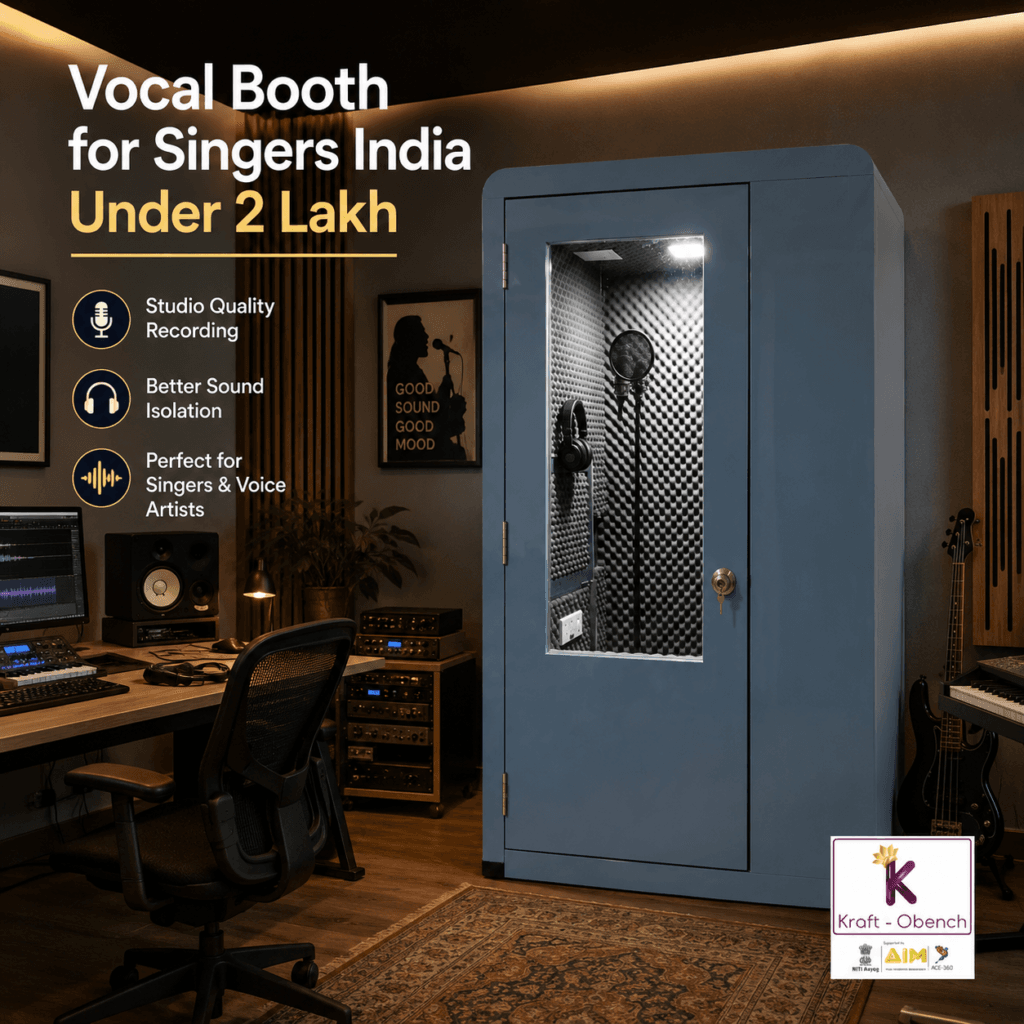
vocal booth for singers

Vocal Booth for Singers India Under 2 Lakh 2026 | Kraft-Obench

The short answer is yes with the right approach, the right materials, and realistic expectations about the acoustic performance ceiling of budget solutions. Whether you are a professional singer, an emerging voice-over artist, a podcaster building your first show, or a content creator who needs broadcast-quality audio on a startup budget, achieving good vocal recording results in India under ₹1 lakh is entirely possible.This guide covers every budget option from zero-cost recording technique improvements to ₹50,000 DIY vocal booth builds, with honest assessments of what each approach delivers acoustically. And when you are ready to upgrade to professional-grade performance, the Kraft-Obench Vocal Pod is India’s most trusted professional solution.Option 1: DIY Wardrobe Vocal Booth (₹20,000 – ₹50,000)A repurposed wardrobe or built-in cupboard lined with Rockwool 60 mineral wool acoustic panels is the most acoustically effective budget vocal recording solution available in India. The wardrobe provides natural parallel-surface irregularity and some mass-based isolation from its walls. Lining the interior surfaces with 4 to 6 inch mineral wool panels at ₹180 to ₹300 per square foot transforms it into a functional recording space.Add a rubber door sweep to the wardrobe door, a cheap LED strip light, a small ventilation gap at the top for passive air exchange, and a microphone stand adapter. Total materials cost: ₹25,000 to ₹50,000 depending on wardrobe size and panel specification. Acoustic performance: approximately NRC 0.60 to 0.70 good for most home recording applications on a budget.Compare this result with the guaranteed NRC 0.90 and STC 38 to 42 of a professional Kraft-Obench Vocal Pod for a clear picture of the performance gap between DIY and professional solutions.Option 2: Portable Desktop Reflection Filter (₹3,000 – ₹15,000)A reflection filter is a curved acoustic shield that mounts on a microphone stand behind and around the microphone, absorbing early reflections from the recording environment before they reach the microphone capsule. Available from major Indian music retailers and on Amazon India, these devices cost ₹3,000 to ₹15,000 and genuinely improve recording quality in reverberant rooms.The critical limitation of reflection filters is that they address internal acoustic reflections but provide zero soundproofing against external noise. A truck passing outside, a neighbour’s television, or a family conversation in an adjacent room will be fully present in your recording regardless of reflection filter quality. For true noise isolation, you need either a DIY booth structure or the Vocal Pod from Kraft-Obench.Option 3: Portable Fabric Recording Enclosure (₹15,000 – ₹40,000)Portable fabric recording enclosures collapsible acoustic tents that the performer stands or sits within during recording create a temporary acoustic environment around the microphone. They fold flat for storage, set up in minutes, and provide meaningful mid and high-frequency absorption.A good-quality fabric enclosure costs ₹15,000 to ₹40,000 and represents a genuine step up from a bare room or reflection filter. For singers in compact apartments in Mumbai and Bangalore who cannot dedicate permanent floor space to a vocal booth, this portability is a significant practical advantage.The Break-Even Case for a Professional Vocal PodFor singers and voice-over artists who record regularly, the financial case for investing in a professional Kraft-Obench Vocal Pod is compelling even when it exceeds the ₹1 lakh budget threshold. At typical Indian professional recording studio rates of ₹2,500 to ₹4,000 per hour including engineer, a singer recording 3 to 4 hours per month spends ₹90,000 to ₹1,92,000 annually on studio time.A Kraft-Obench Vocal Pod at ₹1,50,000 to ₹2,00,000 breaks even in 12 to 18 months. Beyond break-even, it provides unlimited 24×7 recording availability at home with zero marginal cost per session. For professional recording artists and voice-over professionals in Delhi, Hyderabad, Chennai, and Pune, the Vocal Pod is a business investment with a clear and rapid return. Rental options are available at our Rentals page for project-based recording.Recording Technique Tips That Cost NothingSeveral recording technique improvements deliver meaningful quality improvements at zero cost. Record at night when ambient noise levels are lowest in most Indian cities, 11pm to 5am provides a noise floor 15 to 20 dB lower than daytime. Use a cardioid pattern microphone and position it so the null (rear rejection point) faces the noisiest surface in your room.Hang thick duvets or moving blankets around the recording position on temporary stands for additional absorption during sessions. Enable real-time noise reduction monitoring in your DAW to identify and eliminate noise floor issues during recording rather than in post-production. View our Blog for detailed recording technique guides.Frequently Asked QuestionsQ1: What microphone works best inside a budget DIY vocal booth? A cardioid condenser microphone such as the Audio-Technica AT2020 at ₹8,000 to ₹10,000 is the best match for a treated DIY booth.Q2: Is the Kraft-Obench Vocal Pod suitable for recording violin or acoustic guitar? Yes. The Vocal Pod’s acoustic treatment works effectively for acoustic string instruments. For full-band recording, a larger custom acoustic room is required.Q3: Can I use a Vocal Pod for a YouTube or Instagram content creation channel? Absolutely. The Vocal Pod provides professional broadcast acoustics and excellent LED lighting for face-to-camera content. Many Indian content creators in Delhi and Bangalore use Vocal Pods as their content studio.Q4: How much NRC improvement does a DIY wardrobe booth provide vs a professional pod? A well-built DIY wardrobe booth achieves approximately NRC 0.60 to 0.70. A Kraft-Obench Vocal Pod achieves NRC 0.90 — measurably better voice clarity and low-frequency control.Q5: Are there any grants or subsidies in India for home recording studio setup? Some state MSME schemes support creative industry infrastructure. Kraft-Obench provides GST-compliant invoices compatible with government scheme applications.Q6: Can the Vocal Pod handle Tamil, Telugu, or other Indian language recordings? Yes. The Vocal Pod is used for recordings in all Indian languages. Our clients in Chennai and Hyderabad include voice-over artists working across South Indian languages.Q7: Where can I hear what a recording inside a Kraft-Obench Vocal Pod sounds like? Audio samples are available on our website. Contact us at our Contact page to arrange a demonstration at our Delhi or Bangalore showroom.

Vocal Booth for Singers India Under 2 Lakh 2026 | Kraft-Obench Read More »

Acoustic Booth

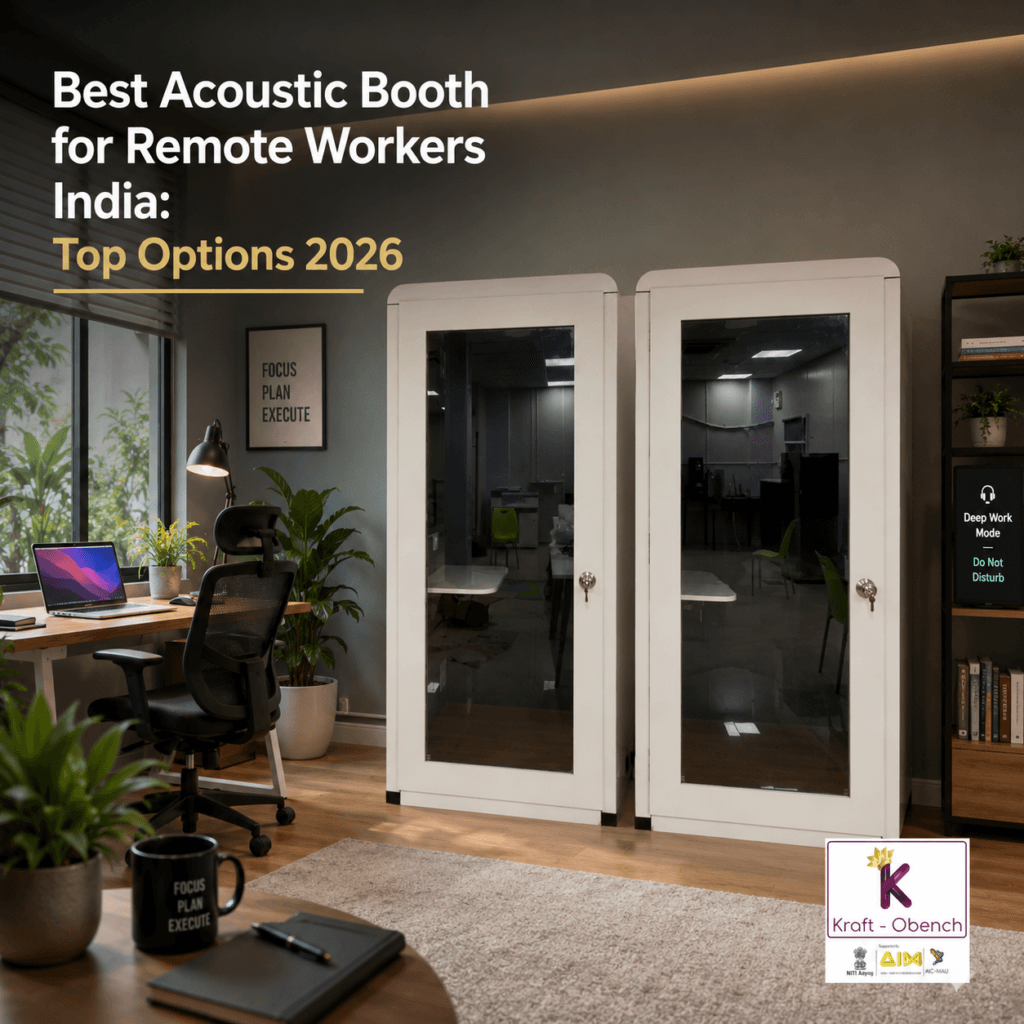
Best Acoustic Booth for Remote Workers India: Top Options 2026

India’s remote workforce has grown to over 15 million full-time remote workers in 2026, representing the largest professionally employed remote population in Asia outside China. This workforce spans technology, finance, consulting, media, education, healthcare administration, and a growing range of knowledge work sectors that have fully embraced location-independent working models.The evolution of this workforce has created a corresponding evolution in home office infrastructure expectations. Early-stage remote workers adapt their dining tables and spare bedrooms. Established remote professionals invest systematically in workspace quality ergonomic furniture, professional monitor setups, and increasingly, acoustic booths that bring corporate-grade call quality and concentration environments into the home. Explore all Kraft-Obench options at Kraft-Obench.What Makes a Great Acoustic Booth for Remote Work?The requirements for an acoustic booth designed for full-time remote professional use are specific and demanding. Silent ventilation operating below 35 dB(A) is essential for both comfort during extended occupancy and call quality. Compact footprint is important for the majority of Indian home layouts where space is at a premium. Easy assembly is relevant for home deliveries where professional installation teams may have limited access. Professional video call background aesthetics matter for client-facing professionals. Moisture resistance is non-negotiable for Indian humidity conditions year-round.All Kraft-Obench products from the Nano Pod to the Work Pod are designed to meet all five of these requirements as standard.Top Option 1: Kraft-Obench Nano Pod – Purpose-Built for Remote WorkThe Nano Pod is purpose-built for the Indian remote professional and has been consistently the top-selling acoustic booth for home office use since its launch. STC 38 acoustic isolation, silent EC fan ventilation, LED lighting with colour temperature control, integrated laptop desk with cable management, and multiple power and USB charging points are all standard.Price in most Indian cities is ₹1,85,000 installed. Customise your Nano Pod using the 3D Configurator at the Nano Pod page before ordering. Personalise the exterior colour, acoustic fabric, desk finish, and LED specification to match your home interior.Top Option 2: Kraft-Obench Phone Booth – Maximum Call QualityThe Phone Booth is the most cost-effective acoustic booth option at ₹1,65,000 installed and delivers the highest STC rating of any compact pod at STC 40. The standing-use design is ideal for call-heavy remote workers in finance, sales, consulting, and client services roles where maximum call quality and a professional presentation environment are the primary requirements.The Phone Booth is also available on rental terms through our Rentals page for remote workers who want to test the acoustic booth experience before committing to purchase. The rental option is particularly popular with workers in Indore and Chandigarh where pod adoption is growing rapidly.Top Option 3: Kraft-Obench Work Pod – For the Senior Remote ProfessionalThe Work Pod is the choice of senior remote professionals who require a fully equipped, ergonomically complete workspace rather than a call pod or compact focus booth. USB-C, HDMI, and 4-gang power as standard. Dimensions of 2.1 metres by 1.4 metres accommodate dual monitors, ergonomic seating, and full desk accessory setups.The Work Pod is ideally suited to remote workers in Gurgaon villa homes and Noida residential developments where sufficient floor space is available for a larger pod footprint. Senior engineers, product directors, financial managers, and legal professionals consistently choose the Work Pod as their home office infrastructure of choice.Top Option 4: Kraft-Obench Meeting Pod – For Remote Team LeadersFor remote team leads, engineering managers, and senior directors who host daily standups, weekly business reviews, and client presentations from home, the Meeting Pod provides the professional 4-person video conference environment that no corner of a living room can replicate.This model is particularly popular with senior managers in Mumbai and Bangalore who are the primary contact point for their organisation’s hybrid teams and need to project professional competence and acoustic quality on every interaction.City-Specific Recommendations for 2026For Bengaluru tech professionals, the Nano Pod at our Bangalore page is the top recommendation. For Mumbai finance professionals, the Work Pod at our Mumbai page is the preferred choice. For Delhi consultants, the Phone Booth at our Delhi page provides the best combination of call quality and footprint. For Chennai IT professionals, the Nano Pod at our Chennai page is the most popular option. For Hyderabad pharma and biotech professionals, the Work Pod at our Hyderabad page is the recommended configuration.Frequently Asked QuestionsQ1: Which pod is best for a remote salesperson making 40+ calls per day? The Phone Booth is ideal. Its standing-use design encourages vocal energy and its STC 40 rating ensures calls are never compromised by household noise.Q2: Can I use a Kraft-Obench pod for online teaching or tutoring? Yes. The Nano Pod is popular with online educators. The LED lighting system provides broadcast-quality illumination for video lessons.Q3: Does the pod stay comfortable for 8-hour working days? Yes. Active ventilation with 6 to 8 air changes per hour maintains CO2 below 800 ppm and temperature within 3°C of ambient throughout full working days.Q4: What is the longest uninterrupted time recommended inside a pod? With active ventilation, 8-hour occupancy is safe and comfortable. Short breaks outside the pod every 2 hours are recommended for ergonomic reasons.Q5: Can I personalise the pod’s interior to match my home decor? Yes. Use the 3D Configurator at our Nano Pod page to design your pod before ordering.Q6: Are pods available in Tier 2 Indian cities for remote workers? Yes. Kraft-Obench delivers to Jaipur, Lucknow, Surat, and Mysore.Q7: Is insurance required for a home office pod? Kraft-Obench recommends adding the pod to your home contents insurance policy as a high-value item under the electronics and equipment category.

Best Acoustic Booth for Remote Workers India: Top Options 2026 Read More »

Soundproof Cabin for Office Price Delhi NCR 2026 Guide

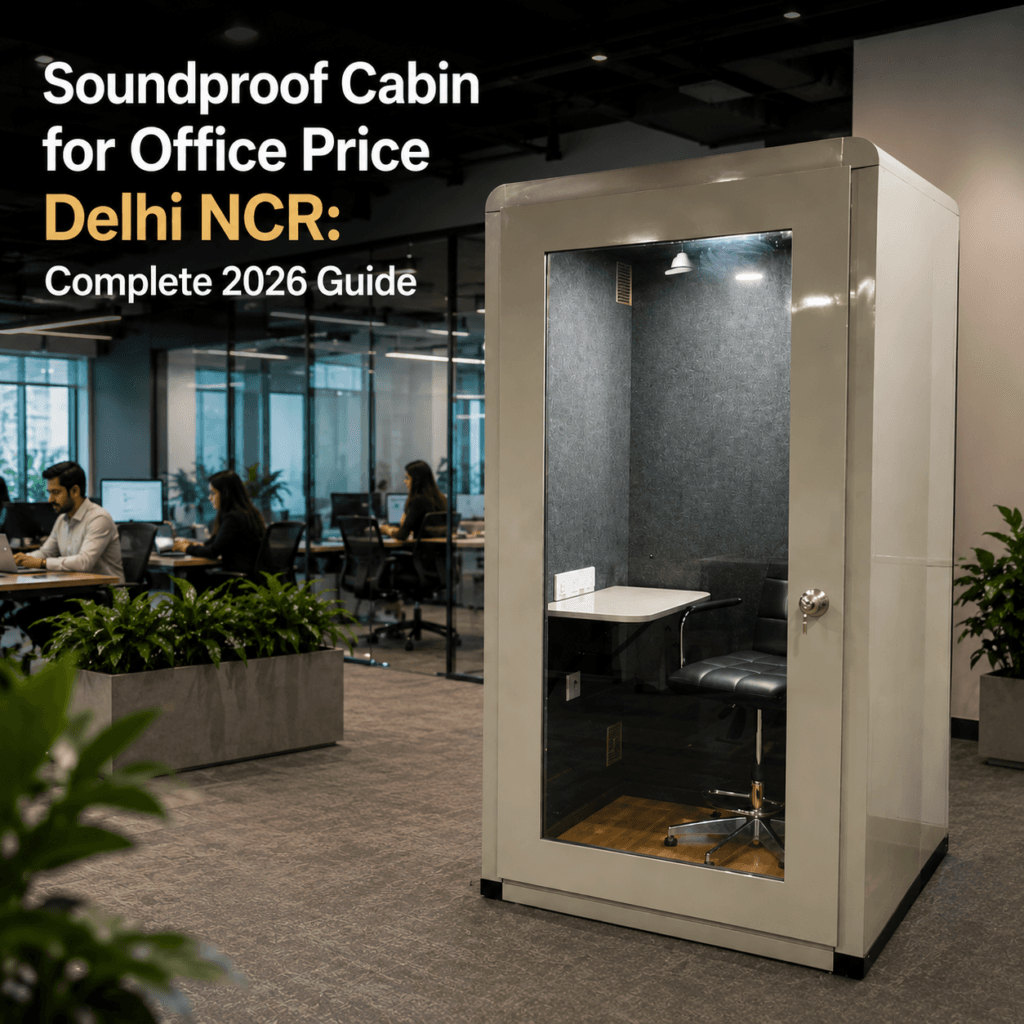
Soundproof Cabin for Office Price Delhi NCR: Complete 2026 Guide

Delhi NCR spanning the capital and its satellite cities of Noida, Gurgaon, Faridabad, and Ghaziabad is India’s largest and most diverse office market. The region encompasses everything from government ministry buildings in Lutyens’ Delhi to glass-fronted Grade-A tech campuses in Cyber City and the dense IT corridors of Noida Sector 62. What unites them all is the acoustic challenge that open plan offices create for the professionals working within them.Delhi’s ambient urban noise levels are among the highest in Asia. Traffic on the Ring Road and NH48, metro construction activity, and the general acoustic density of a 30-million-person metropolitan area all contribute to a background noise environment that penetrates even well-constructed commercial buildings. Kraft-Obench is the NCR’s preferred acoustic pod supplier — start your research at our website.2026 Price Guide for Soundproof Cabins in Delhi NCRAll prices below include delivery and professional installation within 60km of Delhi. No hidden charges or freight supplements apply within this zone.A single-person Phone Booth ranges from ₹1,50,000 to ₹2,20,000 depending on specification and technology package. A single-person Nano Pod with integrated desk ranges from ₹1,75,000 to ₹2,10,000. A 1 to 2 person Work Pod ranges from ₹2,20,000 to ₹2,80,000. A 4-person Meeting Pod ranges from ₹4,50,000 to ₹8,00,000 depending on AV specification and finish level.View full model details at Kraft-Obench including the Phone Booth, Nano Pod, and Meeting Pod.City-Specific Delivery and Service in Delhi NCROur Delhi NCR operations cover all major sub-markets with dedicated local installation teams and same-week delivery for standard in-stock models. Visit our Delhi page for the Delhi capital area. Our Noida page covers all Noida and Greater Noida sectors. Our Gurgaon page covers Cyber City, DLF phases, and all Gurugram sectors. All NCR installations are handled by our dedicated local team with same-week availability for most standard orders.Which Pod for Which Delhi NCR Office Type?Different industries and office types in Delhi NCR have different acoustic pod requirements based on their primary use cases and work patterns.IT and ITES companies in Noida Sector 62 and 63 typically need Nano Pod clusters with app-based booking integration for focused development work and architecture reviews. BFSI institutions in Cyber City Gurgaon prioritise Phone Booths for regulatory compliance call documentation. Consulting firms in Connaught Place and Aerocity require Meeting Pods for client presentations and team workshops. Work-from-home professionals across NCR’s residential suburbs choose the Work Pod for a complete home office environment.How AI Tools Are Driving NCR Pod DemandDelhi NCR’s large concentration of technology companies, consulting firms, and financial services organisations means that AI productivity tools are deployed at scale across the region’s offices. Meeting transcription, AI-assisted document drafting, voice-to-text workflow tools, and AI code generation assistants are all standard in NCR’s enterprise technology companies.As these organisations discover that their AI tools underperform in noisy open plan environments producing inaccurate transcriptions, missed action items, and degraded voice input the demand for acoustic pods that provide clean audio environments for AI tool operation has grown significantly. For NCR’s technology-intensive organisations, acoustic pods are now positioned as AI productivity infrastructure as much as noise management solutions.Factors That Affect Soundproof Cabin PriceSeveral specification choices significantly affect the final price of a soundproof cabin in Delhi NCR. STC rating the difference between STC 38 and STC 42 adds 10 to 15 percent to base price. Ventilation type passive ventilation versus active EC fan adds ₹15,000 to ₹25,000. Glass specification single versus double versus acoustic laminated glass spans a ₹20,000 to ₹40,000 price range. Interior finish standard laminate versus wood veneer adds 15 to 25 percent. Technology package smart lock, IoT integration, and integrated display add ₹30,000 to ₹80,000 to the base pod price.For a detailed price build based on your exact specification, contact us at our Contact page.Rental Options for Delhi NCR OfficesNot every NCR office is at the stage where pod purchase is the right decision. Our Rentals page provides flexible monthly rental terms for all major pod models with maintenance included in the rental price. View real NCR installations in our Gallery and read client testimonials from NCR companies at our Clients page.Frequently Asked QuestionsQ1: Is delivery free across Delhi NCR? Yes. Delivery and installation within 60km of Delhi is included in the pod price for all Kraft-Obench models. Contact our Contact page for a delivered price to your specific address.Q2: Can I get same-day or next-day installation in Gurgaon or Noida? For in-stock standard models, same-week installation is typically available in Gurgaon and Noida. Same-day installation is possible for urgent requirements with a priority service fee.Q3: Does Kraft-Obench have a Delhi NCR showroom? Yes. Visit our Delhi page for showroom address and viewing appointment details.Q4: Are there special pricing programmes for Delhi NCR government or PSU offices? Yes. Kraft-Obench offers Government Rate Contract pricing for central government and PSU clients in Delhi NCR. Contact our Contact page for government procurement documentation.Q5: How do pods perform in Delhi’s extreme summer temperatures of 45°C+? All Kraft-Obench pods are rated for ambient temperatures up to 45°C. For Delhi’s peak summer months, we recommend the active EC fan ventilation upgrade which provides 8 air changes per hour.Q6: Can I get pods delivered to a Faridabad or Ghaziabad factory? Yes. Kraft-Obench delivers to all NCR industrial zones including Faridabad and Ghaziabad.Q7: What is the warranty on pods purchased in Delhi NCR? All Kraft-Obench pods carry the standard national warranty with the added advantage of same-city service technicians for rapid warranty support. Contact our Contact page for full warranty terms.

Soundproof Cabin for Office Price Delhi NCR: Complete 2026 Guide Read More »

prefabricated office pods India vs traditional construction

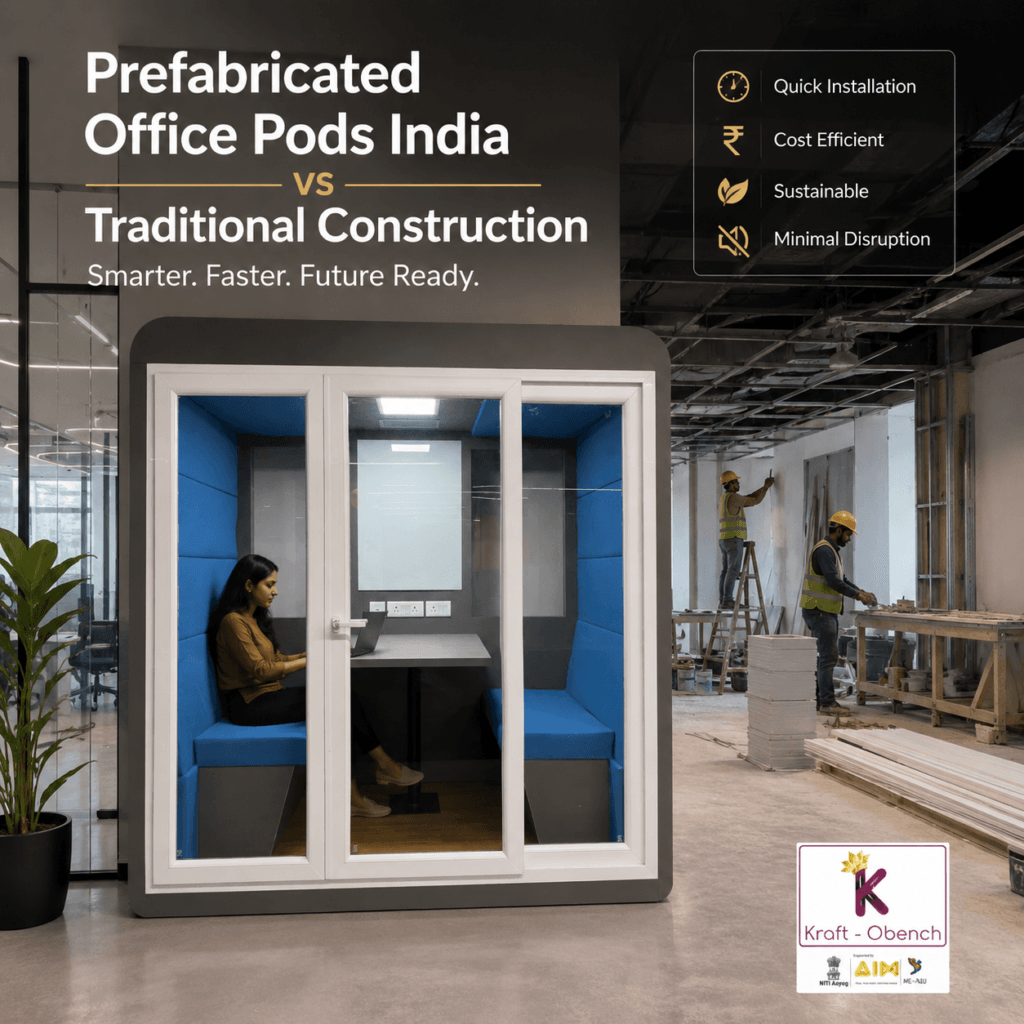
Prefabricated Office Pods India vs Traditional Construction

Every growing Indian company eventually faces an inflection point where available workspace is insufficient for operational needs. The decision about how to respond — through traditional construction of new partitioned offices, or through installation of prefabricated acoustic pods — has major implications for cost, timeline, operational flexibility, and long-term workspace quality.In 2026, the evidence in favour of prefabricated pods for the vast majority of Indian office applications is overwhelming. Start by exploring Kraft-Obench’s full pod range at our website before reviewing this detailed comparison.Comparison 1: Time to DeploymentTraditional construction of a new enclosed office within an existing commercial building involves civil work approvals, contractor procurement, structural work, electrical fit-out, plastering, painting, and finishing. This process takes a minimum of 6 to 12 weeks even for a simple single-room addition. During this period, the surrounding office area is disrupted by construction noise, dust, contractor access, and material storage.A prefabricated Kraft-Obench pod is operational in 1 to 7 days from delivery. Single-person pods like the Phone Booth install in a single day. A 4-person Meeting Pod installs in 2 days. For offices in Gurgaon, Noida, and Delhi, our teams routinely complete full pod installations in a single working day with no disruption to ongoing office operations.Comparison 2: Total Cost Including Hidden CostsComparing pod purchase price against construction tender price systematically understates the true cost advantage of pods. Traditional construction costs include architect fees, structural engineer assessment, contractor markup, building management fees for construction access, fire NOC amendment costs, and the productivity cost of construction disruption to your existing team.Building a 100 square foot acoustic office room costs ₹3,00,000 to ₹7,00,000 with all these costs included. A comparable Kraft-Obench Work Pod costs ₹2,00,000 to ₹3,00,000 installed with all costs included. The Nano Pod provides even more compact acoustic workspace from ₹1,85,000.Comparison 3: Acoustic PerformanceTraditional masonry construction can achieve STC 50 to 55 when properly designed and built. Kraft-Obench pods achieve STC 38 to 42. For 95 percent of Indian office applications — call privacy, meeting confidentiality, focused work isolation — STC 38 to 42 is entirely sufficient.The 10 to 15 dB difference between STC 42 and STC 52 is only relevant for applications requiring near-total speech isolation, such as professional recording studios, legal deposition rooms, or clinical audiology facilities. For standard office use, the pod’s acoustic performance is indistinguishable from traditional construction in practice. See our Vocal Pod for the highest-isolation pod option when maximum acoustic performance is required.Comparison 4: Operational FlexibilityA constructed partition wall is permanent. It cannot be relocated when your office lease ends, when your team grows and the space needs to be reconfigured, or when you move to a new building. The construction cost is entirely sunk with no residual value.Kraft-Obench pods move with your organisation. Our installations in Bangalore, Mumbai, Hyderabad, and Chennai include dozens of pods that have been relocated as companies have grown, moved offices, or reconfigured their workspace. Every relocation preserves the full acoustic performance and original appearance of the pod.Comparison 5: Regulatory RequirementsStructural alterations to commercial buildings require building plan approval, structural engineering sign-off, and in many cases fire NOC amendments. This approval process takes 4 to 8 weeks in most Indian municipal jurisdictions and can face unexpected delays or rejections. Landlord consent is always required and is not always forthcoming.Freestanding pods require no building plan approval, no structural engineering, and no fire NOC amendments in most Indian municipal jurisdictions. They can be installed without any landlord approval beyond standard access. View our Gallery for examples of pods installed without any civil permissions in Grade-A offices across India.Comparison 6: Resale Value and End-of-Life OptionsA constructed wall has zero resale value at end of use. Demolishing it to restore the original space costs additional money and generates waste. A Kraft-Obench pod retains 40 to 60 percent of its original value after 5 years and can be sold through our pre-owned programme, transferred to a new office location, or returned through our Rentals page exchange programme. Contact us at our Contact page to discuss resale value for your specific model. Discover more about Kraft-Obench – a startup redefining modern workspaces with innovative pods and soundproof solutions.Frequently Asked QuestionsQ1: Can a prefabricated pod achieve the same noise isolation as a purpose-built room? For most office applications, yes. For applications requiring STC 50+, traditional construction or a custom high-STC pod is recommended. Contact our Contact page for high-STC options.Q2: What happens to the pod at the end of an office lease? The pod can be taken to the new office, sold through the Kraft-Obench pre-owned programme, or returned through our Rentals page process.Q3: Can a prefabricated pod be upgraded after purchase? Yes. Upgrades including enhanced acoustic panels, smart locks, better ventilation, and display mounts can be retrofitted to most models.Q4: Are prefabricated pods fire-safe? Yes. Kraft-Obench pods are manufactured with fire-retardant materials meeting Indian IS standards. Material certification is available on request.Q5: How does a pod handle the need for natural light? Kraft-Obench pods are available with double-glazed glass panels providing natural light transmission while maintaining acoustic performance.Q6: Is there a risk that prefabricated pods look cheap compared to traditional offices? Not with Kraft-Obench. Our premium veneer, HPL, and custom RAL finish options produce pods that match the aesthetic quality of traditional construction. View our Gallery for evidence.Q7: Can we buy just the panels and self-assemble to reduce cost? Kraft-Obench does not offer self-assembly kits. Professional installation ensures acoustic seal integrity and is included in the pod price.

Prefabricated Office Pods India vs Traditional Construction Read More »

Office Privacy Booth

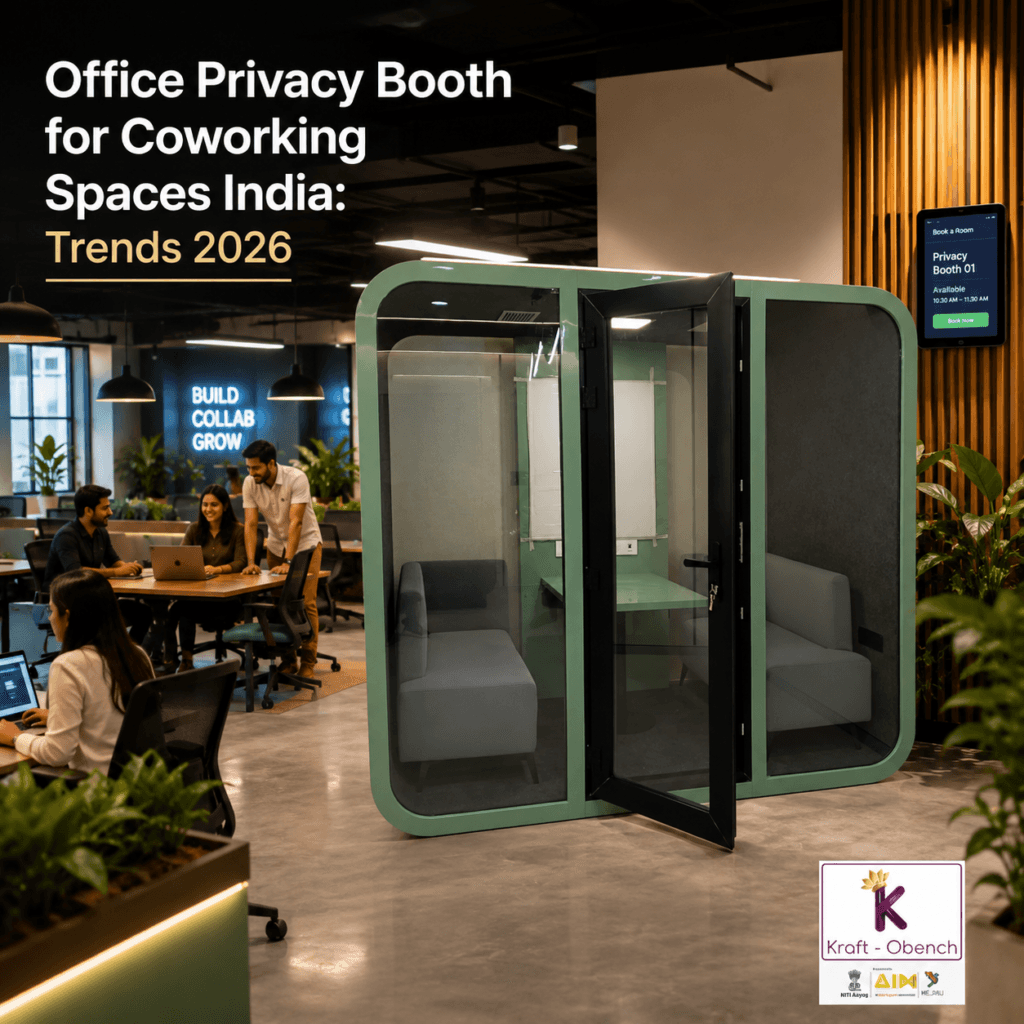
Office Privacy Booth for Coworking Spaces India: Trends 2026

India’s coworking sector has experienced extraordinary growth over the past five years. With over 50 million square feet of managed workspace now active across Tier 1 and Tier 2 cities, coworking has moved from a fringe offering for freelancers to the primary office solution for enterprise teams, funded startups, and distributed businesses of every size. This rapid growth has intensified the acoustic challenges that have always been inherent to the shared workspace model. Open coworking floors — the format that made the sector economically viable — are inherently noisy. Multiple companies, diverse work styles, and high-density seating create ambient noise levels of 65 to 75 dB throughout the working day. This acoustic reality is increasingly incompatible with the enterprise-grade productivity that premium coworking operators are now trying to deliver. Kraft-Obench is India’s leading supplier to coworking operators — visit our website to understand why the country’s best coworking brands choose our pods as their acoustic infrastructure. Trend 1: Privacy Pods as the Primary Membership Differentiator In 2026, pod availability has become the second most important factor in enterprise coworking membership decisions — after internet speed and ahead of location, price, and ancillary amenities. Enterprise members — the highest-value customer segment for premium coworking operators — require private, acoustically isolated spaces for calls, confidential discussions, and focused deep work as a non-negotiable workplace requirement. Coworking operators who have invested in quality acoustic pod infrastructure report significantly higher enterprise membership retention, higher revenue per desk, and stronger member satisfaction scores. Kraft-Obench’s Phone Booth and Nano Pod are the two most-deployed pod types in Indian coworking spaces and have been for three consecutive years. Trend 2: Hourly Booking Integration and Smart Lock Technology Premium coworking operators are integrating acoustic pods with digital booking systems to maximise utilisation, generate additional revenue, and provide members with a seamless booking experience. Kraft-Obench pods support smart lock integration with major coworking management platforms including Nexudus, OfficeRnD, Cobot, and SpacetoCo. Members book pods by the hour through the coworking space’s app, receive a one-time access code, and the pod unlocks automatically at the booked time. Utilisation data flows directly into the operator’s management dashboard. This integration capability is driving pod adoption among operators in Bangalore, Mumbai, and Gurgaon who are managing large, complex member bases. Trend 3: AI-Optimised Pod Utilisation Management Artificial intelligence tools are beginning to be applied to coworking pod utilisation management in sophisticated ways. AI-powered occupancy analytics platforms analyse booking patterns, utilisation rates, peak demand periods, and member behaviour to optimise pod placement, pricing, and availability across multi-floor coworking spaces. For coworking operators managing 20 or more pods across multiple floors, AI utilisation management can increase revenue-generating pod occupancy from 50 to 60 percent to 75 to 85 percent through dynamic pricing, predictive booking reminders, and intelligent pod placement recommendations. Kraft-Obench’s smart pods are designed to integrate with these AI management platforms through standard IoT and API connectivity. Trend 4: Branded Pod Environments for Operator Identity Coworking operators are increasingly using branded acoustic pods as a primary visual identity element that differentiates their spaces from competitors. A custom-branded Kraft-Obench pod cluster in an operator’s signature colour, featuring their logo on etched glass, creates a memorable visual signature that members associate with quality and professionalism. This trend is most advanced in premium coworking spaces in Hyderabad, Noida, and Chandigarh. Rental pods with operator branding are available at our Rentals page for operators who want to test branded pod concepts before committing to a fleet purchase. ROI Analysis for Coworking Operators The financial case for acoustic pod investment in coworking spaces is compelling when analysed correctly. A Kraft-Obench Phone Booth at ₹2,00,000 charged at ₹200 to ₹500 per hour achieves full return on investment in 4 to 8 months at typical Indian coworking utilisation rates of 4 hours per day. Beyond break-even, the pod generates pure margin with minimal ongoing costs. The Meeting Pod at higher pricing per hour achieves similar ROI timelines despite the higher capital cost. Our Clients page showcases real coworking operator ROI case studies from spaces across India. Installation in Coworking Spaces Coworking spaces face a specific installation challenge: they are typically leased commercial spaces where the operator cannot make permanent structural modifications without landlord approval. Kraft-Obench pods are ideal for this context because they require absolutely no civil work, no floor anchoring, and no permanent building modifications. Our teams in Jaipur and Lucknow handle coworking fit-outs regularly for both new space launches and existing space upgrades. Frequently Asked Questions Q1: How many pods does a 50-desk coworking space need? A 50-desk coworking space typically needs 4 to 6 single-person phone booths or Nano Pods plus one 4-person Meeting Pod as a minimum viable pod suite. Q2: Can pods be integrated with coworking management software? Yes. Kraft-Obench pods with smart lock options integrate via API with Nexudus, Cobot, OfficeRnD, and SpacetoCo. Contact our Contact page for integration documentation. Q3: Is there a revenue share model available for coworking operators? Kraft-Obench does not currently offer a revenue share model. However, the Rent-to-Own programme converts rental cost to ownership over 24 to 36 months at our Rentals page. Q4: What is the typical utilisation rate of a phone booth in a coworking space? Phone booths typically achieve 4 to 7 hours of daily utilisation in medium-to-large coworking spaces. Q5: How do coworking operators price their pod hours? Typical pricing: ₹150 to ₹400 per hour for a single-person phone booth, ₹400 to ₹800 per hour for a Nano Pod, and ₹800 to ₹1,500 per hour for a 4-person Meeting Pod. Q6: Can pods be moved within the coworking space as the layout evolves? Yes. All Kraft-Obench pods are fully relocatable. Contact our Contact page for relocation service details. Q7: Do Kraft-Obench pods meet fire safety requirements for commercial spaces? Yes. All pods are manufactured with fire-retardant materials meeting IS standards. We provide material certificates for compliance audits.

Office Privacy Booth for Coworking Spaces India: Trends 2026 Read More »

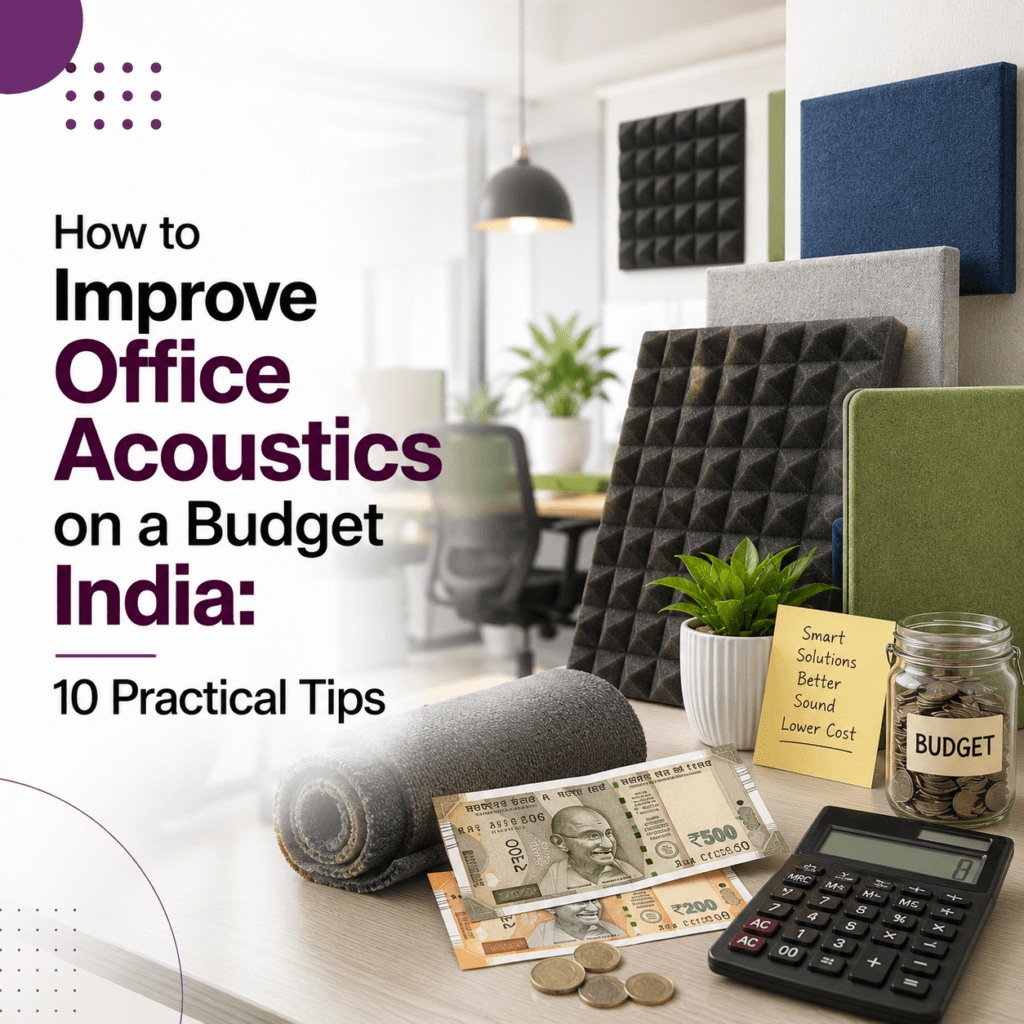
How to Improve Office Acoustics on a Budget India: 10 Practical Tips

How to Improve Office Acoustics on a Budget India: 10 Practical Tips

The assumption that meaningful acoustic improvement requires significant investment is one of the most persistent and damaging misconceptions in Indian office planning. For SMEs, startups, and growing organisations that cannot justify lakh-scale acoustic investments in the short term, targeted budget interventions deliver 60 to 70 percent of the benefit at 20 to 30 percent of the cost. This guide covers 10 practical, immediately actionable acoustic improvements for Indian offices at every budget level — from zero-cost rearrangements to strategic pod investments. Start by visiting Kraft-Obench to understand the full range of acoustic solutions available before deciding which combination is right for your office. Tip 1: Add Carpet to Hard Floors (₹30–₹80 per sqft) Hard tile floors are acoustic nightmares. Every footstep, chair movement, and dropped item generates impact noise that travels through the building structure and reflects off hard surfaces to amplify ambient noise levels. A commercial-grade carpet tile — available at ₹30 to ₹80 per square foot from any commercial flooring supplier in India — absorbs mid-frequency speech sound and reduces footfall noise simultaneously. This single change cuts reverberation time by approximately 25 percent in most Indian tiled offices. For a 1,000 square foot office, the total investment is ₹30,000 to ₹80,000 — less than a single month’s rent in most Indian commercial buildings — yet the acoustic improvement is immediately perceptible to every occupant from day one. Tip 2: Hang Acoustic Panels at Primary Reflection Points (₹2,000–₹5,000 each) Two to four well-placed 600mm by 1200mm fabric-wrapped acoustic panels reduce reverberation time more effectively than covering every wall with low-density foam. Place panels at the primary acoustic reflection points: side walls at seated ear height and the ceiling above the highest-density workstation clusters. Kraft-Obench uses the same high-density acoustic panel technology inside all its pods — from the Nano Pod to the Meeting Pod. This means you can trust the panel performance specifications when selecting standalone panels to complement a pod installation. Tip 3: Add Bookshelves Filled with Books (Near Zero Cost) Irregular surfaces break up standing waves and scatter sound rather than reflecting it in coherent beams. A well-stocked bookshelf positioned against a primary reflective wall is an effective acoustic diffuser at virtually zero cost. The irregular surface of book spines, mixed sizes, and varying depths provides the surface irregularity that acoustic engineers deliberately create with expensive purpose-built diffuser panels. This works as effectively in offices in Ahmedabad and Kolkata as in premium Bangalore tech offices. It is not a complete acoustic solution, but as a supplementary measure it costs nothing and requires no specialist knowledge to implement. Tip 4: Soft Furnishings in Break Areas (₹10,000–₹30,000) Break rooms and informal collaboration areas are often the noisiest zones in Indian offices because they combine hard surfaces, loud informal conversation, and the general acoustic energy of a social space. Replace hard plastic chairs with upholstered seating. Add fabric curtains at windows. Use area rugs on hard floors. This investment of ₹10,000 to ₹30,000 produces a measurable acoustic improvement in the space that generates the most noise. It is especially effective in the mid-size offices typical in Chandigarh and Jaipur where break rooms tend to be adjacent to workstation areas without acoustic separation. Tip 5: Install Acoustic Ceiling Tiles (₹50–₹150 per sqft) Suspended ceilings fitted with mineral wool acoustic tiles rather than standard gypsum or metal tiles provide a dramatic improvement in offices with high ceilings. The ceiling is the largest single reflective surface in most open plan offices, and treating it acoustically delivers the highest acoustic return per square foot of any fixed treatment. This improvement is particularly dramatic in older commercial buildings with high ceilings — common in heritage commercial properties in Delhi and Mumbai where original construction predates the modern open plan office concept. At ₹50 to ₹150 per square foot, acoustic ceiling tiles represent one of the highest-value acoustic investments available. Tip 6: Use Plant Walls for Acoustic and Biophilic Benefits (₹15,000–₹40,000) Living plant walls — panels of plants grown in vertical hydroponic or soil systems — scatter and absorb high-frequency sound while providing the biophilic design benefits that are increasingly valued in Indian corporate offices. Plants do not provide meaningful low-frequency absorption, but their effect on speech clarity and high-frequency reverberation is measurable. Plant walls are popular in Hyderabad and Pune tech offices as both acoustic treatment and wellness design elements. The dual benefit — acoustic improvement plus biophilic design value — makes them a particularly efficient investment for companies managing both acoustic and employee wellbeing priorities. Tip 7: Seal Door Gaps (₹500–₹2,000 per door) Acoustic door sweeps and weather stripping cost under ₹2,000 per door and deliver 6 to 8 dB of acoustic improvement between adjoining spaces — equivalent to doubling the thickness of the partition wall between them. This is the single highest-ROI acoustic investment per rupee spent for offices with multiple enclosed or semi-enclosed rooms. The same door seal technology is used in all Kraft-Obench pods including the Phone Booth and Work Pod. Applying it to existing office doors extends the acoustic separation between spaces without any construction involvement. Tip 8: Use a Phone Booth for All Calls A single Kraft-Obench Phone Booth handles the call noise generated by 10 to 15 employees and eliminates the most disruptive noise source in most open plan offices — the nearby loud phone call. By policy, requiring all calls above 5 minutes to be taken in the phone booth removes the dominant acoustic disruptor from the open floor. Rental options are available at our Rentals page for budget-conscious offices not yet ready for purchase. The Nano Pod provides the same benefit with the addition of a full laptop desk for focus work, making it a slightly more versatile investment for offices where focused solo work is as frequent a need as call privacy. Tip 9: White Noise Systems (₹5,000–₹20,000) White noise or pink noise speaker systems raise the ambient noise floor in a controlled way, making nearby speech less intelligible from a distance without adding…

How to Improve Office Acoustics on a Budget India: 10 Practical Tips Read More »

Acoustic Pods for Libraries

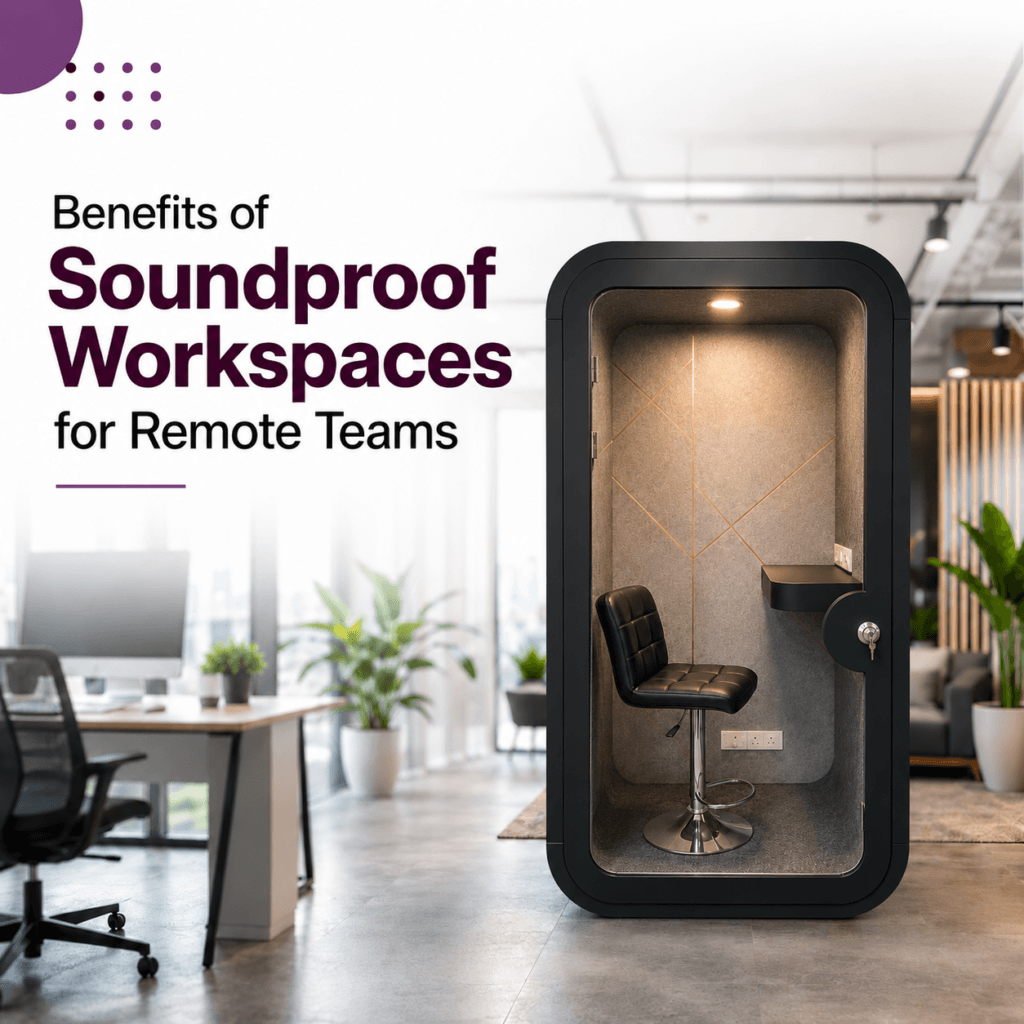
Benefits of Soundproof Workspaces for Remote Teams

The transition to hybrid and remote work across Indian companies has fundamentally changed the relationship between workspace quality and professional performance. When everyone worked in the same office, acoustic problems were shared and broadly accepted. Now that professional interactions happen over video calls, audio quality has become a personal performance differentiator that is immediately visible — or rather, audible — to every colleague, client, and senior stakeholder on every call. Background noise during professional calls does not just signal a lack of professionalism. It actively degrades communication quality, increases cognitive load for everyone on the call, and undermines the perception of competence that remote workers must work harder to establish without the physical presence cues available in a shared office. Kraft-Obench solves this with a range of acoustic pods designed specifically for India’s remote and hybrid workforce. Benefit 1: Dramatically Improved Video Call Quality Background noise is consistently rated as the most disruptive element of remote meetings by both participants and meeting facilitators. Dog barking, traffic noise, family conversations, construction activity, and household appliances all compete for attention during video calls in ways that are impossible to fully suppress with software noise cancellation alone. A soundproof workspace eliminates these noise sources at the physical level — before they ever reach the microphone. The Nano Pod and Phone Booth both deliver broadcast-quality call environments at home, giving remote workers the professional acoustic presence that their in-office colleagues automatically enjoy. For teams in Bangalore and Mumbai, pod adoption has produced immediately measurable improvements in call quality scores. Benefit 2: Sustained Deep Work and Cognitive Flow Knowledge workers require 20 to 25 minutes of uninterrupted concentration to enter the productive flow states where their highest-quality analytical and creative work occurs. Even brief acoustic interruptions — a phone ringing in another room, a delivery at the door, a neighbour’s conversation — reset this clock completely. The cumulative cost of these interruptions across a working day is enormous. The Work Pod and Nano Pod provide the sustained acoustic isolation that makes genuine deep work possible at home. For software developers, analysts, writers, and designers whose output quality depends on extended uninterrupted concentration, the pod is not a luxury — it is a professional productivity tool with a measurable return. Benefit 3: Reduced Cognitive Load and End-of-Day Fatigue Neuroscience research consistently shows that background noise — even at levels below conscious awareness — consumes cognitive resources that would otherwise be available for the primary work task. This cognitive tax accumulates across the working day, resulting in greater mental fatigue by late afternoon and reduced capacity for complex decision-making in the hours when many senior professionals schedule their most important calls and reviews. Soundproof workspaces reduce this cognitive tax fundamentally. Remote workers who transition to acoustic pod environments consistently report lower end-of-day fatigue, improved afternoon concentration, and greater capacity for evening recovery. This benefit is reported consistently by Kraft-Obench users across Delhi, Hyderabad, and Pune. Benefit 4: Professional Brand Image on Every Call The physical environment visible behind a remote worker on video calls communicates professional identity just as powerfully as their clothing, preparation, and communication style. A Kraft-Obench pod provides a clean, professional, neutral backdrop that signals a serious commitment to professional standards. Client-facing professionals — consultants, account managers, sales directors, and executive leaders — report that the transition to a pod environment produces immediate positive feedback from clients and senior stakeholders who notice the improved call quality and professional presentation. See real professional setups in our Gallery and client stories at our Clients page. Benefit 5: Psychological Work-Life Separation One of the most underappreciated benefits of a dedicated acoustic workspace at home is the psychological boundary it creates between professional and personal life. Physically entering a pod at the start of the working day and exiting it at the end creates a ritual of transition — comparable to the commute-to-office experience — that signals to the brain when work mode begins and ends. This psychological boundary reduces the work-life blurring that is a primary driver of remote work burnout. It also improves sleep quality by reducing the cognitive activation that comes from working in the same physical space where you sleep and relax. This is a key reason why the Meeting Pod is increasingly installed in home environments by senior managers and directors. Benefit 6: Compliance for Regulated Industries India’s BFSI sector, legal profession, and healthcare industry all have regulatory requirements around call confidentiality and data security that are difficult to meet when working from a shared home environment. Acoustic pods ensure that client conversations, financial discussions, and legally sensitive communications cannot be overheard by household members or neighbours. BFSI and legal professionals in Gurgaon, Noida, and Chennai are among the most active users of Kraft-Obench home office pods specifically for regulatory compliance reasons. The Vocal Pod also supports compliant recording environments for regulated call documentation requirements. How AI Meeting Tools Work Better in Soundproof Pods AI-powered meeting tools — transcription services, action item extractors, sentiment analysis platforms, and meeting summary generators — have become standard productivity infrastructure for India’s remote teams. All of these tools are fundamentally dependent on audio quality for their performance. In a noisy home environment, AI transcription accuracy rates drop to 70 to 80 percent, producing summaries and action items that require significant manual correction. Inside a Kraft-Obench acoustic pod, clean audio input enables AI tools to achieve accuracy rates of 95 percent or higher — approaching the accuracy of human transcriptionists at zero marginal cost per use. Flexible Access Through Rental Not every remote worker is in a position to commit to a pod purchase immediately. Kraft-Obench’s rental programme provides access to professional acoustic workspace without the upfront capital commitment of purchase. Rental pods for remote workers are available at our Rentals page with flexible monthly and annual terms and maintenance included in the rental price. Contact us at our Contact page to discuss the right model for your role, home layout, and budget. Frequently Asked Questions Q1:…

Benefits of Soundproof Workspaces for Remote Teams Read More »

office pod for home office Mumbai price and features

Office Pod for Home Office Mumbai: Price, Features & Buying Guide 2026

Mumbai is India’s financial capital, its entertainment industry headquarters, and the operational base for some of the country’s most demanding professional roles. Finance professionals at BKC, consultants in Lower Parel, media executives in Andheri, and technology managers in Powai share a common working reality: they are doing high-stakes professional work in residential environments that were designed for rest, not for performance.Mumbai is also one of India’s noisiest cities. Traffic on Western and Eastern Express Highways, local train noise, dense residential neighbourhoods, and constant construction activity create an acoustic environment that makes professional home working genuinely difficult. Without physical acoustic separation, focused work and professional client calls are constantly compromised.Start at Kraft-Obench and visit our dedicated Mumbai page for location-specific pricing, delivery zones, and showroom details before reviewing the top pod options for Mumbai home offices in 2026.Top Home Office Pod Models for MumbaiMumbai’s diverse residential stock from compact 1BHK apartments in Malad and Borivali to spacious villas in Juhu and Bandra means different pod models suit different home types and professional needs.The Nano Pod is compact and lift-friendly, making it the ideal choice for the city’s mid-size apartments. At under 1.2 square metres, it fits in a bedroom corner, a study alcove, or a dedicated corner of the living space. The Work Pod suits finance professionals and consultants who need a full dual-monitor desk environment, ergonomic seating, and docking station capability. The Phone Booth is perfect for professionals on constant client calls who need maximum call quality in the most compact possible footprint. The Meeting Pod serves senior managers and directors who regularly host team meetings, client briefings, and board-level discussions from home.2026 Pricing Guide for MumbaiAll prices below include delivery within Mumbai limits and professional assembly by Kraft-Obench’s local installation team.The Nano Pod is priced at ₹1,85,000 installed. The Work Pod is priced at ₹2,40,000 installed. The Phone Booth is priced at ₹1,65,000 installed. The Meeting Pod (4-person configuration) starts at ₹4,50,000 installed. Prices may vary based on floor access, lift availability, and specific building requirements identified during the pre-installation site survey.Check rental options at our Rentals page if you prefer a lower upfront commitment with the flexibility of returning the pod if your home or work situation changes.Mumbai-Specific Installation ConsiderationsMumbai apartments present a distinctive set of installation challenges that our local team has extensive experience managing. Low ceilings in pre-1990 residential buildings in Colaba, Dadar, and Matunga require our low-profile pod configuration. Narrow lifts particularly in older co-operative housing society buildings are addressed by our flat-pack panel system where no individual component exceeds the lift’s carrying capacity.Marble floors, which are common in Mumbai apartments across all price points, are handled with our non-marking rubber levelling feet. Our Mumbai team covers all zones including Thane and Navi Mumbai. See our Thane page and the full Mumbai service zone details for delivery coverage confirmation.Features That Matter for Mumbai’s Coastal ClimateMumbai’s coastal location creates a humidity environment that is significantly more demanding than most inland Indian cities. During the monsoon season from June to September, outdoor humidity regularly exceeds 90 percent. Even in the dry season, coastal Mumbai humidity rarely drops below 60 percent.All Kraft-Obench pods use anti-humidity acoustic panels with sealed facings, moisture-stable laminates and veneer surfaces, powder-coated steel frames with 80-micron minimum coating, and sealed joint systems at all panel connections. These are the identical specifications used in our Kochi and Chennai coastal installations which face similarly demanding year-round humidity conditions.Power Stability in Mumbai BuildingsMumbai’s electrical infrastructure is relatively reliable in commercial zones, but older residential buildings in established neighbourhoods can experience voltage fluctuations, brief outages during monsoon, and phase imbalances. All Kraft-Obench pods include surge-protected power distribution units as standard equipment.For sensitive computing and recording equipment inside pods particularly in home studio configurations. we recommend an additional 1kVA UPS as a supplementary measure. This protects against the transient voltage events that are most damaging to professional equipment and ensures that work in progress is never lost during brief power interruptions. Our Vocal Pod installations in Mumbai’s Andheri, Versova, and Bandra creative community typically include UPS protection as a standard configuration item.Financing and EMI OptionsKraft-Obench offers flexible financing for Mumbai home office pod purchases. Zero percent EMI for 6 months is available on purchases above ₹1,50,000 on select major credit cards. Standard 12 to 24-month EMI is available through partner NBFCs at competitive rates. Contact us via our Contact page for current financing options and eligibility requirements.View completed Mumbai home office installations at our Gallery and read client reviews from Mumbai professionals at our Clients page.Customisation for Mumbai InteriorsMumbai’s real estate values are among the highest in India, and the interiors of Mumbai homes across all segments reflect a significant personal investment in design and aesthetics. Kraft-Obench offers extensive customisation to ensure that your home office pod complements rather than contrasts with your existing interior.Available customisations include veneer finishes in oak, walnut, and teak, RAL colour matching for exterior panels, fabric selection for acoustic panels from our full colour range, and LED lighting specification for colour temperature and dimming profile. Our design team produces a 3D render showing your exact specification before production begins, ensuring complete satisfaction with the final result. See our full customisation guide in Blog 17 and contact us via our Contact page for a bespoke brief.Frequently Asked QuestionsQ1: Can a Kraft-Obench pod be installed in a Mumbai society flat? Yes. Freestanding pods require no civil work, drilling, or structural modification and therefore do not require housing society permission in most cases.Q2: How do pods handle Mumbai’s power voltage fluctuations? All Kraft-Obench pods include surge-protected power distribution units as standard. For sensitive equipment, we recommend an additional 1kVA UPS.Q3: Is there a Kraft-Obench showroom in Mumbai? Yes. Visit our Mumbai page for showroom address and appointment booking. Live pod demonstrations are available.Q4: How long does installation take in a Mumbai high-rise? Standard installation takes 4 to 8 hours depending on model and floor. Our Mumbai team factors in lift availability and building management coordination.Q5: What…

Office Pod for Home Office Mumbai: Price, Features & Buying Guide 2026 Read More »

how to soundproof a room for recording vocals India

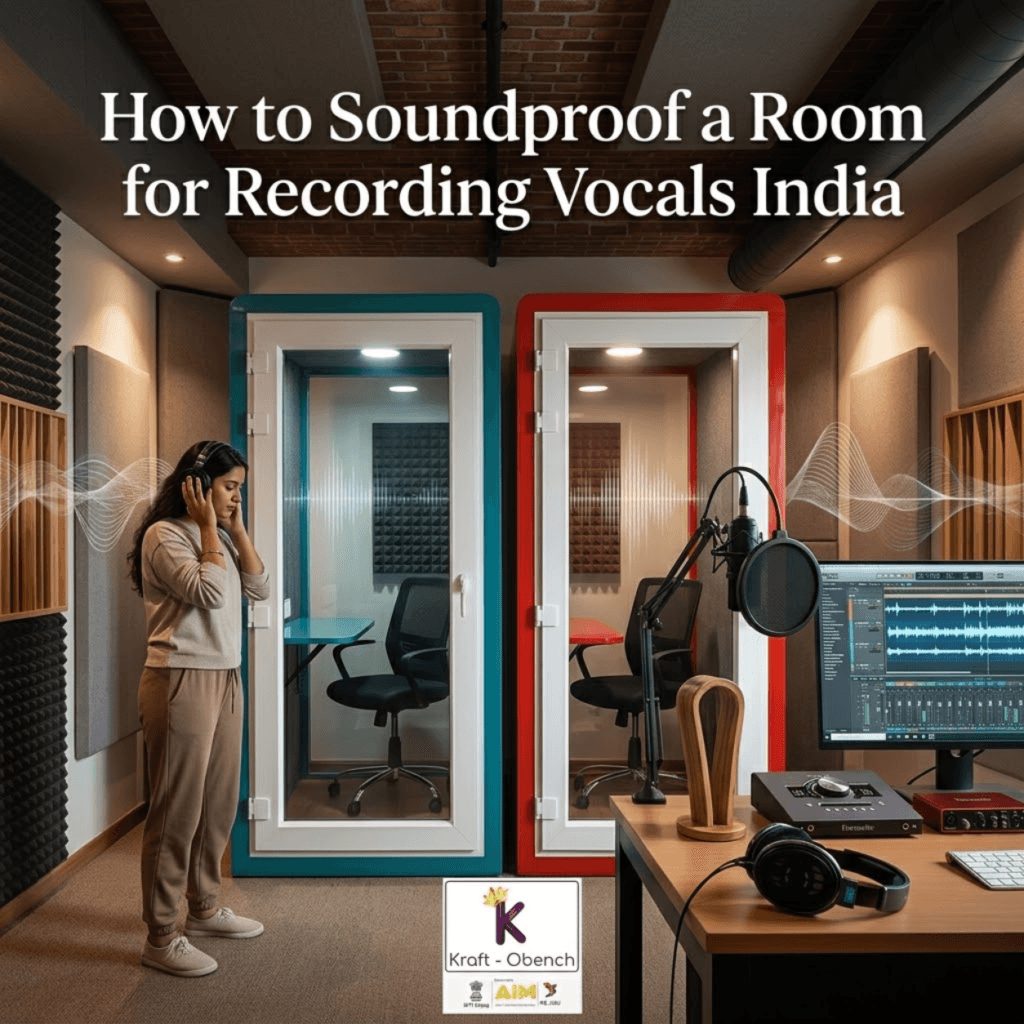
How to Soundproof a Room for Recording Vocals India

India is home to one of the world’s most dynamic music and content creation ecosystems. From Mumbai’s Bollywood studios to Bangalore’s independent music scene, from Chennai’s classical recording tradition to Delhi’s rapidly growing podcasting community, the demand for high-quality vocal recording environments has never been higher. Yet India is also one of the noisiest countries in the world to record in.Street traffic, construction activity, neighbourhood noise, and the general acoustic density of Indian urban environments make recording quality vocals at home or in a small studio an acoustic engineering challenge, not just a microphone selection question. A poorly treated recording environment adds reverb, flutter echo, comb filtering, and background noise floor problems that no microphone, preamp, or post-production software can fully correct.Begin with the professional solution at Kraft-Obench particularly the Vocal Pod and use this guide to understand the full range of approaches available at every budget level.Soundproofing vs Acoustic Treatment: Understanding the DifferenceThese two terms are frequently confused, but they describe fundamentally different acoustic interventions. Soundproofing refers to blocking external sound from entering your recording space it is about mass, isolation, and structural decoupling. Acoustic treatment refers to controlling how sound behaves inside your recording space it is about absorption, diffusion, and reverberation management.You need both for a functional vocal recording environment. A room can be perfectly soundproofed but acoustically terrible for recording if it has untreated reflective surfaces. Conversely, a beautifully acoustically treated room is useless for professional recording if traffic noise bleeds into every take. The Kraft-Obench Vocal Pod delivers both soundproofing and acoustic treatment in a single pre-assembled unit, which is why it is the most popular vocal recording solution across India.Step 1: Seal All Air Gaps FirstBefore investing in any acoustic panels, mass-loaded vinyl, or recording pods, seal every air gap in your recording space. Sound follows air. A 1mm gap around a door frame or window reduces the effective isolation of an entire wall system by up to 50 percent. Acoustic door sweeps the rubber seal at the bottom of the door are the single highest-ROI first step for DIY soundproofing.Apply acoustic sealant around all electrical boxes in walls. Use weatherstripping on door perimeters. Seal pipe penetrations through walls. This work costs under ₹5,000 for a typical room and delivers 6 to 8 dB of additional isolation before any other investment is made. It is the universally recommended first step before spending on panels, pods, or construction work.Step 2: Add Mass to WallsOnce air gaps are sealed, adding mass to walls is the most effective next step for DIY soundproofing. Sound transmission through a wall is governed by the mass law heavier walls transmit less sound. Adding a second layer of 12mm gypsum board with Green Glue viscoelastic damping compound between the layers delivers 6 to 10 dB of additional isolation at a cost of ₹150 to ₹300 per square foot.For singers in Mumbai apartments and Delhi flats with rental restrictions on permanent structural changes, this double-layer gypsum approach applied to the noisiest wall typically the one facing the street provides meaningful isolation improvement without requiring landlord approval for major construction.Step 3: Decouple the StructureStructural decoupling is the most technically advanced and acoustically impactful DIY soundproofing step. Sound transmits through solid structures as vibration it bypasses even very heavy walls by travelling through the building’s structural frame. Resilient channels or rubber isolation mounts interrupt this vibration path when used to attach wall panels and ceilings to the building structure.This step alone can add 10 to 15 dB of low-frequency isolation far more than additional mass alone. For singers who want to bypass all this complexity, the Kraft-Obench Vocal Pod is pre-engineered with full structural decoupling built into every panel assembly, delivering the benefit without requiring any construction knowledge.Step 4: Treat the Room AcousticallyAfter addressing sound transmission, address the acoustic character of the space itself. Place broadband acoustic panels at first reflection points the wall directly to the side of the microphone position at ear height, and the wall behind the performer. Use deep corner bass traps (minimum 300mm thick) to control low-frequency energy buildup in room corners.Target an RT60 of under 0.3 seconds for a vocal recording environment. This is significantly drier than even a professional broadcast studio and requires substantial panel coverage typically 40 to 60 percent of total room surface area. Compare the labour, cost, and quality uncertainty of achieving this DIY with the professionally tuned acoustic interior of Kraft-Obench products at our Nano Pod page.Step 5: Use a Professional Vocal BoothFor singers, voice-over artists, and podcasters who cannot undertake construction in a rental apartment or who need immediate professional-quality results, a Kraft-Obench Vocal Pod delivers studio-quality isolation and acoustic treatment with zero construction involvement.The Vocal Pod achieves STC 38 to 42 isolation and NRC 0.90 acoustic panel performance with silent ventilation at below 30 dB(A). It installs in one day and is available across all major Indian cities including Bangalore, Hyderabad, Chennai, and Pune.How AI Audio Tools Enhance Pod RecordingsIndia’s recording professionals are increasingly using AI-powered audio tools including AI noise reduction, AI vocal enhancement, and AI mastering platforms as part of their standard production workflow. These tools perform significantly better when given clean source recordings from acoustically controlled environments.AI noise reduction algorithms, for instance, are designed to separate signal from noise. The cleaner the original recording meaning the lower the noise floor and the fewer room reflections the more accurately AI can process the vocal without introducing artefacts. A Kraft-Obench Vocal Pod recording provides AI audio tools with the ideal clean source material, compounding the acoustic quality of the recording environment with the enhancement capability of AI post-production software.DIY Cost vs Professional Pod: The Real ComparisonDIY soundproofing a 100 square foot room in India costs ₹85,000 to ₹1,20,000 in materials and takes 3 to 5 weeks of disruptive renovation work with uncertain acoustic outcomes. A Kraft-Obench Vocal Pod costs ₹1,50,000 to ₹2,00,000, installs in one day, delivers guaranteed acoustic performance, and retains significant resale value.For working musicians and voice-over…

How to Soundproof a Room for Recording Vocals India Read More »

Kraft-Obench · Vocal Booth Rentals
Soundproof Vocal Booths for Rent

Noise-free calls, focused work & a professional recording booth for work from home.

Flat 10% OFF on Rentals⏱ Limited-time offer
  • Professional recording booth
  • Ideal for WFH, meetings & recordings
  • Easy installation & flexible rentals

Available only in Delhi NCR, Mumbai, Chennai, Bengaluru & Hyderabad

Soundproof vocal booth available for rent