The Hidden Cost of Working From Home: Why Every Remote Employee Needs a Real Workspace
Work from home has stopped being a temporary arrangement and has become a permanent part of how many organisations operate. It offers flexibility, cuts commute time, and gives employees more control over their day. But it also quietly introduces a problem that rarely shows up in a performance review: the lack of a dedicated workspace.
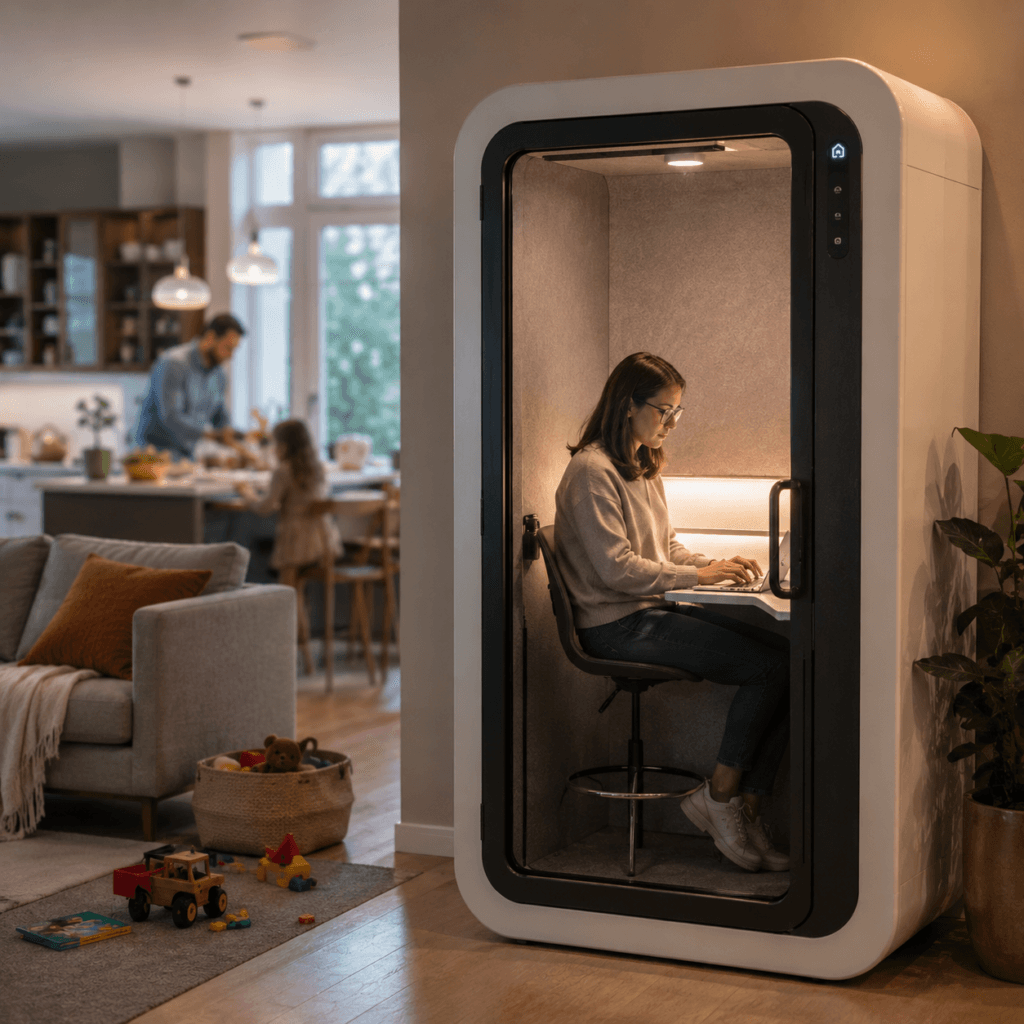
Kitchen tables turn into workstations. Video meetings compete with the sound of a washing machine, a doorbell, or a sibling’s cricket match on TV. Confidential conversations end up happening in shared living rooms, where anyone can walk in mid-sentence. None of these things look dramatic on their own. But day after day, they chip away at focus, professionalism, and eventually, well-being.
This post looks at why a dedicated workspace matters just as much as a laptop or a stable internet connection, and how a well-designed work pod can solve a problem that most remote-first companies haven’t fully addressed yet.
Remote Work Solved One Problem and Created Another
When offices shut their doors and remote work became the default, the immediate priority was simple: get people connected. Laptops were issued, VPNs were set up, and video conferencing tools became part of daily vocabulary. That solved the connectivity problem.
What it didn’t solve was the environment problem.
An office, whatever its flaws, was still a physical space designed for work. It had a desk, a chair, four walls, and crucially some degree of separation from the rest of life. Home doesn’t automatically offer that. Unless someone already had a spare room to convert into a study, most remote employees have been making do: a corner of the bedroom, a spot at the dining table, or a laptop balanced on the arm of a sofa.
Over time, this catches up with people in several ways.
1. Noise That Never Fully Goes Away
Homes are not built for acoustic privacy. Between family members, pets, traffic outside the window, and neighbours, there’s rarely a moment of true quiet. On a call, this noise doesn’t just distract the employee the other party on the line hears it too, which can come across as unprofessional regardless of how good the actual work is.
2. No Space for Confidential Conversations
Performance discussions, client negotiations, HR matters, or anything sensitive becomes awkward when the only available room is shared with a partner, roommates, or children. Many employees end up taking calls in a car, a stairwell, or a balcony solutions that are uncomfortable at best and unprofessional at worst.
3. The Slow Erosion of Focus
Every interruption at home a knock on the door, a notification from a family group chat, someone asking a quick question pulls attention away from deep work. Individually, these interruptions seem minor. Cumulatively, they add up to hours of lost focus every week, often without anyone realising exactly where the time went.
4. Blurred Boundaries Between Work and Life
Without a dedicated space, work has a way of spilling into every room of the house. Laptops end up on kitchen counters at dinner time. The bedroom becomes an extension of the office. This blurring makes it harder to mentally “leave work,” which over time affects rest, sleep, and overall well-being.
Why a Dedicated Workspace Matters as Much as a Laptop
It’s easy to think of remote-work equipment as laptops, monitors, and a good chair. But the physical environment around that equipment matters just as much. A dedicated workspace does three things that a shared table simply can’t:
- It creates a psychological boundary between “work mode” and “home mode,” even within the same house.
- It gives employees control over noise and privacy, rather than leaving it to chance.
- It signals, in a very real way, that the company takes remote work seriously enough to invest in it properly.
This is where a purpose-built work pod for home comes in.
What a Work Pod Actually Solves
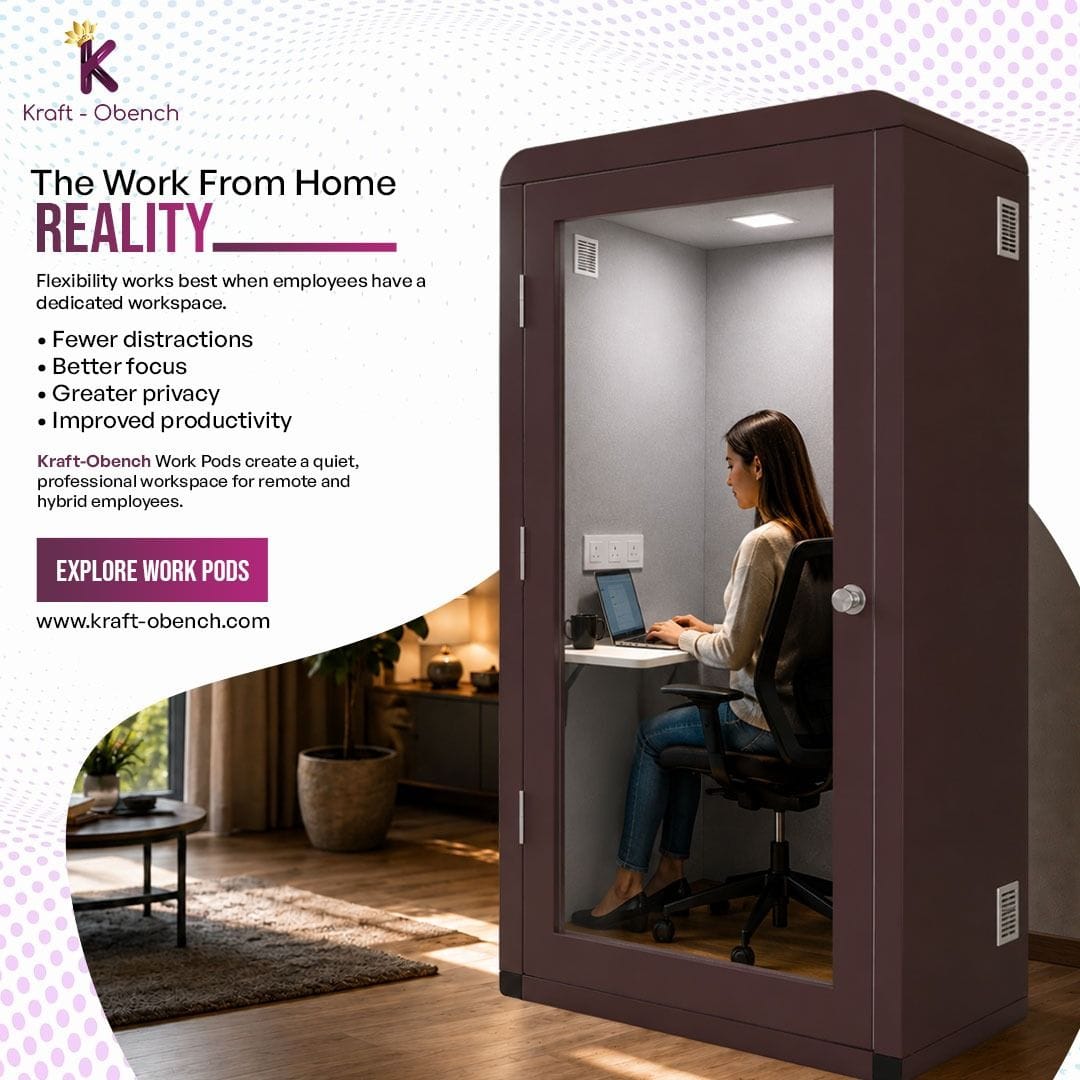
Kraft-Obench’s Work Pods are designed specifically around this gap the space between “has a laptop” and “has an actual place to work.” Rather than treating a home workspace as an afterthought, these pods are engineered as complete, self-contained environments that can be dropped into a bedroom corner, a balcony, or a small study, and be fully functional within hours of arriving. A few things make them effective at solving the problems remote employees run into every day:
Acoustic isolation. Built with high-density acoustic panels, these pods significantly reduce sound both entering and leaving the space. That means a call taken inside the pod doesn’t pick up household noise, and conversations inside stay private.
A genuinely private environment. Whether it’s a phone booth-style unit for solo calls or a slightly larger enclosure for longer working sessions, the pod creates a physical boundary that a corner of a room never can.
Comfort over long hours. Integrated lighting, ventilation, and ergonomic seating mean the pod doesn’t just look good, it holds up over an eight-hour workday, not just a fifteen-minute call.
A compact footprint. Not every home has a spare room. Kraft-Obench’s compact models, including the Nano Pod, are built to fit into small spaces without demanding a major renovation.
Fast, non-disruptive setup. Installation follows a structured, engineered process rather than a construction project meaning a home workspace can be ready in a matter of hours, not weeks.
Ownership Isn’t the Only Option
One reason organisations hesitate to invest in dedicated home workspaces is the assumption that it means buying furniture outright for every remote employee, which can feel like a large upfront commitment. In practice, many providers, including Kraft-Obench, offer rental options alongside outright purchase, which means a company can equip a distributed team with pods without needing to commit to permanent ownership for every single setup. This is particularly useful for organisations that are still figuring out their long-term hybrid policy, or for employees whose living situations might change in the near future. Details on rental terms and installation logistics are typically covered on the FAQ page, which is worth reviewing before making a decision either way.
Beyond Individual Focus: Meetings, Calls, and Recording Needs
Not every remote work challenge is about solo focus. Many roles also require:
- Virtual meetings with clients or larger teams, where a compact meeting pod provides enough space for a proper video setup with clean audio.
- Confidential one-on-one discussions, such as performance conversations or sensitive client calls, best handled inside an office booth for home that guarantees privacy.
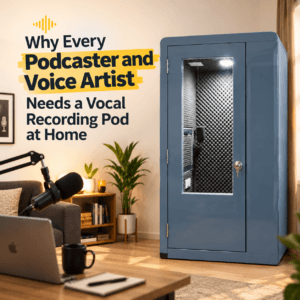
- Recording or presentation work, where sound quality genuinely matters — something a dedicated acoustics booth is specifically engineered to support.
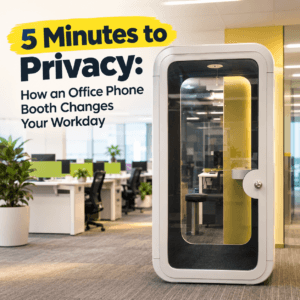
- Quick daily calls, best served by a compact soundproof phone booth that doesn’t take up much room.
For employees in smaller apartments, even more compact options like a nano-sized acoustic booth or a compact phone booth pod offer a workable middle ground between “no dedicated space” and “a full home office.”
Browsing the full range of phone booths or the complete product catalogue makes it easier to match a pod to the specific space and budget available.
It’s Not Just a Home Problem Offices Deal With This Too
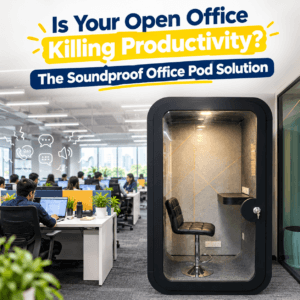
Interestingly, the same core problem shows up inside physical offices as well. Open floor plans, popular for their cost-efficiency and collaborative feel, run into the exact same noise and privacy issues that home workers deal with. That’s why the same workspace pod philosophy that works at home is being adopted across cities from soundproof pods in Thane to private acoustic booths in Kochi as companies retrofit privacy into offices that were never designed with hybrid work in mind.
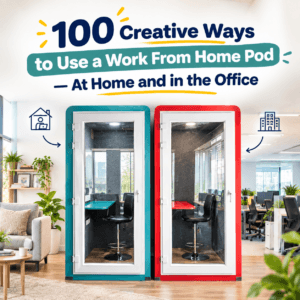
This overlap matters. It means organisations don’t need two completely different strategies for office and home. The same underlying principle give people a private, acoustically controlled space, wherever they’re working from applies in both settings.
What This Means for Employers
For organisations that have embraced hybrid or fully remote work, the conversation about employee tools needs to expand beyond hardware and software. A laptop and a stable internet connection are necessary, but they’re not sufficient.
Investing in a proper workspace whether that’s outfitting a home office corner with a compact pod or adding pods to a physical office to support hybrid schedules signals something important to employees: that their productivity and comfort are taken seriously, not left to whatever corner of the house happens to be free that day.
This has knock-on effects that are easy to underestimate:
- Professionalism on client calls improves when there’s no background noise competing with the conversation.
- Employee well-being improves when work has a physical boundary instead of bleeding into every room of the house.
- Retention and satisfaction tend to improve when employees feel a company has genuinely invested in making remote work sustainable, not just possible.
Getting Started
For organisations considering this shift, it helps to start small piloting a few pods with teams that rely heavily on calls or confidential conversations, then expanding based on feedback. A good starting point is usually to browse Kraft-Obench’s full pod range, look through the gallery to see how different models look in real homes and offices, and check the FAQ page for common questions around installation timelines, customisation, and rental options.
It’s also worth checking whether Kraft-Obench already services your city. The company has been expanding its footprint across India, with dedicated pages for cities such as Hyderabad and Visakhapatnam, Indore, and a broader locations page listing where installation support is currently available. Reading more about the company’s approach on their about us page, or reaching out directly through their contact page, are reasonable next steps before deciding on the right model and configuration for a specific team or household.
For anyone specifically evaluating a home setup, it can help to start from the home pods overview, which walks through the different Work Pod variants side by side, before narrowing down to a particular size or budget.
Final Thought
As hybrid work continues to evolve, the organisations that invest in better work environments both in the office and at home will be the ones best positioned to support real employee performance. A dedicated, acoustically sound workspace isn’t a luxury add-on anymore; it’s quickly becoming as essential as the laptop sitting on top of it.
The kitchen table was never meant to be a permanent workstation. It’s time the workspace caught up with how people actually work now.
For teams and organisations ready to make that shift, the starting point is usually simple: figure out which employees rely most heavily on calls, confidential conversations, or deep focus work, and equip them first. From there, scaling up whether that means more pods at home, a few in the office, or a mix of both becomes a much easier decision to make.