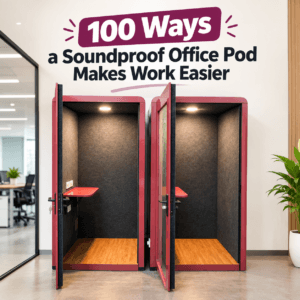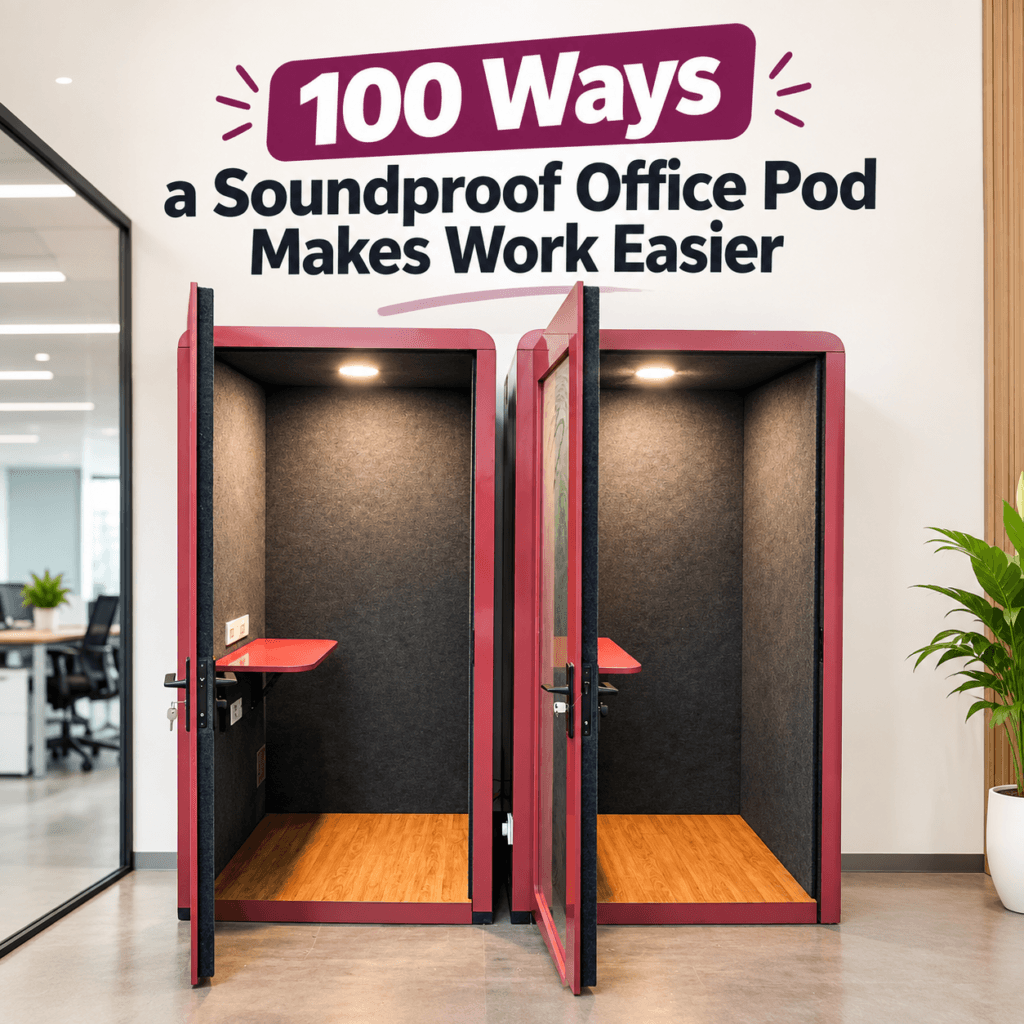
100 Ways a Soundproof Office Pod Makes Work Easier
A soundproof office pod sounds like a single-purpose product until you actually own one then you realise it quietly rewires almost every part of your workday. What starts as “a quiet place to take calls” ends up handling client meetings, focused deep work, podcast recording, therapy sessions, and even the occasional power nap. We put together 100 real ways professionals use their work pod, grouped into five categories, based on patterns we see across home offices, coworking spaces, and corporate installs.
The list below isn’t theoretical. It’s drawn from actual usage logs, customer interviews, and installation feedback across hundreds of pods from a single Nano Pod in a one-bedroom apartment to multi-pod corporate rollouts. What you’ll notice as you read through it is that no two owners use their pod the same way. A freelance voice artist and a finance director might buy the exact same model and end up using it for completely different reasons within the first month.
Why One Product Ends Up Doing So Much
Most furniture is single-purpose. A desk is for working, a chair is for sitting, a filing cabinet is for storing documents. A soundproof office pod breaks that pattern because it isn’t really “furniture” in the traditional sense — it’s a controlled environment. Once you have a space that reliably blocks out noise, gives you privacy, and includes power, lighting, and ventilation, you start bringing every task that benefits from those three things into the pod. That’s why the list below spans everything from HR conversations to vocal warm-ups.
Focus & Deep Work (1–20)
- Blocking out kitchen and household noise during work from home hours
- Creating a dedicated “focus zone” separate from your bedroom or living room
- Reducing traffic and construction noise from outside
- Signalling to family members that you’re “at work,” not available
- Improving concentration during writing or coding sessions
- Reducing eye strain with adjustable smart lighting
- Giving your brain a consistent cue that it’s time to work
- Cutting down on multitasking triggered by visual clutter
- Creating an ergonomic setup with a proper chair and foldable table
- Reducing fatigue from noise-induced stress over long days
- Making early-morning or late-night work sessions less disruptive to family
- Allowing uninterrupted studying for exams or certifications
- Supporting freelancers who bill by focused hours
- Giving students a quiet space for online classes
- Reducing the urge to check phones triggered by ambient noise
- Improving memory retention during reading-heavy tasks
- Enabling “flow state” work sessions without external triggers
- Creating a psychological boundary for work-life balance
- Reducing decision fatigue by having one dedicated workspace
- Making the portable office pod a permanent productivity ritual
Deep work is where most owners first notice the return on investment. Remote workers consistently report that the biggest productivity killer isn’t a single loud interruption — it’s the constant, low-level awareness of household noise: a dishwasher running, someone on a call in the next room, a delivery at the door. A pod removes that background hum entirely, which lets your brain settle into sustained concentration faster and stay there longer. Many owners also describe a psychological effect that goes beyond acoustics — stepping into the pod becomes a ritual that tells the brain “it’s time to work” the same way putting on running shoes signals “it’s time to exercise.”
Calls & Meetings (21–40)
- Taking client calls without background noise apologies
- Hosting video interviews with a clean, professional backdrop
- Running one-on-one performance reviews privately
- Making sales calls with better vocal clarity
- Joining town halls without shushing the household
- Recording internal training calls with a compact phone booth
- Taking HR or legal calls that require confidentiality
- Reducing “can you repeat that?” moments on Zoom
- Hosting podcast-style interviews for internal comms
- Running vendor negotiation calls privately
- Making international calls without time-zone household disruption
- Hosting webinars from a controlled acoustic space
- Using a portable meeting pod in coworking spaces for client meetings
- Conducting exit interviews discreetly
- Taking emergency calls without disturbing the open office
- Running quick stand-ups in an acoustic meeting pod
- Hosting board-level video calls with visual privacy
- Recording voice memos for meeting minutes
- Practising presentations aloud before the real thing
- Doing mock interviews for job seekers
This is the category most businesses associate with pods first, and for good reason — video calls have become the default meeting format, and audio quality is now judged as closely as content. A clean, echo-free background says more about professionalism than most people realise. Sales teams in particular report that call clarity directly affects how prospects perceive credibility, especially on calls where trust needs to be built quickly. For confidential conversations — HR matters, legal calls, performance reviews — a pod offers something an open office glass room can’t: true acoustic isolation, not just visual privacy.
Privacy & Confidentiality (41–55)
- Reviewing sensitive financial documents away from prying eyes
- Discussing salary or compensation matters privately
- Handling legal contracts without interruption
- Protecting client data during screen-shares
- Taking therapy or counselling sessions online
- Managing HR grievance conversations
- Reviewing performance data without office visibility
- Conducting internal audits confidentially
- Handling recruitment calls discreetly
- Working on unreleased product plans securely
- Taking personal medical consultations during work hours
- Reviewing legal case files in a meeting pod
- Discussing M&A or investment matters privately
- Protecting IP discussions from open-plan eavesdropping
- Running compliance training sessions
Confidentiality is often the least anticipated benefit and the one that ends up mattering most once a pod is installed. Open-plan offices were designed for collaboration, not privacy, which creates constant friction whenever a conversation needs to be genuinely confidential. Legal, HR, and compliance teams in particular gravitate toward booking pods for exactly this reason — not because they need soundproofing for noise, but because sensitive conversations require a space where nothing leaks past the walls, literally or figuratively. Even individual employees find themselves booking a pod for a personal medical call or salary conversation they’d never want overheard in an open office.
Content Creation & Recording (56–75)
- Recording podcasts inside a vocal recording pod
- Producing voiceovers for ads and explainer videos
- Recording audiobooks with studio-level clarity
- Doing ADR and dubbing work in a dubbing artist studio pod
- Recording YouTube voiceovers without room echo
- Practising singing or vocal warm-ups privately
- Hosting live-streamed webinars with clean audio
- Recording internal e-learning modules
- Producing corporate training narration
- Recording language-learning content
- Doing character voice work for games or animation
- Producing radio-style ad reads
- Recording customer testimonial voiceovers
- Editing audio with reference-quality monitoring
- Practising public speaking or TEDx-style talks
- Recording standup comedy sets for review
- Producing meditation or wellness audio content
- Hosting Twitch or gaming commentary sessions
- Recording multi-language dubbing for global content
- Testing microphone setups in a controlled vocal booth
This is where the line between “office furniture” and “creative studio infrastructure” disappears entirely. Independent voice artists and podcasters were early adopters of acoustic pods precisely because a purpose-built recording room used to require a real construction budget. A vocal recording pod with proper rockwool insulation gives freelancers and small studios the same acoustic control as a professionally treated room, at a fraction of the cost and without any structural work. For dubbing and ADR work specifically, consistent, echo-free acoustics aren’t a nice-to-have — they’re a technical requirement, which is why a dedicated dubbing artist studio pod has become a standard tool for voice professionals working from home.
Everyday & Practical Uses (76–100)
- Charging devices via built-in LAN and power outlets
- Storing work essentials in the amenities table
- Keeping a dedicated space cool with a compact A.C. unit
- Folding away the table when the pod isn’t in use
- Using smart lighting controlled from your phone
- Creating a reading nook after work hours
- Giving teenagers a quiet study pod during exams
- Setting up a compact gaming or streaming corner
- Using the pod as a meditation or quiet room
- Hosting solo brainstorming sessions with a whiteboard
- Taking a quick power nap between meetings
- Using the Nano Pod as a personal sanctuary in shared apartments
- Storing archival documents securely
- Creating a hobby space for art or writing
- Hosting small family video calls privately
- Using the pod for personal journaling time
- Running a small home-based consulting practice
- Hosting tutoring sessions for students
- Using it as a quiet space for religious or mindfulness practice
- Setting up a compact home studio for hobbyist musicians
- Creating a “no-phone zone” for digital detox breaks
- Using it as a guest workspace when visitors need to work
- Hosting quick portfolio reviews with clients
- Giving remote teams a bookable work pod in shared offices
- Making every soundproof office pod double as a long-term productivity investment
This final category is the one owners rarely predict before buying. A pod purchased strictly for work calls often ends up doing double duty as a study space for a teenager during exam season, a meditation corner, or even a quiet room for a power nap between back-to-back meetings. In shared apartments, a Nano Pod frequently becomes the one truly private space in the home — used for everything from journaling to hobby music production. This flexibility is part of why pods tend to get used daily rather than occasionally, unlike most furniture purchases that see diminishing use over time.
Which Use Case Fits You?
If most of your list falls under content creation, start with the vocal recording pod range in our vocal booth category. If it’s mostly calls and privacy, an office phone booth from our phone booth lineup will serve you better. For teams, browse meeting pods designed for four-person discussions.
Final Thoughts
A pod that started as “a quiet place to take calls” often ends up handling dozens of unexpected tasks — from studying to streaming to storage. The real value isn’t any single use case on this list; it’s the compounding effect of having one reliable, private, quiet space available whenever you need it, for whatever the day throws at you. Explore the full shop, check our gallery for real setups, read more on our blog, or contact us to find the configuration that matches your list.