Office Pod vs Traditional Meeting Room: Full Cost Comparison for India
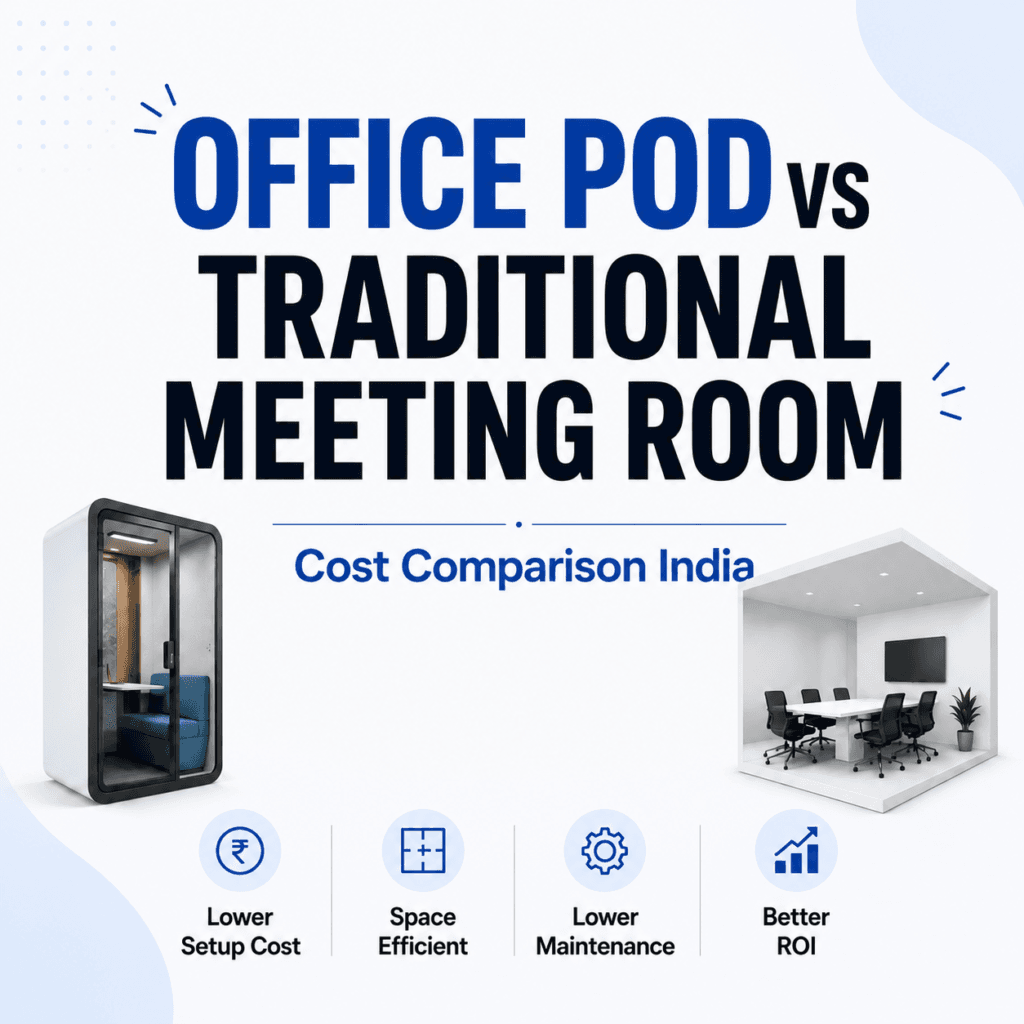
Your office is growing. You need more private meeting space. The obvious option feels like booking a contractor and building out a new meeting room. But before you do that, consider what Indian businesses are increasingly discovering: a modern acoustic meeting pod delivers the same function at a fraction of the cost, in a fraction of the time, with far more flexibility.
This comparison breaks down the real numbers so you can make a fully informed decision.
The Real Cost of Building a Meeting Room in India
A standard four-person meeting room in India with basic acoustic treatment, glass partition, lighting, and air conditioning typically costs between ₹4,00,000 and ₹12,00,000 depending on the city, finish level, and building requirements.
Here is where the costs come from:
Civil and partition work – Drywall or glass partitions with a door, including labour: ₹1,50,000 to ₹4,00,000.
Acoustic treatment – Ceiling baffles, acoustic panels, and flooring upgrades: ₹80,000 to ₹2,00,000.
Electrical and HVAC – Dedicated air conditioning unit, lighting, and power points: ₹1,00,000 to ₹2,50,000.
Interiors – Table, chairs, display screen, whiteboard, and cabling: ₹80,000 to ₹2,50,000.
Timeline – Three to eight weeks of construction disruption, contractor management, and approvals from the building society or landlord.
And critically – once it is built, it is permanent. If your team grows, shrinks, or moves, the room is stuck where it is.
What Does an Acoustic Office Pod Cost in India?
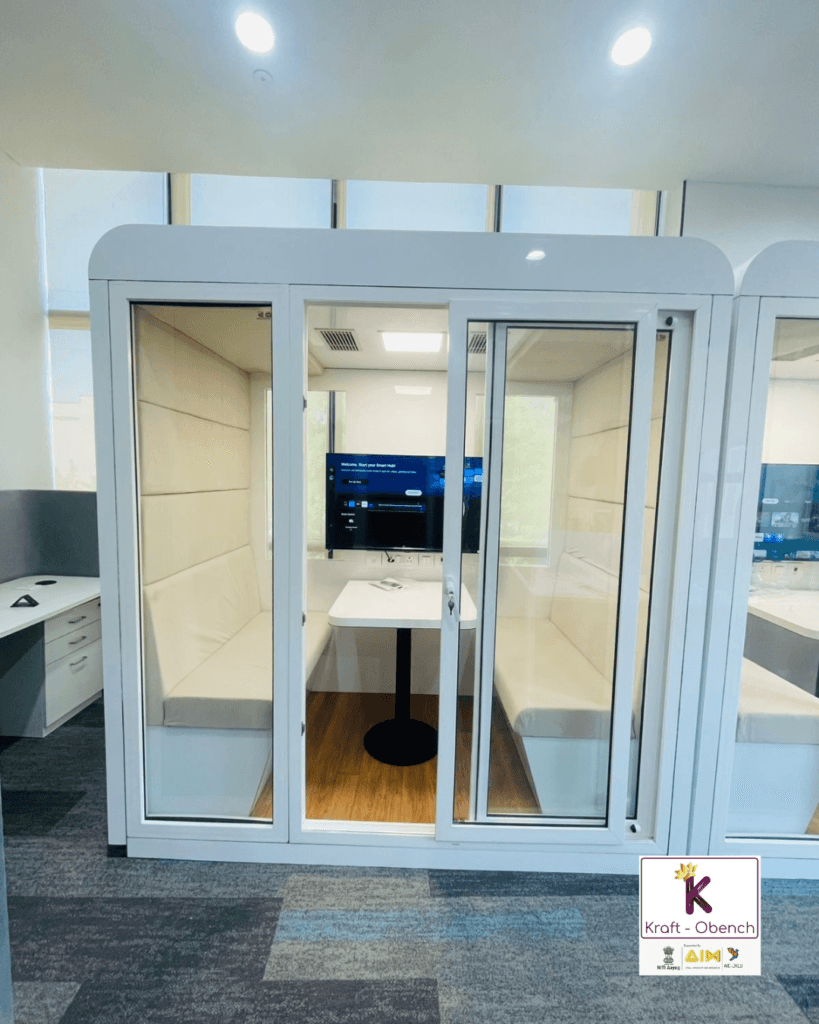
An acoustic meeting pod from a quality Indian manufacturer like Kraft-Obench costs significantly less than construction and includes everything you need out of the box.
A four-person acoustic meeting pod including built-in soundproofing, ventilation, lighting, and power is available in the range of ₹2,00,000 to ₹5,00,000 depending on size, finish, and specification. Single-person phone booth pods start from around ₹80,000 to ₹1,50,000.
These prices include delivery and assembly. No civil work, no contractor, no permits. The pod arrives, is assembled by a trained team in a few hours, and is ready to use the same day.
Setup Time: Pods Install in Hours, Rooms Take Weeks
This is one of the most overlooked costs of building a traditional meeting room: time.
During construction, the surrounding office is disrupted by noise, dust, and workers. Employees lose access to nearby areas. Conference calls get interrupted. Morale dips. The construction itself typically takes three to six weeks, plus another one to two weeks for snagging and finishing.
An acoustic pod from Kraft-Obench is assembled in three to six hours by two people. Your team arrives in the morning, the pod is assembled before lunch, and meetings are happening inside it by afternoon. There is no disruption to the rest of the office and no impact on ongoing work.
Maintenance and Long-Term Running Costs Compared
Traditional meeting rooms require ongoing maintenance: repainting walls, repairing acoustic panels, servicing the dedicated AC unit, and periodic furniture replacement. In older buildings, water seepage and electrical issues add further cost. Annual maintenance budgets for a meeting room typically run ₹30,000 to ₹80,000 per year.
Acoustic pods have minimal maintenance requirements. The ventilation system requires periodic cleaning a task that takes minutes. Panels and surfaces are designed to be durable and cleanable. There are no structural elements that degrade over time. Most quality pods carry multi-year warranties on their core components.
Over a five-year period, the total cost of ownership of an acoustic pod is substantially lower than a built room of equivalent function.
Flexibility: Moving a Pod vs Demolishing a Room
The flexibility advantage of pods is profound, especially in India’s dynamic business environment where office leases change, teams expand and contract, and co-working spaces are increasingly common.
If your company moves office, a pod moves with you. It disassembles in a few hours, loads onto a truck, and reassembles in the new space. Your investment is completely portable.
A traditional meeting room, by contrast, stays in your old office. The fit-out cost is a sunk cost the moment you sign a new lease. Many Indian companies are discovering this painfully as hybrid work policies lead to office consolidations and moves.
ROI Analysis: Which Option Pays Off Faster?
Let us run a simple scenario. Your team of 20 people needs two private meeting spaces. You are comparing building two meeting rooms vs buying two acoustic pods.
Meeting rooms: ₹10,00,000 total investment, six weeks disruption, five-year maintenance of ₹3,00,000. Total five-year cost: ₹13,00,000. Zero residual value if you move.
Acoustic pods: ₹6,00,000 total investment, zero disruption, five-year maintenance of ₹50,000. Total five-year cost: ₹6,50,000. Full residual value you take them with you.
The pods save ₹6,50,000 over five years and give you full asset portability. The ROI case is decisive.
Our Verdict: When to Choose a Pod vs a Room
Choose a traditional meeting room when you own the building, the space is permanent, you require very large capacity (eight or more people regularly), and you have the budget and timeline for construction.
Choose an acoustic pod when you are a tenant, your office may move or change, you need space quickly, your team is mid-sized or growing, or you want to preserve budget flexibility. For the vast majority of Indian businesses startups, SMEs, co-working residents, and growing teams an acoustic pod is the clearly superior choice.