Budget Acoustics Is Not a Compromise
The assumption that meaningful acoustic improvement requires significant investment is one of the most persistent and damaging misconceptions in Indian office planning. For SMEs, startups, and growing organisations that cannot justify lakh-scale acoustic investments in the short term, targeted budget interventions deliver 60 to 70 percent of the benefit at 20 to 30 percent of the cost.
This guide covers 10 practical, immediately actionable acoustic improvements for Indian offices at every budget level — from zero-cost rearrangements to strategic pod investments. Start by visiting Kraft-Obench to understand the full range of acoustic solutions available before deciding which combination is right for your office.
Tip 1: Add Carpet to Hard Floors (₹30–₹80 per sqft)
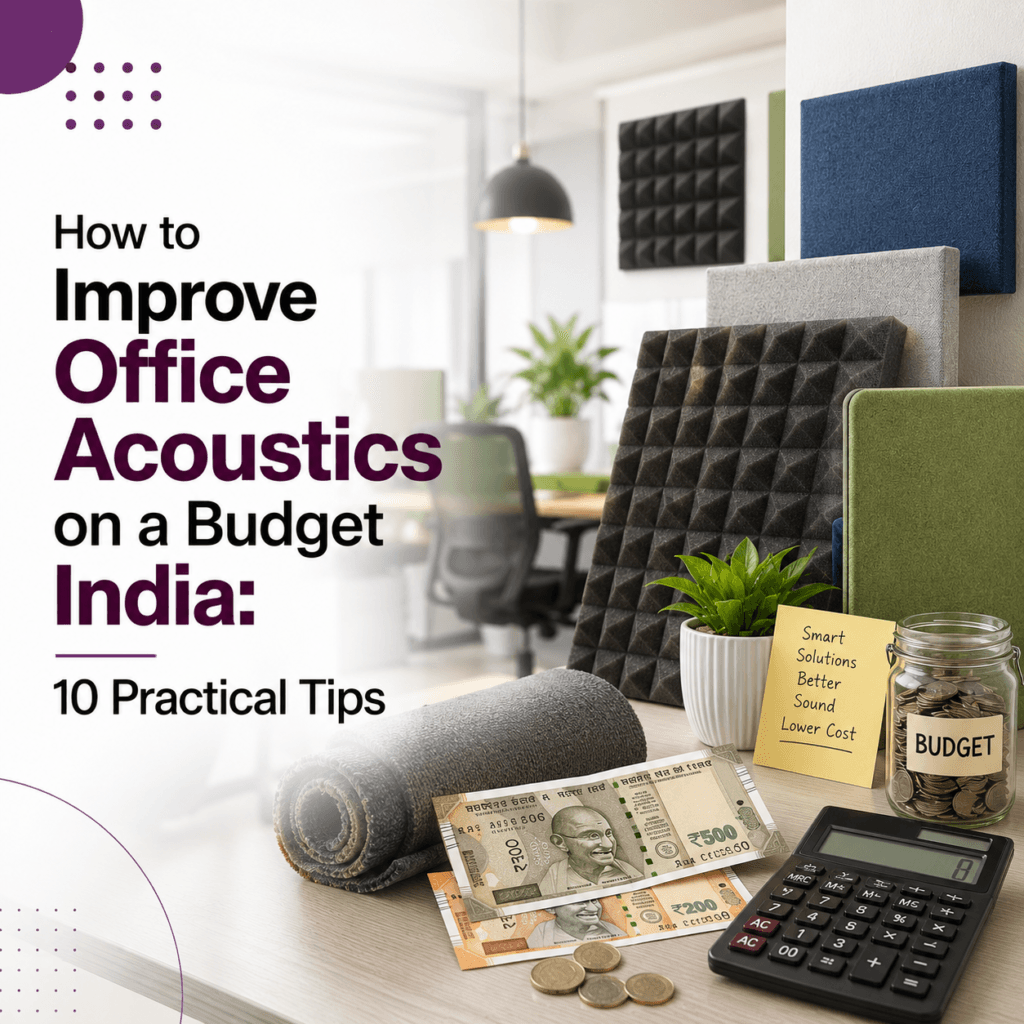
Hard tile floors are acoustic nightmares. Every footstep, chair movement, and dropped item generates impact noise that travels through the building structure and reflects off hard surfaces to amplify ambient noise levels. A commercial-grade carpet tile — available at ₹30 to ₹80 per square foot from any commercial flooring supplier in India — absorbs mid-frequency speech sound and reduces footfall noise simultaneously.
This single change cuts reverberation time by approximately 25 percent in most Indian tiled offices. For a 1,000 square foot office, the total investment is ₹30,000 to ₹80,000 — less than a single month’s rent in most Indian commercial buildings — yet the acoustic improvement is immediately perceptible to every occupant from day one.
Tip 2: Hang Acoustic Panels at Primary Reflection Points (₹2,000–₹5,000 each)
Two to four well-placed 600mm by 1200mm fabric-wrapped acoustic panels reduce reverberation time more effectively than covering every wall with low-density foam. Place panels at the primary acoustic reflection points: side walls at seated ear height and the ceiling above the highest-density workstation clusters.
Kraft-Obench uses the same high-density acoustic panel technology inside all its pods — from the Nano Pod to the Meeting Pod. This means you can trust the panel performance specifications when selecting standalone panels to complement a pod installation.
Tip 3: Add Bookshelves Filled with Books (Near Zero Cost)
Irregular surfaces break up standing waves and scatter sound rather than reflecting it in coherent beams. A well-stocked bookshelf positioned against a primary reflective wall is an effective acoustic diffuser at virtually zero cost. The irregular surface of book spines, mixed sizes, and varying depths provides the surface irregularity that acoustic engineers deliberately create with expensive purpose-built diffuser panels.
This works as effectively in offices in Ahmedabad and Kolkata as in premium Bangalore tech offices. It is not a complete acoustic solution, but as a supplementary measure it costs nothing and requires no specialist knowledge to implement.
Tip 4: Soft Furnishings in Break Areas (₹10,000–₹30,000)
Break rooms and informal collaboration areas are often the noisiest zones in Indian offices because they combine hard surfaces, loud informal conversation, and the general acoustic energy of a social space. Replace hard plastic chairs with upholstered seating. Add fabric curtains at windows. Use area rugs on hard floors.
This investment of ₹10,000 to ₹30,000 produces a measurable acoustic improvement in the space that generates the most noise. It is especially effective in the mid-size offices typical in Chandigarh and Jaipur where break rooms tend to be adjacent to workstation areas without acoustic separation.
Tip 5: Install Acoustic Ceiling Tiles (₹50–₹150 per sqft)
Suspended ceilings fitted with mineral wool acoustic tiles rather than standard gypsum or metal tiles provide a dramatic improvement in offices with high ceilings. The ceiling is the largest single reflective surface in most open plan offices, and treating it acoustically delivers the highest acoustic return per square foot of any fixed treatment.
This improvement is particularly dramatic in older commercial buildings with high ceilings — common in heritage commercial properties in Delhi and Mumbai where original construction predates the modern open plan office concept. At ₹50 to ₹150 per square foot, acoustic ceiling tiles represent one of the highest-value acoustic investments available.
Tip 6: Use Plant Walls for Acoustic and Biophilic Benefits (₹15,000–₹40,000)
Living plant walls — panels of plants grown in vertical hydroponic or soil systems — scatter and absorb high-frequency sound while providing the biophilic design benefits that are increasingly valued in Indian corporate offices. Plants do not provide meaningful low-frequency absorption, but their effect on speech clarity and high-frequency reverberation is measurable.
Plant walls are popular in Hyderabad and Pune tech offices as both acoustic treatment and wellness design elements. The dual benefit — acoustic improvement plus biophilic design value — makes them a particularly efficient investment for companies managing both acoustic and employee wellbeing priorities.
Tip 7: Seal Door Gaps (₹500–₹2,000 per door)
Acoustic door sweeps and weather stripping cost under ₹2,000 per door and deliver 6 to 8 dB of acoustic improvement between adjoining spaces — equivalent to doubling the thickness of the partition wall between them. This is the single highest-ROI acoustic investment per rupee spent for offices with multiple enclosed or semi-enclosed rooms.
The same door seal technology is used in all Kraft-Obench pods including the Phone Booth and Work Pod. Applying it to existing office doors extends the acoustic separation between spaces without any construction involvement.
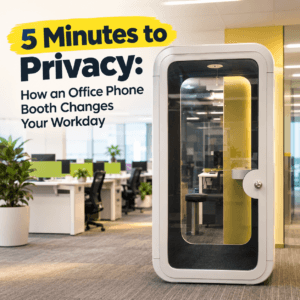
Tip 8: Use a Phone Booth for All Calls
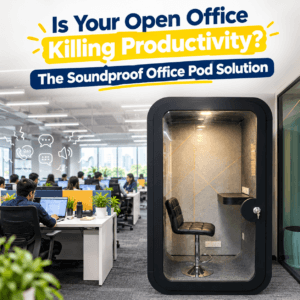
A single Kraft-Obench Phone Booth handles the call noise generated by 10 to 15 employees and eliminates the most disruptive noise source in most open plan offices — the nearby loud phone call. By policy, requiring all calls above 5 minutes to be taken in the phone booth removes the dominant acoustic disruptor from the open floor.
Rental options are available at our Rentals page for budget-conscious offices not yet ready for purchase. The Nano Pod provides the same benefit with the addition of a full laptop desk for focus work, making it a slightly more versatile investment for offices where focused solo work is as frequent a need as call privacy.
Tip 9: White Noise Systems (₹5,000–₹20,000)
White noise or pink noise speaker systems raise the ambient noise floor in a controlled way, making nearby speech less intelligible from a distance without adding subjectively annoying noise. A basic white noise system for a 50-person office costs ₹5,000 to ₹20,000 and can be self-installed in an afternoon.
This approach is popular in Noida and Gurgaon tech offices as a low-cost complement to pod installations. The combination of a sound masking system and a pod cluster delivers results that approach those of a full acoustic renovation at a fraction of the cost.
Tip 10: Rearrange Workstation Orientation (Zero Cost)
The orientation of workstations relative to noise sources has a significant effect on the acoustic experience of individual workers. Positioning monitors so that workers face away from high-traffic corridors, communal areas, and the noisiest colleagues reduces direct-path sound exposure by 6 to 10 dB with absolutely zero financial investment.
This is a zero-cost first step that every office manager can implement immediately. For more guidance, read our Blog and contact us at our Contact page for a free virtual acoustic assessment.
Frequently Asked Questions
Q1: What is the single most impactful budget acoustic change for an Indian office? Sealing door gaps. A ₹1,500 door sweep and weather seal kit can deliver 8 dB of improvement between rooms — equivalent to doubling the wall thickness.
Q2: Is there a budget pod option under ₹1 lakh? Kraft-Obench’s entry-level products start above ₹1 lakh because we do not compromise on acoustic performance. We do offer rental from our Rentals page as a low-commitment starting point.
Q3: How much should an Indian SME budget for a full acoustic upgrade of a 20-person office? A comprehensive upgrade including carpet, panels, door sealing, and one Phone Booth typically costs ₹3,00,000 to ₹5,00,000 — providing 10 to 15 dB of overall noise reduction.
Q4: Do acoustic panels need professional installation? No. Standard acoustic panels with foam adhesive mounts are DIY-installable in 30 minutes per panel. Contact us at our Contact page for free panel specification advice.
Q5: How quickly can I see results from acoustic improvements? Most improvements — panels, carpet, door seals — deliver immediate results on day one.
Q6: Can I combine DIY acoustic improvements with a Kraft-Obench pod? Absolutely. This is the recommended approach. DIY improvements handle the general office environment while a Kraft-Obench pod provides the highest-isolation zone for calls and focused work.
Q7: Is there a free acoustic assessment available from Kraft-Obench? Yes. Kraft-Obench offers a free virtual acoustic assessment for offices in cities including Delhi, Gurgaon, Chennai, and Kolkata. Book via our Contact page.