Can You Get a Good Vocal Booth Under ₹1 Lakh in India?
The short answer is yes with the right approach, the right materials, and realistic expectations about the acoustic performance ceiling of budget solutions. Whether you are a professional singer, an emerging voice-over artist, a podcaster building your first show, or a content creator who needs broadcast-quality audio on a startup budget, achieving good vocal recording results in India under ₹1 lakh is entirely possible.
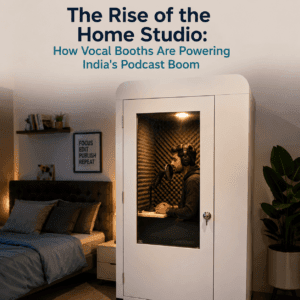
This guide covers every budget option from zero-cost recording technique improvements to ₹50,000 DIY vocal booth builds, with honest assessments of what each approach delivers acoustically. And when you are ready to upgrade to professional-grade performance, the Kraft-Obench Vocal Pod is India’s most trusted professional solution.
Option 1: DIY Wardrobe Vocal Booth (₹20,000 – ₹50,000)
A repurposed wardrobe or built-in cupboard lined with Rockwool 60 mineral wool acoustic panels is the most acoustically effective budget vocal recording solution available in India. The wardrobe provides natural parallel-surface irregularity and some mass-based isolation from its walls. Lining the interior surfaces with 4 to 6 inch mineral wool panels at ₹180 to ₹300 per square foot transforms it into a functional recording space.
Add a rubber door sweep to the wardrobe door, a cheap LED strip light, a small ventilation gap at the top for passive air exchange, and a microphone stand adapter. Total materials cost: ₹25,000 to ₹50,000 depending on wardrobe size and panel specification. Acoustic performance: approximately NRC 0.60 to 0.70 good for most home recording applications on a budget.
Compare this result with the guaranteed NRC 0.90 and STC 38 to 42 of a professional Kraft-Obench Vocal Pod for a clear picture of the performance gap between DIY and professional solutions.
Option 2: Portable Desktop Reflection Filter (₹3,000 – ₹15,000)
A reflection filter is a curved acoustic shield that mounts on a microphone stand behind and around the microphone, absorbing early reflections from the recording environment before they reach the microphone capsule. Available from major Indian music retailers and on Amazon India, these devices cost ₹3,000 to ₹15,000 and genuinely improve recording quality in reverberant rooms.
The critical limitation of reflection filters is that they address internal acoustic reflections but provide zero soundproofing against external noise. A truck passing outside, a neighbour’s television, or a family conversation in an adjacent room will be fully present in your recording regardless of reflection filter quality. For true noise isolation, you need either a DIY booth structure or the Vocal Pod from Kraft-Obench.
Option 3: Portable Fabric Recording Enclosure (₹15,000 – ₹40,000)
Portable fabric recording enclosures collapsible acoustic tents that the performer stands or sits within during recording create a temporary acoustic environment around the microphone. They fold flat for storage, set up in minutes, and provide meaningful mid and high-frequency absorption.
A good-quality fabric enclosure costs ₹15,000 to ₹40,000 and represents a genuine step up from a bare room or reflection filter. For singers in compact apartments in Mumbai and Bangalore who cannot dedicate permanent floor space to a vocal booth, this portability is a significant practical advantage.

The Break-Even Case for a Professional Vocal Pod
For singers and voice-over artists who record regularly, the financial case for investing in a professional Kraft-Obench Vocal Pod is compelling even when it exceeds the ₹1 lakh budget threshold. At typical Indian professional recording studio rates of ₹2,500 to ₹4,000 per hour including engineer, a singer recording 3 to 4 hours per month spends ₹90,000 to ₹1,92,000 annually on studio time.
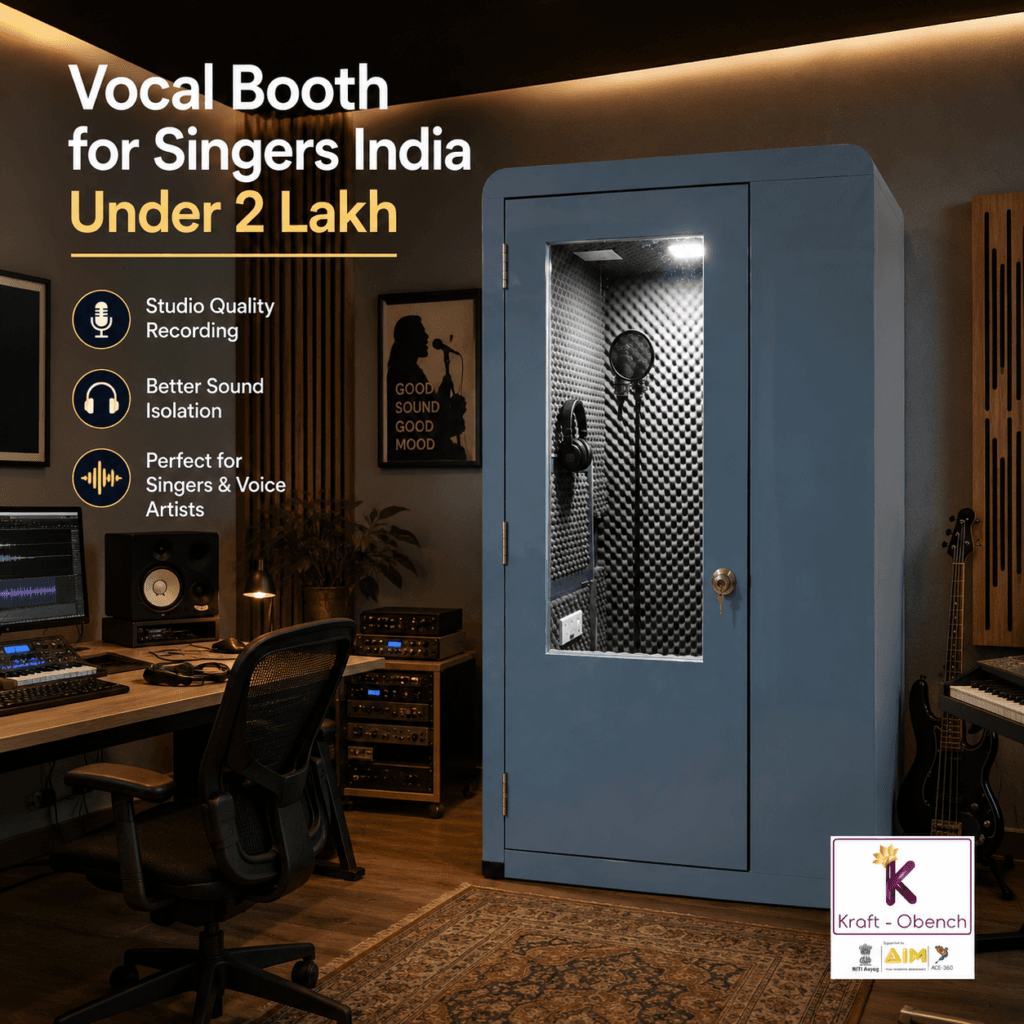
A Kraft-Obench Vocal Pod at ₹1,50,000 to ₹2,00,000 breaks even in 12 to 18 months. Beyond break-even, it provides unlimited 24×7 recording availability at home with zero marginal cost per session. For professional recording artists and voice-over professionals in Delhi, Hyderabad, Chennai, and Pune, the Vocal Pod is a business investment with a clear and rapid return. Rental options are available at our Rentals page for project-based recording.
Recording Technique Tips That Cost Nothing
Several recording technique improvements deliver meaningful quality improvements at zero cost. Record at night when ambient noise levels are lowest in most Indian cities, 11pm to 5am provides a noise floor 15 to 20 dB lower than daytime. Use a cardioid pattern microphone and position it so the null (rear rejection point) faces the noisiest surface in your room.
Hang thick duvets or moving blankets around the recording position on temporary stands for additional absorption during sessions. Enable real-time noise reduction monitoring in your DAW to identify and eliminate noise floor issues during recording rather than in post-production. View our Blog for detailed recording technique guides.
Frequently Asked Questions
Q1: What microphone works best inside a budget DIY vocal booth? A cardioid condenser microphone such as the Audio-Technica AT2020 at ₹8,000 to ₹10,000 is the best match for a treated DIY booth.
Q2: Is the Kraft-Obench Vocal Pod suitable for recording violin or acoustic guitar? Yes. The Vocal Pod’s acoustic treatment works effectively for acoustic string instruments. For full-band recording, a larger custom acoustic room is required.
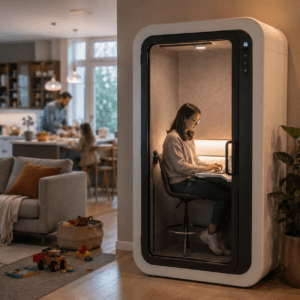
Q3: Can I use a Vocal Pod for a YouTube or Instagram content creation channel? Absolutely. The Vocal Pod provides professional broadcast acoustics and excellent LED lighting for face-to-camera content. Many Indian content creators in Delhi and Bangalore use Vocal Pods as their content studio.
Q4: How much NRC improvement does a DIY wardrobe booth provide vs a professional pod? A well-built DIY wardrobe booth achieves approximately NRC 0.60 to 0.70. A Kraft-Obench Vocal Pod achieves NRC 0.90 — measurably better voice clarity and low-frequency control.
Q5: Are there any grants or subsidies in India for home recording studio setup? Some state MSME schemes support creative industry infrastructure. Kraft-Obench provides GST-compliant invoices compatible with government scheme applications.
Q6: Can the Vocal Pod handle Tamil, Telugu, or other Indian language recordings? Yes. The Vocal Pod is used for recordings in all Indian languages. Our clients in Chennai and Hyderabad include voice-over artists working across South Indian languages.
Q7: Where can I hear what a recording inside a Kraft-Obench Vocal Pod sounds like? Audio samples are available on our website. Contact us at our Contact page to arrange a demonstration at our Delhi or Bangalore showroom.